Characters of Shakespeare's Plays
What does it mean to understand a human being? For William Hazlitt, one of the keenest minds of the English Romantic era, the answer often lay in the pages of Shakespeare. In his celebrated work, "Characters of Shakespeare's Plays," Hazlitt performs a remarkable feat of literary excavation, peeling back layers of theatrical performance and critical commentary to reveal the raw, beating heart of Shakespeare’s creations. Far from being a dry academic treatise, this audiobook offers a vivid intellectual adventure, inviting the listener to witness a brilliant critic grappling with immortal art. It remains a foundational text for anyone seeking to deepen their appreciation of Shakespeare's genius and, through him, gain profound insights into the universal truths of human nature that resonate just as powerfully today. This distinctive work presents not a conventional narrative with characters and a story arc, but rather a grand intellectual performance. Hazlitt’s stage is the entirety of Shakespeare’s dramatic canon, and his "characters" are the figures he meticulously dissects and brings to incandescent life through his prose. The journey begins with Hamlet, Shakespeare's most introspective and perhaps most debated creation, and proceeds through a comprehensive roster of central figures from the tragedies, comedies, and histories alike. Listeners are guided through the labyrinthine minds of figures like the tormented King Lear, the ambitious Macbeth, and the passionate Othello, each portrait painted with a precision that makes their dramatic predicaments immediate and deeply felt. Hazlitt’s primary aim throughout this extensive critical endeavor is to strip away the accretions of centuries of interpretation and present Shakespeare’s characters as living, breathing entities, free from the constraints of artificial literary categories. He dissects their motivations, their contradictions, their triumphs, and their failings, often quoting directly from the plays to underpin his arguments. He shows us the boundless wit of Falstaff, the fierce love of Juliet, the devious cunning of Iago, and the regal charm of Cleopatra. Listeners will find themselves not merely learning about these characters, but feeling as though they are encountering them for the first time, seeing them with fresh eyes as Hazlitt masterfully articulates their psychological depths and dramatic functions within their respective plays. William Hazlitt was born in Maidstone, Kent, in 1778, the son of a Unitarian minister. His early life was marked by intellectual curiosity, though his initial aspirations leaned towards painting before he found his true calling in writing. A self-taught and fiercely independent thinker, Hazlitt became a prominent essayist, journalist, and literary critic during a period of immense intellectual ferment in England. He frequented the circle of the Lakes Poets – Samuel Taylor Coleridge, William Wordsworth, and Robert Southey – though his relationships with them were often tempestuous, characterized by both mutual respect and bitter disagreements. Hazlitt’s career flourished in London, where he delivered popular lecture series on English poetry and the dramatic literature of the Elizabethan age. His writing style was characterized by its passion, its trenchant honesty, and its capacity for piercing psychological insight. Beyond "Characters of Shakespeare's Plays," his other significant works include "The Spirit of the Age," a collection of portraits of his contemporary literary and political figures, and "Table-Talk," a miscellany of essays touching on various aspects of life, art, and philosophy. Hazlitt stands as a unique and vital voice in the Romantic movement, often described as an unsystematic philosopher and a critic whose judgments were rooted in a profound feeling for human experience. He passed away in 1830, leaving behind a body of work that continues to provoke thought and inspire literary appreciation. Central to "Characters of Shakespeare's Plays" is the theme of human psychology and motivation. Hazlitt consistently seeks to understand why characters act as they do, observing their inner lives with a clinical yet empathetic eye. For instance, he distinguishes between Macbeth's initial hesitation and his later, almost mechanical, descent into tyranny, tracing the erosion of his conscience under the weight of guilt and ambition. Another prominent theme is the dramatic interplay between individual will and external circumstance. Hazlitt brilliantly illustrates how a character like King Lear is not merely a victim of his daughters' treachery, but also an agent in his own downfall, with his pride and flawed judgment setting the tragic wheels in motion. Furthermore, Hazlitt continually engages with the transformative power of dramatic art itself. He champions Shakespeare's ability to create a world that, while fictional, possesses a truth more profound than mere realism. He notes how Shakespeare's characters, through their speech and actions, reveal the full spectrum of human virtue and vice, from the unblemished innocence of Desdemona to the calculating malice of Iago. Through these specific examples, Hazlitt shows how art provides not just entertainment, but a mirror reflecting the complexities and contradictions inherent in our own lives, pushing us to question and understand our shared humanity. "Characters of Shakespeare's Plays" emerged in 1817, a pivotal moment in English literature. The early 19th century witnessed the full bloom of the Romantic movement, a period that championed emotion, individualism, and the power of imagination over the strictures of Enlightenment rationalism. During this era, Shakespeare was being re-evaluated not merely as a playwright conforming to classical rules, but as an unparalleled genius whose works transcended such limitations. Critics like Samuel Taylor Coleridge and Charles Lamb, contemporaries and often rivals of Hazlitt, were also engaged in fresh interpretations of Shakespeare, moving away from 18th-century critiques that often found fault with his "irregularities." The political landscape, too, played a role. Britain was navigating the aftermath of the Napoleonic Wars, a time of national introspection and a renewed appreciation for national cultural treasures. This period encouraged a more personal, subjective engagement with art, aligning perfectly with Hazlitt's own critical temperament. His work thus stands as a crucial monument to this shift, offering a deeply personal yet universally resonant appreciation of Shakespeare that helped cement the Bard's position as the quintessential English literary figure and a profound interpreter of the human condition for the Romantic age and beyond. Listening to "Characters of Shakespeare's Plays" as an audiobook offers a unique advantage. Hazlitt’s prose, while intellectually rigorous, is also passionate and often conversational, making it particularly well-suited for the spoken word. The narrator's performance breathes life into Hazlitt’s detailed analyses, allowing listeners to follow his intricate arguments and appreciate the nuances of his critical voice without the need to constantly re-read passages. With a run length of several hours, this allows for an immersive appreciation of Hazlitt's arguments, giving ample time to absorb his insights into dozens of Shakespearean figures. A skilled narrator can modulate their voice to differentiate between Hazlitt's commentary and his frequently quoted lines from Shakespeare's plays, creating an atmosphere that is both scholarly and dramatically engaging, drawing the listener deep into the intellectual exchange with one of literature's most perceptive critics.
Enjoyed Characters of Shakespeare's Plays? A few ways to support us
Audible & Amazon links are affiliate; we may earn a small commission at no extra cost.
About this production
Human narration by a volunteer reader from LibriVox.org, the public-domain audiobook project. LibriVox volunteers record literary works whose copyright has expired in the United States, releasing the resulting recordings into the public domain.
Characters of Shakespeare's Plays by William Hazlitt. The underlying text is in the U.S. public domain. We do not republish any modern copyrighted edition, translation, or commentary.
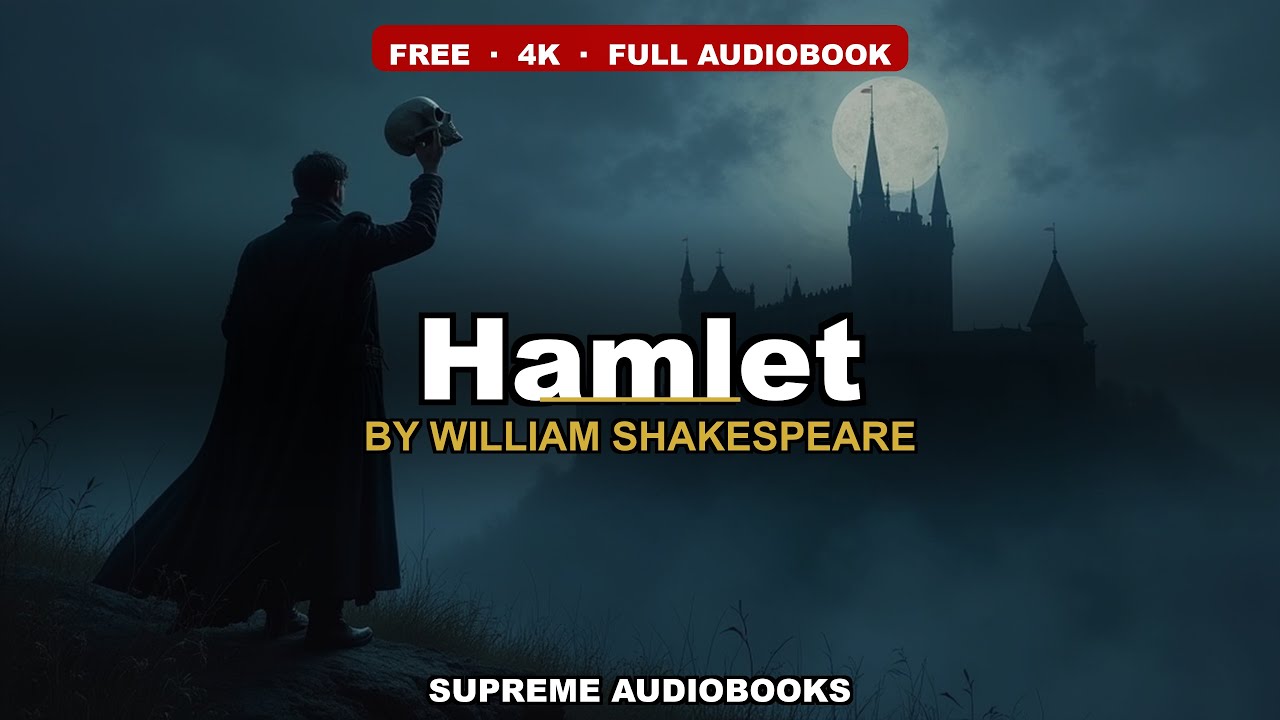
The 4K cinematic visuals accompanying this audiobook are generated by an AI image model from prompts derived from the source text. No copyrighted photos, paintings, or stock footage are used. AI generation is disclosed on every video on our YouTube channel as required by YouTube's altered/synthetic content policy.
English subtitles are transcribed from the LibriVox recording with OpenAI Whisper. Translations into the 11 other supported languages are produced by Meta's NLLB-200 neural translation model. No human translator's copyrighted translation is used.
Questions about sourcing or rights? See our DMCA & Sourcing policy or contact us.
Enjoyed this audiobook?
If you'd like to own a copy of Characters of Shakespeare's Plays or hear a professionally produced edition, the links below help support free audiobook production at no extra cost to you.
As an Amazon Associate we earn from qualifying purchases. Audible / print links are affiliate.