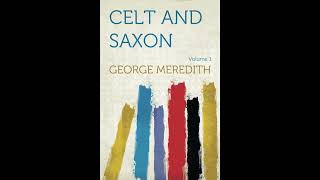
Celt and Saxon - Complete
In the landscape of classic literature, certain voices call out with a distinct, often challenging, elegance, offering insights into human nature that resonate with striking clarity across the centuries. George Meredith's Celt and Saxon stands as one such testament, a work that, though unfinished, pulses with the keen observation and intellectual vigor characteristic of its author. It presents not merely a story, but a profound examination of cultural temperament, social expectation, and the intricate dance between individuals shaped by different inheritances. For listeners today, this narrative offers a chance to consider how national identities and personal desires intersect, how prejudice and understanding struggle for dominance, and how the pursuit of love often finds itself entangled in the web of societal convention. It remains a relevant and thought-provoking listen, a window into the perpetual tension between self and society, then as now. The story introduces us to Lady Charlotte, a young woman of refined English background, firmly rooted in the "Saxon" world of order and established convention. Her life, though seemingly secure within the framework of her social standing, carries an undercurrent of disquiet, a sense that the prescribed paths might not align with her deeper self. Into this carefully structured existence strides Roy, an Irishman whose fiery spirit and passionate nature embody the "Celt" he represents. He is a character of immediate magnetism, possessed of a quick wit and an untamed spirit that stands in stark contrast to Lady Charlotte's more reserved demeanor. The novel establishes their initial encounters with a compelling energy, immediately highlighting the friction and attraction that spring from their differing backgrounds and temperaments. The narrative arc quickly draws them into a complicated relationship, not merely a romantic entanglement, but a collision of worlds. Meredith meticulously details the social circles they inhabit, showing how Lady Charlotte's family and acquaintances view Roy with a mixture of fascination and suspicion, often colored by the prevailing English attitudes toward Ireland at the time. Roy, in turn, finds himself navigating an environment that both attracts and alienates him, his independent spirit often chafing against the rigid proprieties he encounters. The central conflict thus becomes a fascinating exploration of whether love and understanding can truly bridge the chasm of cultural difference and ingrained prejudice, or if the weight of societal expectations will prove too heavy a burden for their burgeoning connection. The story follows their attempts to reconcile personal affection with public perception, and to understand one another across the divide of their birthright, setting the stage for a drama where hearts and nations subtly clash. George Meredith, born in 1828 in Portsmouth, England, was a novelist and poet whose literary career spanned much of the Victorian era. His early life was marked by considerable hardship; orphaned by the age of five, he was raised in part by his father's former tailor, a man of Quaker faith who provided him with an education in Germany. These formative years, far from the traditional English public school system, instilled in him a unique perspective and a deep-seated individualism that would shape his work. His adult life was equally fraught with personal difficulty, most notably his first marriage to Mary Ellen Nicolls, daughter of Thomas Love Peacock, which ended unhappily and provided the inspiration for his early masterpiece, The Ordeal of Richard Feverel. This novel, published in 1859, cemented his reputation as a daring and innovative writer, though its controversial themes initially met with a mixed reception. Meredith continued to produce a steady stream of novels and poetry throughout his life, becoming known for his complex psychological realism and his often aphoristic, demanding prose style. He was a master of the "comic spirit," a term he himself championed, which allowed him to dissect human foibles and societal hypocrisies with incisive wit and intellectual rigor. Other major works include The Egoist (1879), a brilliant social comedy satirizing male vanity, and Diana of the Crossways (1885), a novel that championed female intelligence and independence. By the time of his death in 1909, Meredith was recognized as a major figure in English letters, his influence extending to later generations of writers who appreciated his psychological depth and his challenge to conventional narrative forms. He is often regarded as a bridge between the Victorian novel and the emergent modernism of the early twentieth century. One of the central themes animating Celt and Saxon is the profound impact of cultural identity on individual relationships. The novel vividly contrasts the perceived temperaments of the English "Saxon" and the Irish "Celt," using Lady Charlotte and Roy as archetypes. Meredith does not simply portray these as differences in accent or custom, but as deeply ingrained ways of perceiving the world, of expressing emotion, and of navigating social interactions. The misunderstandings and attractions between Charlotte and Roy often stem directly from these cultural lenses, showing how national character can manifest in personal chemistry, creating both powerful bonds and significant barriers. This dynamic allows for a sophisticated examination of how inherited identities shape our interactions with those from other backgrounds. Another significant theme is the clash between social convention and individual desire. Lady Charlotte, despite her intelligence, feels the immense pressure of English societal expectations, particularly concerning appropriate romantic attachments. Roy, with his less constrained, more spontaneous nature, challenges these norms by simply existing outside their rigid boundaries. The book shows how individuals struggle to reconcile what their hearts might want with what society dictates is proper or prudent. This tension is enacted not through grand declarations, but through subtle gestures, unspoken judgments, and the constant internal negotiations characters make between authenticity and conformity. Meredith demonstrates how adherence to superficial rules can stifle genuine connection and happiness, while also acknowledging the formidable power these conventions hold over human behavior. Celt and Saxon, though published posthumously in 1910, was conceived and partially written during a period of significant social and political change in the British Isles. The late Victorian and early Edwardian eras were characterized by growing calls for Irish Home Rule, an issue that frequently dominated political discourse and fueled public debate about Anglo-Irish relations. Meredith, with his nuanced understanding of human nature and society, was keenly aware of these tensions. The novel emerged from a cultural moment where ideas about national character were often debated, sometimes with a romanticized view of different "races" within the British Empire, and sometimes with outright prejudice. This backdrop naturally informed his decision to frame a love story around the archetypal figures of Celt and Saxon, allowing him to comment on broader societal dynamics through the microcosm of personal relationships. Furthermore, the literary landscape of the late nineteenth century was transitioning. While realism and naturalism held sway, there was also a growing interest in psychological depth and a challenging of traditional narrative structures. Meredith, with his experimental prose and focus on inner life, was at the forefront of this shift. Celt and Saxon reflects these trends, not only in its subject matter but also in its sophisticated characterizations and its less straightforward narrative style. The unfinished nature of the work itself, as published, gives us a glimpse into Meredith's working process and his ambitious intent to capture the complexities of an evolving world, poised on the brink of significant social upheaval and cultural re-evaluation. Listening to Celt and Saxon as an audiobook offers a singular opportunity to immerse oneself in Meredith's distinctive prose. His writing, known for its intellectual density and often poetic phrasing, truly comes alive when read by a skilled narrator. The several hours of this audiobook provide ample space for the listener to attune to Meredith's rhythm, to savor his precise observations, and to fully appreciate the subtleties of his dialogue. A good narration can illuminate the intricate interplay between characters, bringing out the nuances in Lady Charlotte's carefully modulated responses and Roy's more impulsive declarations. It allows the atmosphere of the drawing rooms and the landscapes to settle around the listener, creating a deeply engaging experience that transforms a challenging text into an accessible and thought-provoking encounter. The spoken word guides the listener through the complexities, ensuring that the wit and wisdom of Meredith's voice are heard as they were intended.
Enjoyed Celt and Saxon - Complete? A few ways to support us
Audible & Amazon links are affiliate; we may earn a small commission at no extra cost.
About this production
Human narration by a volunteer reader from LibriVox.org, the public-domain audiobook project. LibriVox volunteers record literary works whose copyright has expired in the United States, releasing the resulting recordings into the public domain.
Celt and Saxon - Complete by George Meredith. The underlying text is in the U.S. public domain. We do not republish any modern copyrighted edition, translation, or commentary.
The 4K cinematic visuals accompanying this audiobook are generated by an AI image model from prompts derived from the source text. No copyrighted photos, paintings, or stock footage are used. AI generation is disclosed on every video on our YouTube channel as required by YouTube's altered/synthetic content policy.
English subtitles are transcribed from the LibriVox recording with OpenAI Whisper. Translations into the 11 other supported languages are produced by Meta's NLLB-200 neural translation model. No human translator's copyrighted translation is used.
Questions about sourcing or rights? See our DMCA & Sourcing policy or contact us.
View 10 famous quotes from this book →
Enjoyed this audiobook?
If you'd like to own a copy of Celt and Saxon - Complete or hear a professionally produced edition, the links below help support free audiobook production at no extra cost to you.
As an Amazon Associate we earn from qualifying purchases. Audible / print links are affiliate.