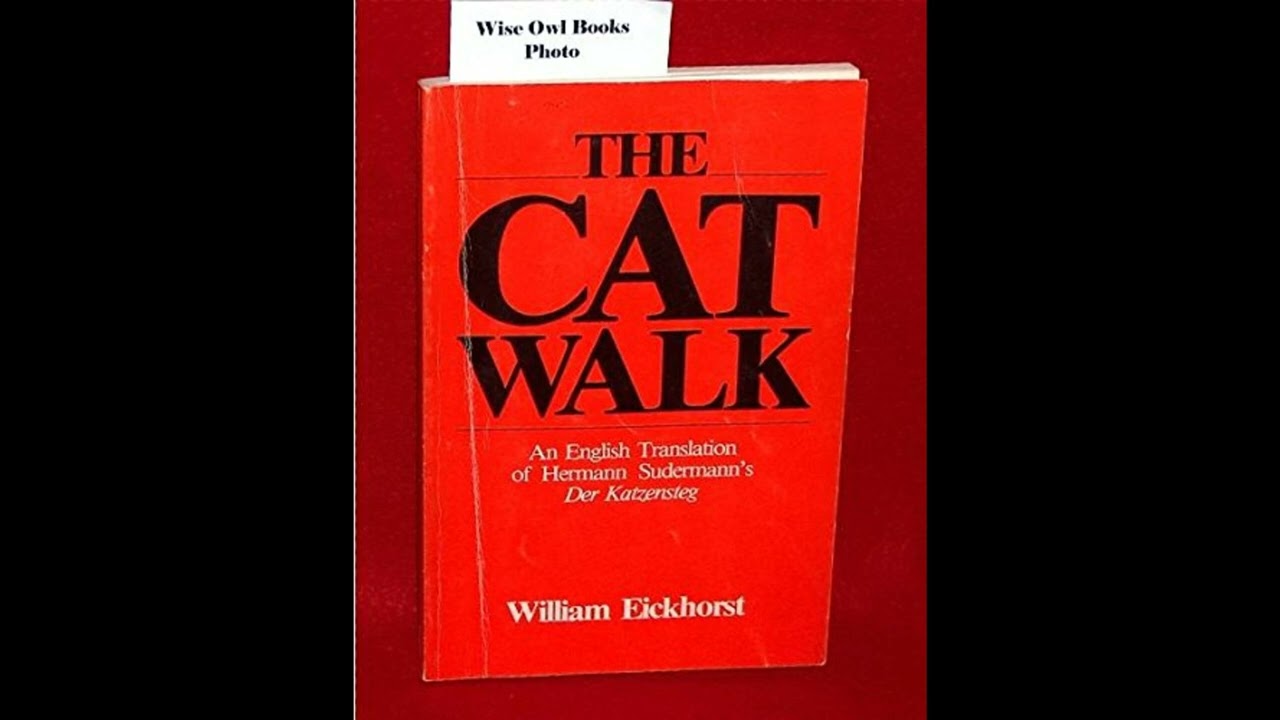
Cat Walk: An English Translation of Hermann Sudermanns Der Katzensteg
Discover a narrative that probes the depths of social prejudice and the enduring weight of ancestral guilt, even as it celebrates the tenacity of unconventional love. Cat Walk, an English rendition of Hermann Sudermann's influential German novel Der Katzensteg, transports listeners to a world where reputation is everything and a single, controversial act can cast a shadow across generations. This is a story that resonates powerfully today, reflecting on how communities judge their members, how individuals struggle for redemption against overwhelming odds, and the stark choices required to forge one's own path when society has already condemned you. It offers a poignant examination of human nature, challenging assumptions about honor, loyalty, and the possibility of finding grace in an unforgiving landscape. The story unfolds in a remote East Prussian village in the aftermath of the turbulent 1848 revolutions, a period still raw with class resentments and unresolved tensions. At its heart is Boleslav von Schranden, a young nobleman who returns to his ancestral estate years after a devastating peasant uprising. During the insurrection, Boleslav's father, Baron von Schranden, had sided with the peasants, a betrayal of his class that earned him the lasting contempt of the local gentry and the common folk alike. The baron’s final, desperate act — retreating across a precarious, narrow plank bridge known locally as the "cat walk" with a peasant girl, fleeing the approaching military — cemented his dishonor in the public imagination. Boleslav, inheriting his father's name and the estate, also inherits this indelible stain of disgrace. Ostracized by nearly everyone, including his own family members who wish to disinherit him, Boleslav faces a bleak existence of solitude and scorn. His only ally, and indeed his only solace, comes in the form of Regine, the very peasant woman who accompanied his father across the infamous cat walk. Regine, fiercely loyal and unapologetically devoted to the memory of the elder Baron, becomes a figure of both scandal and profound compassion in Boleslav's life. Their complex relationship forms the emotional core of the narrative, as Boleslav strives to understand his father's controversial actions, clear his family name, and carve out a life free from the pervasive judgment of a society determined to punish him for sins not his own. The central conflict lies in Boleslav's desperate quest for absolution and the community's unyielding demand for further penance, pushing him towards a dramatic confrontation that will either break him or define him. The original author of Der Katzensteg, Hermann Sudermann, was a prominent German novelist and playwright whose work captured the social anxieties and moral dilemmas of late 19th-century Germany. Born in 1857 in Matzicken, East Prussia (now Macikai, Lithuania), to a family of German-Dutch Mennonites, Sudermann's humble origins profoundly shaped his artistic sensibilities. He worked as a journalist and tutor before finding immense success as a writer, first with his novel Dame Care (Frau Sorge, 1887) and later with the play Honor (Die Ehre, 1889). These works, like Der Katzensteg (published in 1890), often focused on the conflicts between social classes, the hypocrisy of bourgeois morality, and the struggles of individuals caught between tradition and modernizing forces. Sudermann's literary approach often placed him at the forefront of the Naturalist movement in Germany, though he often blended its stark realism with elements of psychological drama and a sometimes melodramatic flair. His plays and novels were widely popular, making him one of the most commercially successful German authors of his time, even as critics sometimes faulted him for appealing too broadly to public taste. Despite these criticisms, Sudermann's ability to create compelling characters and narratives that tackled significant social issues—the weight of reputation, the search for identity, and the quest for justice—secured his lasting place in the German literary canon, reflecting a distinct voice from the transition into the modern era. He died in 1928, leaving behind a body of work that continues to provoke thought and discussion. Cat Walk powerfully enacts several key themes, beginning with the enduring burden of the past and inherited guilt. Boleslav's entire existence is overshadowed by his father's actions during the uprising. Every interaction, every glance from a villager, serves as a concrete example of this inherited stigma, such as when he attempts to engage in local affairs only to be met with cold silence or thinly veiled accusations. The book also illuminates the harsh realities of social ostracism and the often arbitrary nature of communal justice. The rigid class structure of the period dictates that Boleslav, despite his innocence, must pay for his father's perceived betrayal of the gentry, while simultaneously being reviled by the peasants his father supposedly aided. This is vividly shown in the villagers' unwavering contempt, a collective judgment that seems immune to reason or compassion. Furthermore, the novel examines the transformative power of unconventional loyalty and forbidden love. Regine, a figure initially associated with the family's shame, emerges as the true embodiment of unwavering devotion. Her fierce protection of the late Baron's memory and her steadfast support of Boleslav stand in stark contrast to the fickle loyalty of others, highlighting how love can transcend societal boundaries and challenge predetermined notions of worth. The "cat walk" itself becomes a potent symbol: a literal path of escape for the father, but for Boleslav, it represents the narrow, treacherous path he must walk to clear his name and find his own form of honor, constantly aware of the abyss of judgment on either side. Der Katzensteg emerged in Germany during the 1890s, a period marked by significant social and political shifts following the country's unification in 1871. This era saw rapid industrialization, burgeoning urban centers, and a growing middle class, but also lingering anxieties about traditional values and the entrenched power of the aristocracy. Culturally, it was a time when the literary movement of Naturalism gained traction, challenging Romantic idealism with a focus on depicting life "as it is," often emphasizing social determinism, the influence of environment, and the psychological realities of ordinary people. Sudermann's novel fits squarely within this context, dissecting the class conflicts and societal hypocrisy that characterized imperial Germany. The lingering memory of the 1848 revolutions provided a fertile ground for exploring themes of social upheaval and its long-term consequences, reflecting a society grappling with its own recent history and the complex interplay of individual actions within a rigid social framework. As an audiobook, Cat Walk offers a particularly immersive experience of this emotionally charged narrative. The skilled narration can bring to life the isolated, somber atmosphere of the East Prussian landscape, making the listener feel the chill of social rejection and the weight of Boleslav's inherited burden. A well-chosen voice will subtly convey the nuances of each character — the unwavering loyalty of Regine, the cold disdain of the villagers, the quiet desperation and simmering resolve of Boleslav. The sustained run length, measured in several hours, allows for a deep, unhurried absorption of the story's complex emotional arcs and philosophical underpinnings. Listeners will find themselves drawn into the slow build of tension, the quiet moments of introspection, and the dramatic confrontations, all enhanced by a narrator's command of pacing and the delicate shifts in tone required to truly illuminate this powerful story of redemption and the enduring human spirit.
Enjoyed Cat Walk: An English Translation of Hermann Sudermanns Der Katzensteg? A few ways to support us
Audible & Amazon links are affiliate; we may earn a small commission at no extra cost.
About this production
Human narration by a volunteer reader from LibriVox.org, the public-domain audiobook project. LibriVox volunteers record literary works whose copyright has expired in the United States, releasing the resulting recordings into the public domain.
Cat Walk: An English Translation of Hermann Sudermanns Der Katzensteg. The underlying text is in the U.S. public domain. We do not republish any modern copyrighted edition, translation, or commentary.
The 4K cinematic visuals accompanying this audiobook are generated by an AI image model from prompts derived from the source text. No copyrighted photos, paintings, or stock footage are used. AI generation is disclosed on every video on our YouTube channel as required by YouTube's altered/synthetic content policy.
English subtitles are transcribed from the LibriVox recording with OpenAI Whisper. Translations into the 11 other supported languages are produced by Meta's NLLB-200 neural translation model. No human translator's copyrighted translation is used.
Questions about sourcing or rights? See our DMCA & Sourcing policy or contact us.
Enjoyed this audiobook?
If you'd like to own a copy of Cat Walk: An English Translation of Hermann Sudermanns Der Katzensteg or hear a professionally produced edition, the links below help support free audiobook production at no extra cost to you.
As an Amazon Associate we earn from qualifying purchases. Audible / print links are affiliate.
More by Unknown

Pray You, Sir, Whose Daughter?: A socially progressive feminist novel from 1892

Camps and Trails in China: A Narrative of Exploration, Adventure and Sport in Little- Full Audiobook

Copyright Law of the United States and Related Laws Contained in Title 17 of the Uni- Full Audiobook