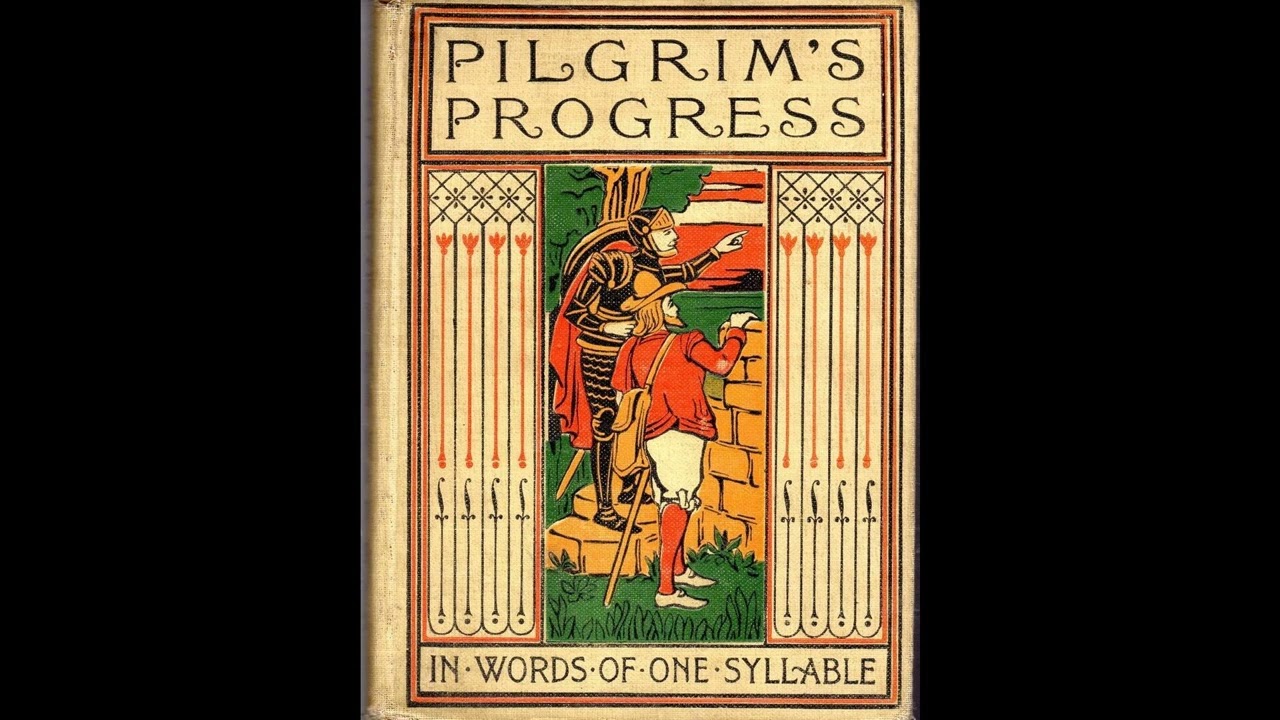
Bunyan's Pilgrim's Progress in Words of One Syllable
Few books have left as deep an imprint on English literature and culture as John Bunyan’s The Pilgrim’s Progress. Its influence stretches across centuries, shaping language, thought, and moral instruction for countless readers. Now, imagine this monumental allegorical tale – a narrative of spiritual quest and self-discovery – retold with an extraordinary linguistic discipline, rendered entirely in words of one syllable. This is the unique achievement of Samuel Phillips Day’s Bunyan’s Pilgrim’s Progress in Words of One Syllable, a text that strips away linguistic complexity to reveal the stark, potent core of Bunyan’s vision. For today’s listener, this version offers a rare chance to engage with a foundational story, not as a dense historical relic, but as an intensely clear and resonant experience, proving that profundity needs not rely on ornate phrasing. The tale opens as Christian, a man burdened by a great weight on his back, flees the City of Destruction. An alarming warning of impending doom spurs him onward, setting him on a path towards a distant, beckoning light. He meets figures like Obstinate and Pliable, who try to dissuade him or briefly join him before falling away. His resolve is tested early on when he finds himself sinking in the Slough of Despond, a bog of doubt and fear. He soon receives guidance from Evangelist, who points him toward the Wicket Gate, the true entry to his ultimate destination, the Celestial City. Christian’s travels are fraught with peril and temptation. He faces the alluring yet dangerous Worldly Wiseman, endures the terrifying trials within the House Beautiful, and battles the fearsome fiend Apollyon. His steadfastness is put to the test in Vanity Fair, a town dedicated to earthly pleasures and material gain, where he witnesses the fate of his companion, Faithful. Later, he and his new friend, Hopeful, are held captive by Giant Despair in Doubting Castle, a period that pushes them to the very brink of despair before a miraculous escape. Through all these ordeals, Christian learns invaluable lessons about faith, resilience, and the nature of salvation, pressing onward towards his hopeful reward. Samuel Phillips Day, the author behind this distinctive adaptation, was an Irish journalist and prolific writer active primarily in the late nineteenth century. Born in Dublin in 1838, Day spent a significant portion of his life engaged in literary pursuits, contributing to newspapers and publishing numerous books across various genres. While not a household name in the same vein as the literary giants he adapted, Day carved out a notable niche for himself through his "One Syllable Series" of books. These adaptations aimed to make classic literature accessible to a wider audience, particularly children and those with limited reading proficiency. His work reflects a pedagogical trend of the era, where simplified texts served as bridges to more complex literary forms. Day produced simplified versions of many beloved tales, including Robinson Crusoe and Gulliver's Travels, alongside this rendition of The Pilgrim's Progress. His skill lay not in inventing new narratives, but in meticulously translating existing ones into the most fundamental units of the English language. He passed away in 1905, leaving behind a legacy of texts that, though adaptations, played a role in broadening the reach of foundational stories during a period of expanding literacy. This version of The Pilgrim’s Progress enacts several profound themes with striking clarity due to its linguistic constraint. Foremost among these is faith and perseverance. Christian’s unyielding progress despite repeated setbacks – from his initial flight from the City of Destruction to his escape from the clutches of Giant Despair – illustrates a persistent belief that a higher goal awaits him. Each obstacle, whether the literal mire of the Slough of Despond or the metaphorical snares of Vanity Fair, serves to refine his resolve and deepen his trust in a guiding light. Another central theme is moral allegory, where every character, place, and event represents a spiritual or ethical concept. For instance, the very name "Worldly Wiseman" points to the danger of trusting human reason over divine guidance, while the dark halls of Doubting Castle stand as a stark symbol of spiritual uncertainty. The text also strongly emphasizes the nature of sin and redemption. Christian's encounters with figures who choose comfort or earthly gain over spiritual truth highlight the diverging paths humans can take. Characters like Obstinate, who rejects the call to salvation out of stubbornness, serve as foils to Christian's steadfastness, showing the ease with which one can stray. Conversely, the fellowship Christian finds with Faithful and Hopeful underscores the theme of community and solitude in belief. His pilgrimage begins as a solitary quest, but he later finds strength and encouragement in shared trials, suggesting that while faith is personal, it can also be strengthened by the communion of like-minded souls. The simple language often serves to underscore the directness of these moral lessons, making them accessible and impactful. Day's adaptation emerged during a period of significant cultural and literary shifts in the late nineteenth century. The Victorian era had fostered a strong emphasis on moral instruction and the value of classic literature, but also saw a rapid expansion of literacy and the publishing industry. There was a growing demand for educational materials and accessible versions of canonical texts, particularly for younger readers and newly literate adults. This was a time when the moral and spiritual lessons embedded in works like Bunyan's original were still considered vital, but the archaic language or complex sentence structures could present a barrier. Day’s work was a direct response to this need, bridging the gap between historical literature and a modern, broader readership by meticulously stripping away linguistic ornamentation. It represents a fascinating moment in the history of publishing, where the enduring power of a story was prioritized above the exact preservation of its original stylistic form. To listen to Bunyan’s Pilgrim’s Progress in Words of One Syllable as an audiobook is to experience the familiar in an utterly fresh way. The unique constraint of one-syllable words lends a distinct rhythm and clarity to the narration. Expect a steady, deliberate pace, where each word carries its full weight, allowing for deep contemplation of Bunyan’s allegorical meaning. The narrator’s voice becomes crucial, needing to convey sincerity and gravity without resorting to overly dramatic inflections, letting the unadorned prose speak for itself. Listen for how dialogue, often pithy and direct, gains added impact from its simplicity, cutting straight to the heart of the moral dilemmas Christian faces. This auditory format offers a meditative quality, transforming a potentially dense text into a highly digestible and remarkably vivid account of one man's spiritual quest, rendered with a singular, quiet power over several hours of engaging listening.
Enjoyed Bunyan's Pilgrim's Progress in Words of One Syllable? A few ways to support us
Audible & Amazon links are affiliate; we may earn a small commission at no extra cost.
About this production
Human narration by a volunteer reader from LibriVox.org, the public-domain audiobook project. LibriVox volunteers record literary works whose copyright has expired in the United States, releasing the resulting recordings into the public domain.
Bunyan's Pilgrim's Progress in Words of One Syllable by Samuel Phillips Day. The underlying text is in the U.S. public domain. We do not republish any modern copyrighted edition, translation, or commentary.
The 4K cinematic visuals accompanying this audiobook are generated by an AI image model from prompts derived from the source text. No copyrighted photos, paintings, or stock footage are used. AI generation is disclosed on every video on our YouTube channel as required by YouTube's altered/synthetic content policy.
English subtitles are transcribed from the LibriVox recording with OpenAI Whisper. Translations into the 11 other supported languages are produced by Meta's NLLB-200 neural translation model. No human translator's copyrighted translation is used.
Questions about sourcing or rights? See our DMCA & Sourcing policy or contact us.
Enjoyed this audiobook?
If you'd like to own a copy of Bunyan's Pilgrim's Progress in Words of One Syllable or hear a professionally produced edition, the links below help support free audiobook production at no extra cost to you.
As an Amazon Associate we earn from qualifying purchases. Audible / print links are affiliate.