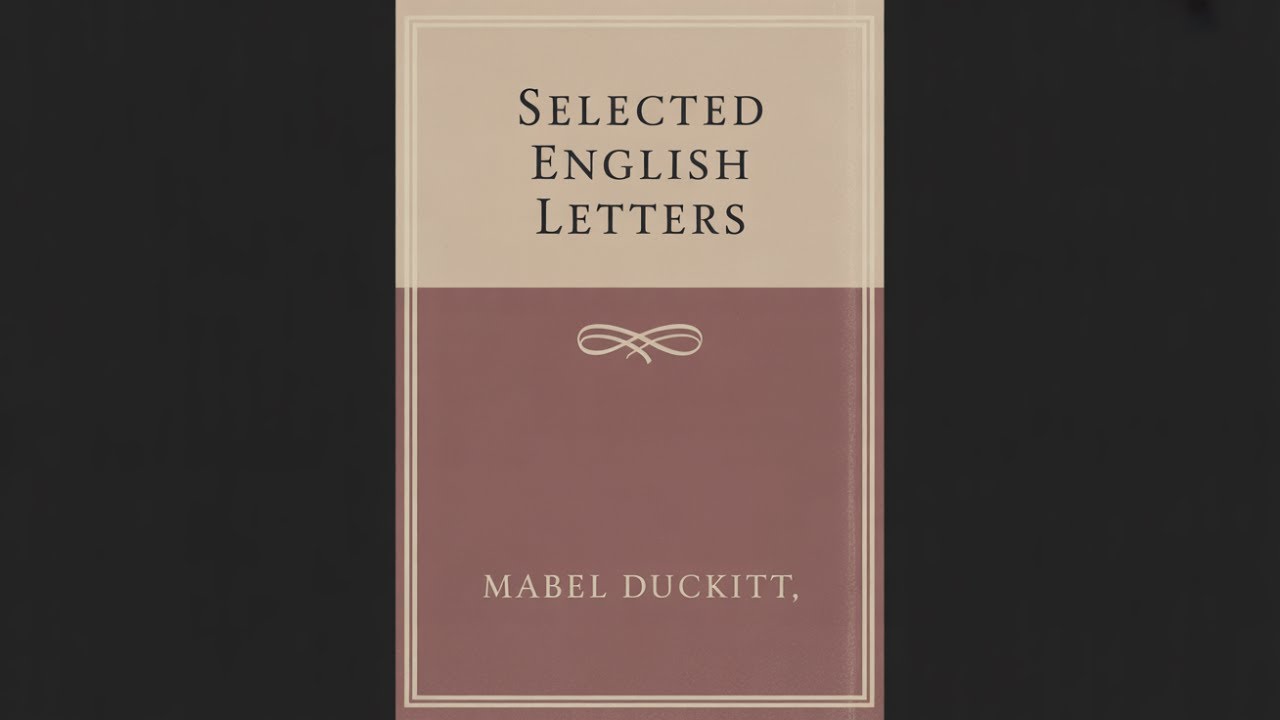
Selected English letters (xv-xix centuries)
Imagine leaning over the shoulder of a bustling Tudor merchant as he dictates news of his latest cargo, or catching the whispered confidences between two estranged sisters during the height of Georgian society. Think of the urgent pleas penned by a statesman to his sovereign, or the tender endearments exchanged by secret lovers across miles and years. Selected English letters (xv-xix centuries) offers precisely this intimate access, a remarkable collection that unseals the envelopes of history to reveal the authentic, unvarnished voices of individuals living through some of England's most transformative eras. This is not history recounted from a distance, but history felt, experienced, and communicated directly from its participants, offering a profound connection to the past that resonates with our own contemporary desire for authentic connection and understanding across time. The 'story' within this collection is the sprawling, personal narrative of England itself, told not by historians, but by its people, one handwritten page at a time. Spanning four pivotal centuries, from the dawn of the printing press and the close of the Middle Ages right up to the cusp of the modern industrial age, the letters paint a panoramic portrait of evolving societal norms, personal struggles, and grand historical moments. Listeners will find themselves transported from the candlelit studies of the fifteenth century, where scribes meticulously copied correspondence, to the busy postal routes of the nineteenth, as steam and industry began to reshape communication. There is no single protagonist here, but rather a chorus of voices – kings and commoners, scholars and housewives, poets and politicians – each contributing a unique thread to the larger narrative of human experience. The central thread tying these disparate voices together is the enduring human need to connect, to inform, to persuade, and to express. The collection reveals the subtle shifts in the English language itself, observing how modes of address, vocabulary, and grammatical structures transformed over hundreds of years. Listeners will encounter letters full of formal address and elaborate courtesy, alongside those brimming with raw emotion or sharp wit. You will discover the practicalities of daily life – requests for money, complaints about servants, travel plans – alongside impassioned arguments for religious reform, reports from distant battlefields, or heartfelt expressions of grief and joy. The arc of this 'story' is the constant evolution of human interaction and the gradual unfolding of a nation's character, seen through the most personal of lenses. Mabel Duckitt, the discerning editor behind Selected English letters, performed an invaluable service to students of history and literature alike. Though details of her personal life are not widely known, her work clearly places her within the academic and literary traditions of the late nineteenth or early twentieth century, a period marked by a surging interest in primary source materials and the meticulous collection and presentation of historical documents. Duckitt's contribution lies in her scholarly rigor and keen eye for selecting correspondence that not only illuminates historical events but also captures the authentic spirit and individual voice of its writer. She acted as an intellectual guide, carefully curating a body of material that might otherwise have remained scattered in archives or inaccessible to the general public. Duckitt's editorial methodology likely involved extensive research in private collections, university libraries, and national archives, sifting through countless pages to identify letters that possessed both historical significance and literary merit. Her compilation speaks to a broader movement among scholars of her era to democratize access to historical records, making the direct voices of the past available to a wider readership beyond specialized academic circles. Rather than imposing a single narrative, Duckitt presented these letters with minimal intervention, allowing the original texts to speak for themselves, trusting the inherent drama, humor, and pathos within these candid communications to resonate with contemporary audiences. Her legacy is this carefully assembled window into the intellectual, social, and emotional lives of previous generations of English speakers. One profound theme woven throughout this collection is the evolution of communication itself. Listeners witness how the very act of writing a letter transformed from a laborious, often public, endeavor involving scribes and messengers in the early centuries to a more widespread, private practice enabled by improved literacy and postal services. Early letters might be formal instruments of power or commerce, dictating alliances or trade deals, while later examples reveal the blossoming of more intimate, confessional correspondence, reflecting a growing emphasis on individual subjective experience. A fifteenth-century letter from a noble to their steward, meticulously worded to maintain social hierarchy and command, stands in stark contrast to a nineteenth-century letter between friends, filled with casual gossip and personal anxieties, illustrating this remarkable shift. Another central theme is the perennial nature of human emotion and societal connection, even as the specific contexts change. While the language and social customs may differ, the underlying human experiences of love, loss, ambition, fear, and humor remain strikingly constant. A mother's concern for her child's health expressed in an Elizabethan missive echoes the worries found in a Victorian parent's note. The political intrigues detailed by a Restoration courtier find parallels in the strategic communications of a Regency diplomat. The letters also offer unique insights into the changing role of women in society, the gradual expansion of education, and the shifting class structures, providing concrete glimpses into how these broader societal changes were experienced on a personal, day-to-day level, making distant historical periods feel remarkably proximate and human. The vast chronological span of Selected English letters means it emerges from, and reflects, an incredible array of historical contexts. The fifteenth century saw England grappling with the Wars of the Roses, a period of profound political instability, where letters often served as vital conduits for intelligence and allegiance. The sixteenth century brought the seismic shifts of the Reformation under Henry VIII and Elizabeth I, influencing not only the religious beliefs expressed but also the very structure of power and loyalty. By the seventeenth century, the Civil War tore the nation apart, and correspondence became a tool for propaganda, military command, and desperate personal pleas amidst conflict. The Enlightenment brought new philosophical currents in the eighteenth century, often debated and disseminated through personal correspondence among intellectuals and burgeoning literary circles. Finally, the nineteenth century – an era of industrialization, empire-building, and profound social reform – saw an explosion in literacy and the establishment of reliable postal services, transforming letter-writing into a truly ubiquitous practice. Letters from this period capture the anxieties and triumphs of an increasingly complex and interconnected world. Mabel Duckitt's decision to compile this collection, likely in the period following this intense growth, reflects a broader scholarly and public appetite for primary sources, a desire to understand history not just through grand narratives but through the authentic, often poignant, voices of those who lived it. It was a time when the value of individual experience, documented in personal archives, was being increasingly recognized as essential to a comprehensive understanding of the past. Listening to Selected English letters as an audiobook offers an unparalleled immediacy, transforming dusty historical documents into living voices. A skilled narrator breathes life into these centuries-old missives, allowing listeners to hear the subtle nuances of tone – the formality of an official decree, the urgency of a secret message, the tender lilt of a love letter, or the sharp wit of a satirical observation. The careful pacing allows each letter to resonate, granting time to absorb the historical detail and emotional weight of its contents. Without the visual distractions of print, the listener is drawn directly into the intimate act of communication, feeling as if they are present when the words were first spoken, dictated, or read aloud. It's a uniquely immersive way to experience the cadences of evolving English and the authentic, unmediated human spirit across five hundred years.
Enjoyed Selected English letters (xv-xix centuries)? A few ways to support us
Audible & Amazon links are affiliate; we may earn a small commission at no extra cost.
About this production
Human narration by a volunteer reader from LibriVox.org, the public-domain audiobook project. LibriVox volunteers record literary works whose copyright has expired in the United States, releasing the resulting recordings into the public domain.
Selected English letters (xv-xix centuries) by Mabel Duckitt. The underlying text is in the U.S. public domain. We do not republish any modern copyrighted edition, translation, or commentary.
The 4K cinematic visuals accompanying this audiobook are generated by an AI image model from prompts derived from the source text. No copyrighted photos, paintings, or stock footage are used. AI generation is disclosed on every video on our YouTube channel as required by YouTube's altered/synthetic content policy.
English subtitles are transcribed from the LibriVox recording with OpenAI Whisper. Translations into the 11 other supported languages are produced by Meta's NLLB-200 neural translation model. No human translator's copyrighted translation is used.
Questions about sourcing or rights? See our DMCA & Sourcing policy or contact us.
Enjoyed this audiobook?
If you'd like to own a copy of Selected English letters (xv-xix centuries) or hear a professionally produced edition, the links below help support free audiobook production at no extra cost to you.
As an Amazon Associate we earn from qualifying purchases. Audible / print links are affiliate.