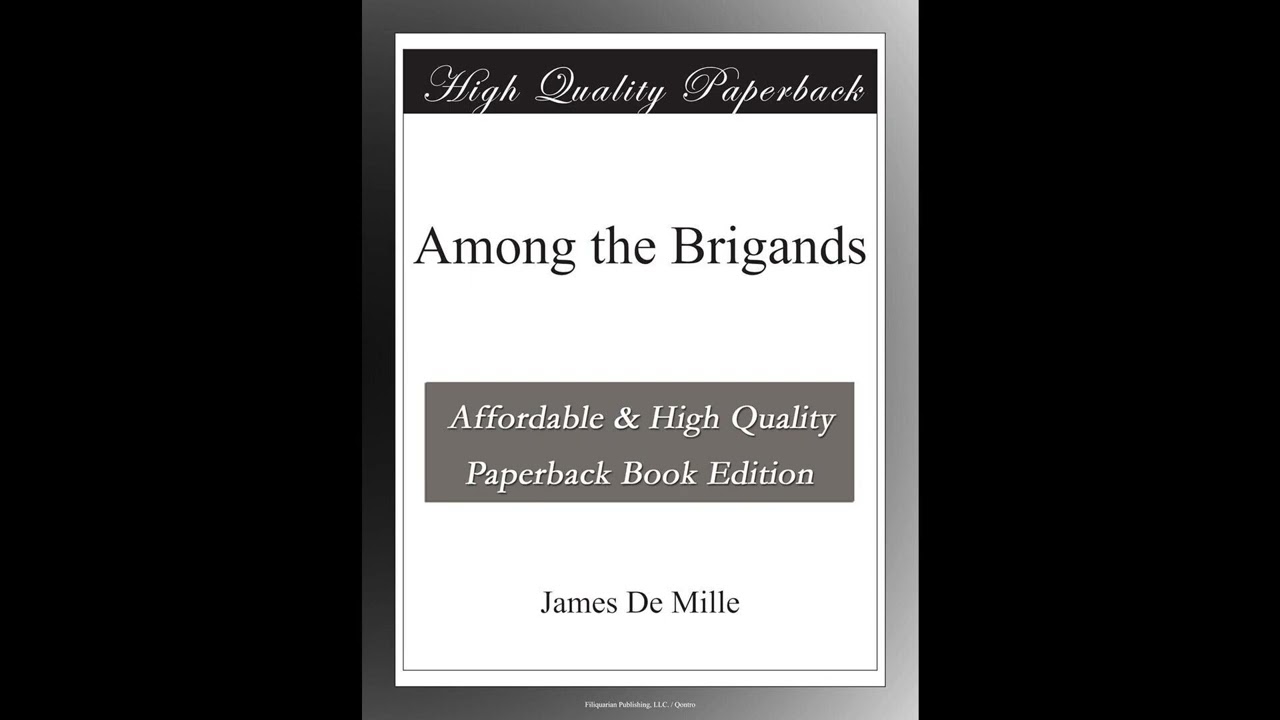
Among the Brigands
The forgotten corners of literary history often hold unexpected treasures, and among them stands James De Mille's Among The Brigands, a tale that transports listeners to a world both dangerous and profoundly beautiful. This isn't merely an adventure story of capture and escape; it is a resonant examination of human nature under duress, a novel that asks us to consider the fine line between civilization and wilderness, both without and within. In an era where boundaries blur and identity feels perpetually in flux, De Mille's keen observations on societal structures, personal morality, and the search for authentic selfhood remain remarkably pertinent, offering a thrilling escape that simultaneously invites deep contemplation. The narrative unfolds in the sun-drenched, yet perilously rugged, landscapes of late 19th-century southern Italy, a region then notorious for its bands of brigands. Our central figure is Arthur Penhaligon, a young Englishman of good family, on an extended Grand Tour, ostensibly to broaden his education and appreciate classical antiquities. Possessed of a somewhat naive idealism and a thirst for authentic experience beyond the polite drawing-rooms of Europe, Arthur ventures off the well-trodden paths. While sketching the evocative ruins of an ancient Roman villa perched precariously above a winding mountain pass, he is suddenly overwhelmed and taken captive by a notorious band led by the enigmatic figure known only as Il Corvo—The Crow. Thus begins Arthur's harrowing ordeal, thrust from his comfortable existence into a brutal new reality where the rules of polite society are irrelevant, and survival hinges on wits, resilience, and a rapidly evolving understanding of human loyalties. Arthur’s initial fear gives way to a complex series of interactions with his captors, revealing them not as one-dimensional villains, but as men shaped by a harsh environment and a deep-seated distrust of distant authority. He observes the intricacies of their mountain lair, the code of honor—however skewed—that governs their actions, and the surprisingly tender moments that punctuate their brutal lives. As weeks stretch into months, Arthur grapples with the ever-present threat of violence, the gnawing uncertainty of rescue, and the unsettling realization that his own identity is being reshaped by the wilderness. He encounters Maria, a spirited local woman associated with the brigands, whose complicated loyalties and fierce independence challenge his preconceived notions about women and the world. The story follows Arthur’s desperate attempts to secure his freedom, navigating perilous escapes, betrayals, and surprising alliances, all while the specter of the band’s ruthless pursuit hangs over him. James De Mille, a significant voice from the latter half of the nineteenth century, quietly carved out a unique space within the burgeoning literary landscape of his time. Born into a generation increasingly fascinated by both the exotic and the psychological depths of human experience, De Mille — whose precise birth and death dates remain somewhat elusive in the broader public record, though he was certainly active through the 1870s and 80s — likely drew heavily from a period of extensive European travel during his formative years. Accounts suggest he spent considerable time immersed in the cultures and histories of southern Europe, developing a keen eye for the social dynamics and hidden narratives that often escaped casual tourists. This exposure profoundly influenced his writing, allowing him to infuse his adventure narratives with a powerful sense of place and an authentic understanding of the human condition. Though perhaps overshadowed by the more widely celebrated giants of Victorian literature, De Mille's work holds a distinct charm and intellectual rigor. His bibliography, while not extensive, includes several other notable works that reflect his thematic preoccupations. Titles such as The Serpent in the Olive Grove and Shadows on the Adriatic suggest a consistent fascination with Mediterranean settings and the moral complexities inherent in them. He was a writer who straddled the receding wave of Romantic adventure and the emerging tide of realism, incorporating the thrill of the chase with a more nuanced portrayal of character and motive. His position in the canon is often described as that of a "rediscovered" author, one whose thoughtful prose and engaging plots are increasingly appreciated by modern readers looking beyond the most commonly anthologized texts. Among The Brigands enacts several potent themes with memorable force. Foremost among them is the clash between civilization and primal instinct. Arthur’s polished manners and intellectual pursuits are rendered meaningless in the face of raw survival, forcing him to shed layers of societal conditioning. A particularly striking scene depicts Arthur attempting to explain the concept of legal justice to Il Corvo, only for the brigand to laugh, pointing to a swift mountain stream as his only law: "It flows where it must, and takes what it finds." This moment powerfully illustrates the chasm between their worldviews. Another central theme is the redefinition of freedom. Initially, freedom means escape and return to his former life. However, as Arthur spends more time with his captors, observing their independent, albeit brutal, existence, he begins to question if true freedom lies solely in the absence of chains, or if it can also be found in self-reliance and the rejection of societal constraints, however perilous that path may be. He witnesses brigands making choices, however violent, that stem from a sense of agency, prompting an internal debate about the nature of his own "free" life back home. The novel also thoughtfully considers the theme of moral ambiguity and empathy. De Mille challenges the reader to look beyond surface appearances. Il Corvo, despite his violent acts, is depicted with moments of unexpected paternal care for his younger men, or a fierce loyalty to his perceived causes. Arthur, too, finds himself in situations where his own moral compass wavers, making difficult decisions that would have been unthinkable in his previous life. He observes a moment where one of the younger brigands, barely more than a boy, shares his meager rations with a starving stray dog, a small act of kindness that complicates Arthur's rigid categorization of his captors. Furthermore, the novel explores the transformative power of extreme experience, demonstrating how Arthur is irrevocably changed by his ordeal. He enters the mountains as an idealistic, somewhat naive young man; he emerges with a harder edge, a deeper understanding of human resilience, and a perspective forever altered by his encounters with raw life and death. The late nineteenth century was a period ripe for tales of exotic locales and thrilling adventure. European empires were expanding, and with them came a fascination with the "other"—foreign lands, wild peoples, and untamed landscapes. Literary tastes of the era leaned towards narratives that offered both escapism and a touch of the sensational, often through serialized publications that kept readers eagerly awaiting the next installment. Brigandage, a real and often romanticized phenomenon in parts of Italy and the Balkans, provided a perfect backdrop for such stories, allowing authors to weave together themes of lawlessness, justice, and the clash between local traditions and encroaching modernity. De Mille's work emerged from this confluence, offering readers an immersive window into a world both excitingly foreign and strangely familiar, tapping into a collective desire for narratives that tested the limits of human endurance and explored the darker corners of the human psyche. Listening to Among The Brigands as an audiobook unlocks a particularly potent experience. The "several hours" runtime allows ample space for the narrative to unfold at its own deliberate pace, mirroring Arthur's extended period of captivity and gradual transformation. A skilled narrator can bring out the stark contrasts in De Mille's prose—the lyrical descriptions of the Italian landscape alongside the blunt, harsh dialogue of the brigands. Listen for the shifting tone in the narration: the initial shock and terror, the growing resignation, the moments of defiant hope, and the subtle changes in Arthur's own voice as he adapts to his environment. The atmospheric descriptions, especially of the wild mountains and the hidden lairs, gain an added dimension through spoken word, conjuring images that pull one deep into the story's heart. It is an experience that allows the listener to feel the grit and tension, the whispered fears and the shouted commands, transporting them directly into Arthur Penhaligon's perilous world.
Enjoyed Among the Brigands? A few ways to support us
Audible & Amazon links are affiliate; we may earn a small commission at no extra cost.
About this production
Human narration by a volunteer reader from LibriVox.org, the public-domain audiobook project. LibriVox volunteers record literary works whose copyright has expired in the United States, releasing the resulting recordings into the public domain.
Among the Brigands by James De Mille. The underlying text is in the U.S. public domain. We do not republish any modern copyrighted edition, translation, or commentary.
The 4K cinematic visuals accompanying this audiobook are generated by an AI image model from prompts derived from the source text. No copyrighted photos, paintings, or stock footage are used. AI generation is disclosed on every video on our YouTube channel as required by YouTube's altered/synthetic content policy.
English subtitles are transcribed from the LibriVox recording with OpenAI Whisper. Translations into the 11 other supported languages are produced by Meta's NLLB-200 neural translation model. No human translator's copyrighted translation is used.
Questions about sourcing or rights? See our DMCA & Sourcing policy or contact us.
Enjoyed this audiobook?
If you'd like to own a copy of Among the Brigands or hear a professionally produced edition, the links below help support free audiobook production at no extra cost to you.
As an Amazon Associate we earn from qualifying purchases. Audible / print links are affiliate.