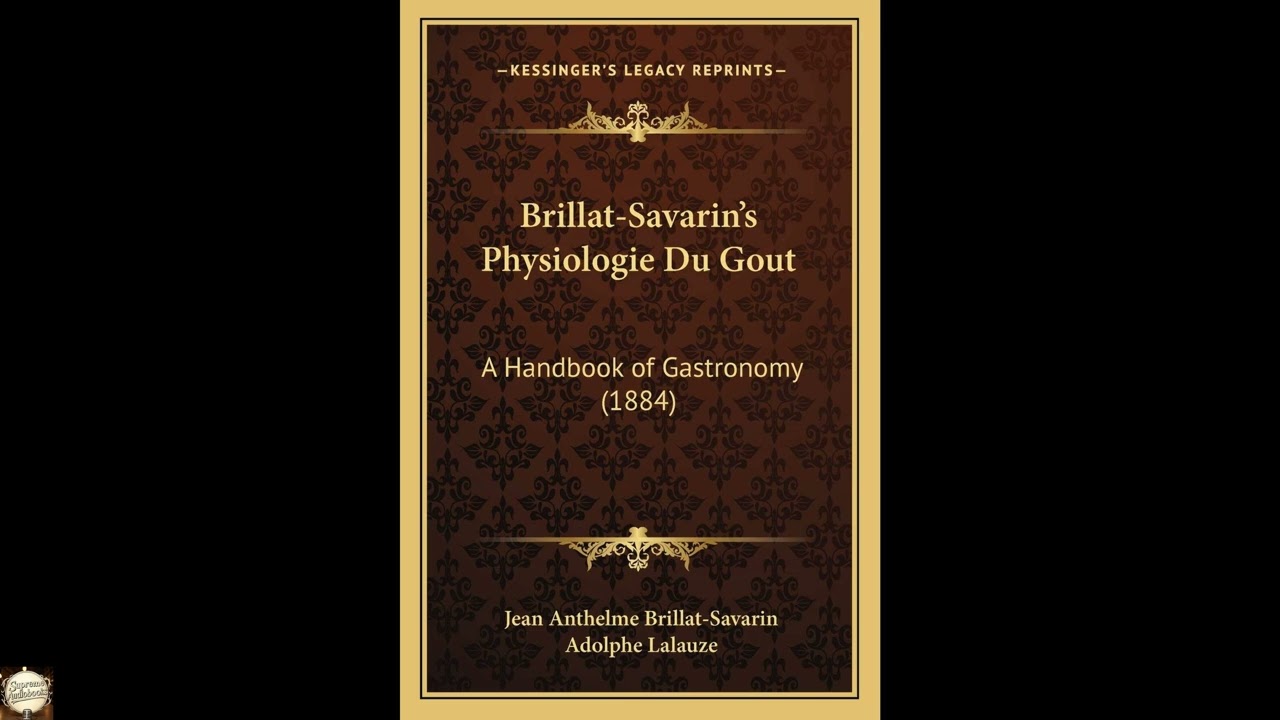
Brillat-Savarin's Physiologie Du Gout: A Handbook of Gastronomy
Imagine a world where the act of eating transcends mere sustenance, transforming into a profound philosophy, a rigorous science, and a celebrated art form. This is the world Jean Anthelme Brillat-Savarin invites you into with his seminal work, Physiologie Du Gout: A Handbook of Gastronomy. More than just a collection of recipes or culinary advice, this extraordinary book, first published in 1825, offers a sweeping meditation on human pleasure, culture, and the very essence of existence as viewed through the lens of taste. It is an enduring testament to the belief that how and what we eat shapes not only our bodies but our minds, our societies, and our understanding of happiness. For anyone seeking to deepen their appreciation for food, understand its historical and social significance, or simply revel in the wit and wisdom of a bygone era, Brillat-Savarin’s observations remain remarkably fresh and relevant today, prompting us to consider our own relationship with the plate before us. Brillat-Savarin’s Physiologie Du Gout does not present a conventional narrative with characters and a linear plot, but rather unfolds as a series of 30 "Meditations" and various anecdotes, aphorisms, and observations, each building upon the last to construct a comprehensive philosophy of gastronomy. The author positions himself as an enlightened guide, a keen observer of human nature and physiological responses, drawing upon his vast personal experience and intellectual curiosity. He establishes the setting primarily within the sophisticated salons and dining rooms of post-Revolutionary and Napoleonic France, yet his scope extends across history and geography, referencing classical antiquity and contemporary discoveries in equal measure. The central intellectual thread running through the book is the idea that gastronomy is a serious discipline, an endeavor worthy of study and refinement, which directly impacts our health, our longevity, and our overall well-being. The arc of this unique "story" begins with fundamental principles, such as the definition of taste, the various senses involved in eating, and the mechanics of digestion. Brillat-Savarin then expands his focus to discuss specific foods—coffee, chocolate, truffles, various meats and fish—detailing their preparation, their effects on the body, and their place in social rituals. He champions the pursuit of pleasure in dining, arguing that it is a natural and necessary component of a fulfilled life, and he differentiates between simple gluttony and the refined discernment of a true gastronome. The "conflict," if one can call it that, is the author's gentle but firm insistence on elevating the act of eating from a mere necessity to a high art, challenging the reader to think more deeply about their culinary choices and experiences, all while delivering his wisdom with charm, erudition, and a generous dose of humor. He introduces the reader to "gastronomic physics," the "influence of diet upon sleep," and even offers thoughts on obesity and fasting, making the entire composition a delightful intellectual feast. The author, Jean Anthelme Brillat-Savarin, was born in Belley, France, on December 1, 1755. A man of considerable intellect and diverse talents, he pursued a career in law, becoming a deputy to the Estates-General in 1789. His political leanings, however, made him a target during the tumultuous years of the French Revolution, forcing him to flee his homeland. He spent several years in exile, living in Switzerland, Holland, and eventually the United States, where he supported himself by teaching French and playing the violin in a theater orchestra in New York. This period of expatriation provided him with unique perspectives on different cultures and cuisines, enriching the observational depth of his later work. Upon his return to France in 1797, Brillat-Savarin resumed his legal career, becoming a judge in the Court of Cassation, a position he held until his death. It was during these later years, drawing upon a lifetime of observation, personal anecdotes, and intellectual curiosity, that he dedicated himself to writing Physiologie Du Gout. Published anonymously just a few months before his death on February 2, 1826, the book swiftly gained acclaim and established his lasting legacy. While he did not produce other works of similar renown, Physiologie Du Gout stands as his singular, crowning achievement, cementing his place as one of the founding figures of culinary literature and a pioneer in the art of sophisticated food writing. At its core, Physiologie Du Gout enacts several enduring themes. Firstly, it champions gastronomy as a serious science and art. Brillat-Savarin systematically dissects the components of taste and digestion, treating them with the rigor of a scientific treatise, yet elevating the practice of cooking and dining to an aesthetic pursuit. For instance, he categorizes taste sensations and meticulously describes the physiology of various organs involved in eating, much like a natural philosopher studying a phenomenon. He doesn't just describe a meal; he analyzes its impact on the diner’s spirit and health. Secondly, the book celebrates the profound connection between food and human happiness. Brillat-Savarin famously declared, "The discovery of a new dish does more for human happiness than the discovery of a new star." He frequently illustrates this with anecdotes of joyful banquets and the restorative power of a well-prepared meal, underscoring how pleasure derived from food contributes directly to contentment and well-being. A third prominent theme is the social and cultural significance of dining. Food, in Brillat-Savarin's view, is not merely individual consumption but a powerful binder of communities and a marker of civilization. He provides vivid descriptions of dinners and balls, highlighting the etiquette, conversation, and bonding that occur around the table. He emphasizes the role of the host in orchestrating these events, turning them into memorable occasions of shared pleasure and intellectual exchange. This emphasis on communal dining reveals how shared meals contribute to social cohesion. Finally, the work consistently demonstrates the power of careful observation and empirical reasoning. Throughout the book, Brillat-Savarin meticulously details his own culinary experiments and draws conclusions from years of watching people eat, drink, and interact. His observations on the effects of different foods—like his discussion of the stimulating properties of coffee or the comforting nature of chocolate—are presented not as dogma but as deductions drawn from repeated experiences, embodying an Enlightenment spirit of rational inquiry applied to the most sensual of human activities. The emergence of Physiologie Du Gout in 1825 was deeply rooted in the historical and cultural milieu of post-Revolutionary France and the Bourbon Restoration. After decades of political upheaval, warfare, and economic instability, French society was entering a period of renewed stability and a desire for the comforts and refinements that had been disrupted. The revolutionary ideals, though radical, had also fostered a spirit of inquiry and a breakdown of old hierarchies, which inadvertently paved the way for a more democratic appreciation of good food, no longer exclusively the domain of the aristocracy. This era saw the rise of the public restaurant, moving dining out of private homes and into accessible commercial spaces, thereby democratizing gastronomic enjoyment to some extent. Brillat-Savarin's work also reflects the lingering intellectual currents of the Enlightenment, particularly its emphasis on reason, observation, and the pursuit of knowledge across all domains of human experience. He applies a quasi-scientific method to a subject traditionally considered purely sensual, attempting to codify and understand the laws governing taste and digestion. At the same time, the book anticipates elements of the emerging Romantic sensibility, with its focus on individual sensation, pleasure, and the unique personal experience of the connoisseur. It was a time when French culture was reasserting its identity, and fine cuisine was a key component of that national pride, making a comprehensive philosophical guide to its pleasures exceptionally timely and resonant. To experience Physiologie Du Gout as an audiobook offers a singular pleasure, allowing the listener to absorb Brillat-Savarin's delightful prose and profound observations at a contemplative pace. The narration, ideally delivered with a measured elegance and perhaps a touch of dry wit, brings the author's distinct personality to life—the learned judge, the seasoned traveler, and the ultimate connoisseur. Over several hours of listening, one can truly savor his aphorisms, his detailed descriptions of meals, and his charming historical anecdotes. This format invites a more intimate relationship with the text, enabling listeners to appreciate the nuanced humor and the underlying wisdom in his philosophical digressions, perhaps while preparing a meal, enjoying a quiet evening, or simply contemplating the daily ritual of eating. The spoken word allows the atmosphere of sophisticated dining and intellectual discourse to envelop you, transforming a simple listening session into a gourmet experience for the mind.
Enjoyed Brillat-Savarin's Physiologie Du Gout: A Handbook of Gastronomy? A few ways to support us
Audible & Amazon links are affiliate; we may earn a small commission at no extra cost.
About this production
Human narration by a volunteer reader from LibriVox.org, the public-domain audiobook project. LibriVox volunteers record literary works whose copyright has expired in the United States, releasing the resulting recordings into the public domain.
Brillat-Savarin's Physiologie Du Gout: A Handbook of Gastronomy by Jean Anthelme Br. The underlying text is in the U.S. public domain. We do not republish any modern copyrighted edition, translation, or commentary.
The 4K cinematic visuals accompanying this audiobook are generated by an AI image model from prompts derived from the source text. No copyrighted photos, paintings, or stock footage are used. AI generation is disclosed on every video on our YouTube channel as required by YouTube's altered/synthetic content policy.
English subtitles are transcribed from the LibriVox recording with OpenAI Whisper. Translations into the 11 other supported languages are produced by Meta's NLLB-200 neural translation model. No human translator's copyrighted translation is used.
Questions about sourcing or rights? See our DMCA & Sourcing policy or contact us.
View 10 famous quotes from this book →
Enjoyed this audiobook?
If you'd like to own a copy of Brillat-Savarin's Physiologie Du Gout: A Handbook of Gastronomy or hear a professionally produced edition, the links below help support free audiobook production at no extra cost to you.
As an Amazon Associate we earn from qualifying purchases. Audible / print links are affiliate.