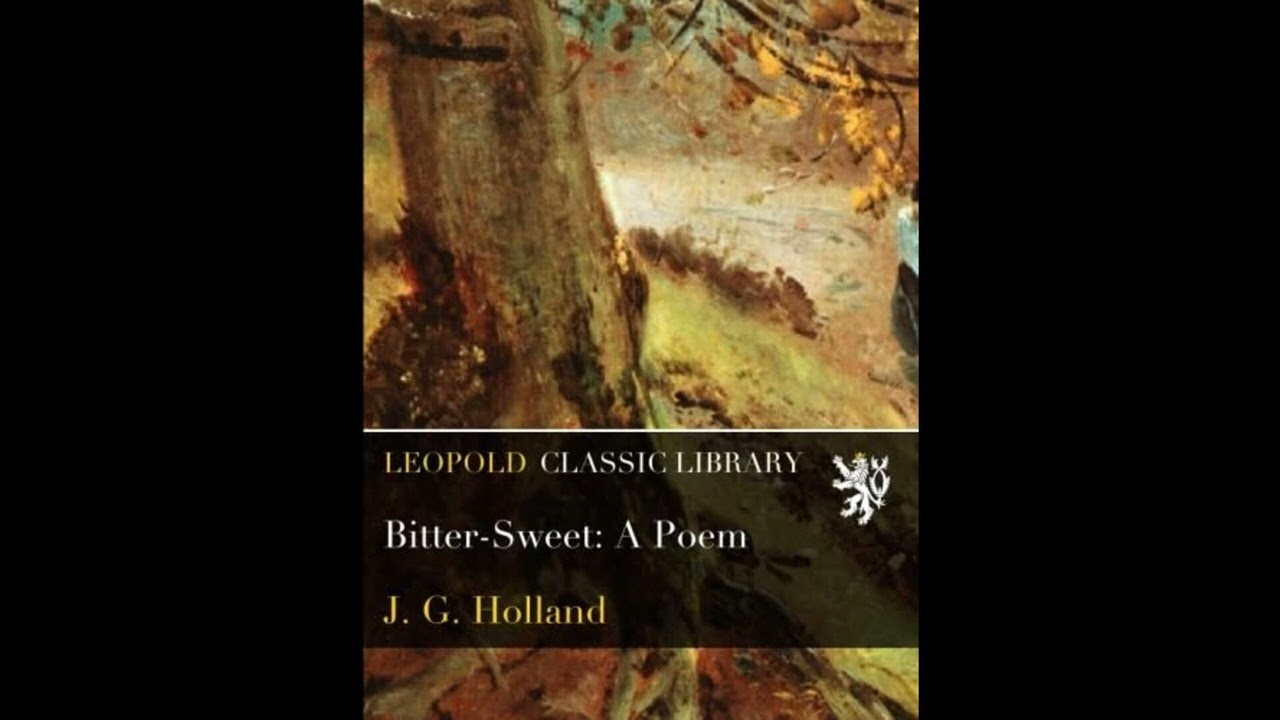
Bitter-Sweet: A Poem
What does it mean to live a full life, one where joy and sorrow are not antagonists but interwoven threads, each giving meaning to the other? This profound question lies at the heart of J. G. Holland's Bitter-Sweet: A Poem, an enduring narrative poem that, despite its century-and-a-half vintage, resonates with an almost startling contemporaneity. Holland’s verse invites us to pause amidst life’s clamor and consider the fundamental paradoxes of human existence: how suffering can precede growth, how doubt can strengthen faith, and how the deepest affections are often forged in the crucible of loss. It’s a work that doesn't offer easy answers but rather a meditative space for contemplation, a fireside chat rendered in lyrical form, perfect for anyone seeking solace, perspective, or simply a moment of quiet reflection in our often-turbulent world. The poem unfolds not through a dramatic external conflict, but within the intimate, reflective atmosphere of a New England fireside gathering. The setting is likely a domestic one, perhaps a living room warmed by a hearth, where a small company of family or close friends — figures drawn with quiet dignity and recognizable human anxieties — come together on a contemplative evening. The central "character" of Bitter-Sweet is arguably the collective voice of these individuals, guided by a gentle, wise narrator who steers their discussions and observations. They ponder the nature of happiness, the sting of grief, the bewildering unpredictability of fate, and the persistent human yearning for meaning. Through a series of interwoven narratives, personal reflections, and philosophical musings, the poem sketches the arc of life itself. We hear of youthful hopes dashed, of mature loves enduring tests, of old age reflecting on a long vista of experiences both sweet and undeniably bitter. The narrative progresses not through outward action, but through the shifting perspectives of the characters as they grapple with universal themes: the sudden loss that redefines priorities, the small joys that sustain through hardship, the comfort found in shared humanity. The overarching tension stems from the constant interplay between life's disappointments and its quiet triumphs, challenging the listener to discern the intricate balance that makes up a complete life, without revealing the poem’s ultimate, consoling revelation. Josiah Gilbert Holland, born in Belchertown, Massachusetts, in 1819, carved an extraordinary path from humble beginnings to become one of the most widely read and influential literary figures of his era. After a brief and largely unsuccessful stint as a physician, he found his true calling in journalism. His career took a decisive turn when he joined the Springfield Republican in 1849, eventually becoming an editor. Holland’s plainspoken, moralistic writings struck a chord with the American public, establishing him as a prominent voice of Victorian sensibility. His popular essays, often published under the pseudonym "Timothy Titcomb," dispensed advice on morality, conduct, and self-improvement, cementing his reputation as a cultural arbiter. Holland's literary output was prolific and varied, encompassing novels, essays, and poetry. Beyond Bitter-Sweet, his other notable poetic works include Kathrina (1867), another long narrative poem, and The Mistress of the Manse (1871). His novels, such as The Bay-Path (1857), Arthur Bonnicastle (1873), and Sevenoaks (1876), offered critiques of contemporary American society and celebrated traditional virtues. In 1870, Holland co-founded Scribner's Monthly, a literary magazine that later became The Century Magazine, which under his editorship quickly grew into one of the most respected and successful periodicals in the nation. He championed American writers and artists, and his influence on the literary tastes of his time was immense, making him a central figure in the popular literature of the late nineteenth century before his death in 1881. At its core, Bitter-Sweet enacts the fundamental theme of duality and the paradox of human existence. The very title encapsulates this idea, suggesting that life’s profoundest experiences are often a blend of opposing forces. For instance, the poem often brings forth reflections on how personal loss, though acutely painful, can strip away superficialities and clarify what truly matters, ultimately leading to a deeper appreciation for life’s fleeting joys. This notion is exemplified as characters recall moments of intense sorrow that, in retrospect, illuminated a path to greater resilience or spiritual understanding, much like a winter landscape, stark in its bareness, holds the implicit promise of spring. Another significant theme present is the continuous interplay of faith and doubt. Holland, writing in a period of considerable intellectual and spiritual upheaval, acknowledges the questions that arise when traditional beliefs confront scientific advancement or personal tragedy. The poem’s participants don't shy away from expressing their uncertainties or frustrations with the seemingly random nature of suffering. Yet, through their collective contemplation, the work gently steers towards a reaffirmation of a broader spiritual comfort, suggesting that doubt is not an enemy of faith but a necessary step in its maturation, much like a seed must break open to grow. The value of domesticity and community also underpins the narrative, presenting the home as a sanctuary where these weighty philosophical discussions can occur and where mutual support provides strength. Bitter-Sweet was published in 1858, a pivotal moment in American history, standing on the precipice of the Civil War. The nation was grappling with immense social and political tensions, from the escalating debate over slavery to the rapid pace of industrialization and westward expansion. This was a time of national anxiety, where traditional American ideals were being tested and redefined. Culturally, the mid-nineteenth century saw the rise of a powerful middle class, eager for literature that both entertained and uplifted. While transcendentalists like Emerson and Thoreau pushed intellectual boundaries, and poets like Longfellow and Whittier offered more expansive narratives, Holland tapped into a desire for accessible, morally earnest prose and verse that affirmed common values and provided solace. His work, including Bitter-Sweet, offered readers a sense of order and moral grounding amidst rapid change. It appealed to a widespread sentiment that valued introspection, domestic virtues, and a search for meaning that was both personal and universally relatable. The poem emerged from a desire to address deep-seated human questions in a comforting, relatable format, providing a literary space for contemplation that resonated with a public seeking reassurance and guidance in a world undergoing profound transformation. It allowed readers to process complex emotions and philosophical concepts through the familiar lens of hearthside conversation and lyrical reflection, making it particularly poignant for its time. Listening to Bitter-Sweet: A Poem as an audiobook transforms the experience into something uniquely intimate and powerful. The very nature of Holland's narrative verse—its gentle rhythms, its carefully chosen words, its contemplative pace—is best appreciated when spoken aloud. A skilled narrator can bring out the inherent musicality of the poem, allowing the listener to absorb its philosophical depth and emotional nuances without the visual demands of reading print. The several hours of run time create an opportunity for sustained immersion, allowing the themes of life's paradoxes, faith, and human connection to truly settle and resonate. A thoughtful interpretation of pacing will allow space for reflection between stanzas, while subtle shifts in voice can differentiate the various perspectives and musings within the fireside company, enhancing the atmosphere of quiet conversation and shared wisdom. Hearing the poem allows its gentle wisdom to unfold gradually, like a conversation with a trusted friend, inviting not just understanding, but profound contemplation.
Enjoyed Bitter-Sweet: A Poem? A few ways to support us
Audible & Amazon links are affiliate; we may earn a small commission at no extra cost.
About this production
Human narration by a volunteer reader from LibriVox.org, the public-domain audiobook project. LibriVox volunteers record literary works whose copyright has expired in the United States, releasing the resulting recordings into the public domain.
Bitter-Sweet: A Poem by J. G. Holland. The underlying text is in the U.S. public domain. We do not republish any modern copyrighted edition, translation, or commentary.
The 4K cinematic visuals accompanying this audiobook are generated by an AI image model from prompts derived from the source text. No copyrighted photos, paintings, or stock footage are used. AI generation is disclosed on every video on our YouTube channel as required by YouTube's altered/synthetic content policy.
English subtitles are transcribed from the LibriVox recording with OpenAI Whisper. Translations into the 11 other supported languages are produced by Meta's NLLB-200 neural translation model. No human translator's copyrighted translation is used.
Questions about sourcing or rights? See our DMCA & Sourcing policy or contact us.
Enjoyed this audiobook?
If you'd like to own a copy of Bitter-Sweet: A Poem or hear a professionally produced edition, the links below help support free audiobook production at no extra cost to you.
As an Amazon Associate we earn from qualifying purchases. Audible / print links are affiliate.