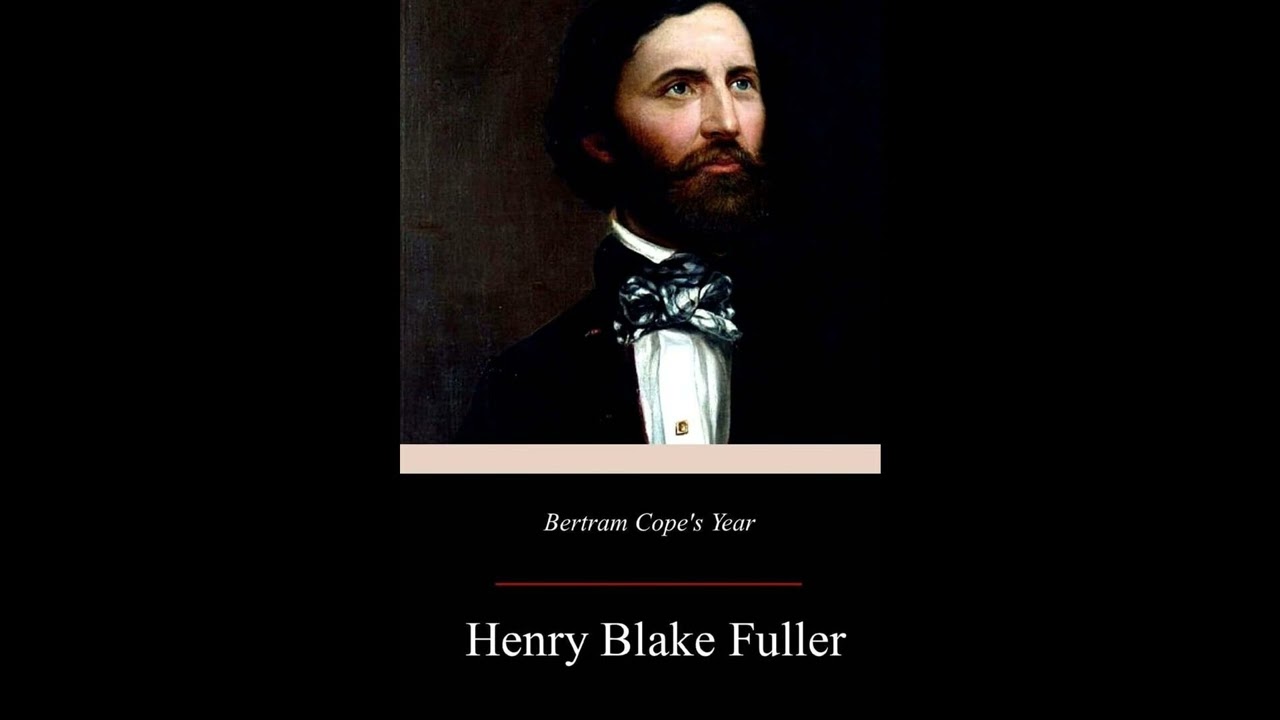
Bertram Cope's Year
Henry Blake Fuller’s Bertram Cope’s Year opens a window onto the social anxieties and hidden desires simmering beneath the surface of early 20th-century Chicago society. This quietly subversive novel, often overlooked, reveals its profundity through a meticulous observation of human nature, making it as resonant today as it was when first published. It’s a story about the stories we tell ourselves about others, a subtle study of projection, longing, and the profound disconnect between how we perceive someone and who they truly are. Listeners keen on character studies, psychological realism, and a nuanced critique of social ambition will find much to consider in its unhurried unfolding. The narrative centers on Bertram Cope, a young, strikingly handsome, and somewhat enigmatic college instructor who arrives in Chicago and quickly becomes an object of intense interest, particularly to the women who populate the city’s intellectual and artistic circles. Fuller establishes the refined, yet somewhat brittle, atmosphere of the city’s upper-middle-class homes—places where cultural aspirations mingle with social maneuvering. From the moment Cope takes lodging with Mrs. Graves, a gracious widow who prides herself on her cultured sensibilities, his presence acts as a catalyst, stirring the desires and imaginations of those around him. Among those drawn into Cope’s orbit are Mrs. Graves’s vivacious niece, Anne; the ambitious and intellectually curious Medora, a family friend; and a host of other figures, each projecting their own hopes, romantic ideals, or social ambitions onto the seemingly unassuming newcomer. Cope himself remains largely an opaque figure, never fully revealing his inner world. He is courteous, attentive, and possesses an undeniable charm, yet his responses often seem to lack genuine depth, leaving others to fill in the blanks with their own interpretations. The central conflict thus becomes less about what Cope does, and more about the ripple effect of his presence on the expectations and eventual disillusionment of those who yearn for his attention or affection. The story follows the course of a year, tracing the slow, often painful, realization among his admirers that the man they have idealized might be nothing more than an elegant, agreeable facade, perhaps even emotionally vacant. Henry Blake Fuller (1857-1929) was a quintessential Chicago author, though one whose literary vision often transcended the local color genre with which he was sometimes associated. Born into a prominent family, he spent the bulk of his life in his native city, becoming a central figure in its burgeoning literary and artistic scene, particularly in the decades surrounding the turn of the 20th century. Fuller was a man of independent means, which afforded him the freedom to travel extensively in Europe, experiences that profoundly shaped his early aesthetic works like The Chevalier of Pensieri-Vani (1890), a European romance that marked his literary debut. His career, however, saw a significant shift towards American realism with novels such as The Cliff-Dwellers (1893) and With the Procession (1895), which sharply satirized Chicago’s commercialism and its striving society. Fuller’s writing was characterized by its elegant prose, keen psychological insight, and a detached, often ironic, observational style. Though he experienced periods of critical acclaim, he remained somewhat apart from mainstream literary trends, cultivating a reputation as a sophisticated stylist and a trenchant social critic. His later works, including Bertram Cope’s Year, continued to demonstrate his quiet radicalism, often subtly challenging societal norms and exploring complex human psychology with a rare delicacy. One of the predominant themes in Bertram Cope’s Year is the nature of perception and projection. Bertram Cope functions as a kind of mirror or a blank canvas, onto which characters like Mrs. Graves and Anne paint their own idealized versions of a companion or a lover. For Mrs. Graves, Cope embodies the refined artistic sensibility she craves in her domestic life, a partner for her intellectual pursuits. She imagines him a cultivated soul, even reading more into his polite silence than is truly there. Anne, younger and more impetuous, sees him as the object of romantic love, attributing to him a depth of feeling and an intent that Cope demonstrably does not possess, leading her to misinterpret his gentle manners as genuine affection. Another significant theme is social ambition and the subtle power dynamics within a cultured urban milieu. The characters in Fuller’s Chicago are deeply conscious of status, reputation, and the delicate dance of social interaction. The various hostesses compete for interesting guests, and connections are made and broken based on perceived intellectual or social currency. The novel shows how even a seemingly innocuous figure like Cope can become a focal point for these aspirations, his perceived status elevating those who are seen to be close to him. This environment creates a hothouse atmosphere where genuine emotion is often subordinated to the maintenance of appearances, and where disappointment is an almost inevitable outcome for those who invest too much in the fleeting currents of social opinion. The novel appeared at a time of profound transformation in America. The early 20th century saw the nation grappling with the rapid growth of its cities, the complexities of industrialization, and the burgeoning of a distinct American cultural identity. Chicago, in particular, was evolving from a raw frontier town into a major metropolitan center, a hub of commerce and, increasingly, of arts and letters. Fuller, as a native Chicagoan who observed this evolution firsthand, captured the nuances of a society that was both proud of its progress and insecure about its cultural standing compared to European centers. His critique of Chicago’s material focus and its social striving was part of a larger literary movement toward realism, aiming to depict American life with unvarnished honesty rather than romantic idealization. The subtle psychological focus of Bertram Cope’s Year also foreshadowed later modernist concerns, showing a writer acutely aware of the inner lives of his characters, even when those characters themselves remain frustratingly opaque. Listening to Bertram Cope’s Year as an audiobook allows the subtle nuances of Fuller’s prose and the delicate unraveling of his characters’ expectations to truly come to life. A skilled narrator can bring out the quiet irony, the unspoken tensions, and the often-poignant undercurrents of longing and disappointment that saturate the story. The pacing of the novel is deliberate, reflecting the slow burn of growing realization among the characters, and a narrator adept at holding that rhythm can enhance the listener’s experience of gradual psychological disclosure. Pay close attention to the dialogue—often polite and restrained, yet laden with subtext and revealing more through what is left unsaid. The duration of several hours makes this a perfect companion for thoughtful listening, allowing time to sink into the turn-of-the-century atmosphere and appreciate Fuller’s meticulous craft in constructing a world where perception is often a fragile, self-made construct.
Enjoyed Bertram Cope's Year? A few ways to support us
Audible & Amazon links are affiliate; we may earn a small commission at no extra cost.
About this production
Human narration by a volunteer reader from LibriVox.org, the public-domain audiobook project. LibriVox volunteers record literary works whose copyright has expired in the United States, releasing the resulting recordings into the public domain.
Bertram Cope's Year by Henry Blake Fuller. The underlying text is in the U.S. public domain. We do not republish any modern copyrighted edition, translation, or commentary.
The 4K cinematic visuals accompanying this audiobook are generated by an AI image model from prompts derived from the source text. No copyrighted photos, paintings, or stock footage are used. AI generation is disclosed on every video on our YouTube channel as required by YouTube's altered/synthetic content policy.
English subtitles are transcribed from the LibriVox recording with OpenAI Whisper. Translations into the 11 other supported languages are produced by Meta's NLLB-200 neural translation model. No human translator's copyrighted translation is used.
Questions about sourcing or rights? See our DMCA & Sourcing policy or contact us.
Enjoyed this audiobook?
If you'd like to own a copy of Bertram Cope's Year or hear a professionally produced edition, the links below help support free audiobook production at no extra cost to you.
As an Amazon Associate we earn from qualifying purchases. Audible / print links are affiliate.