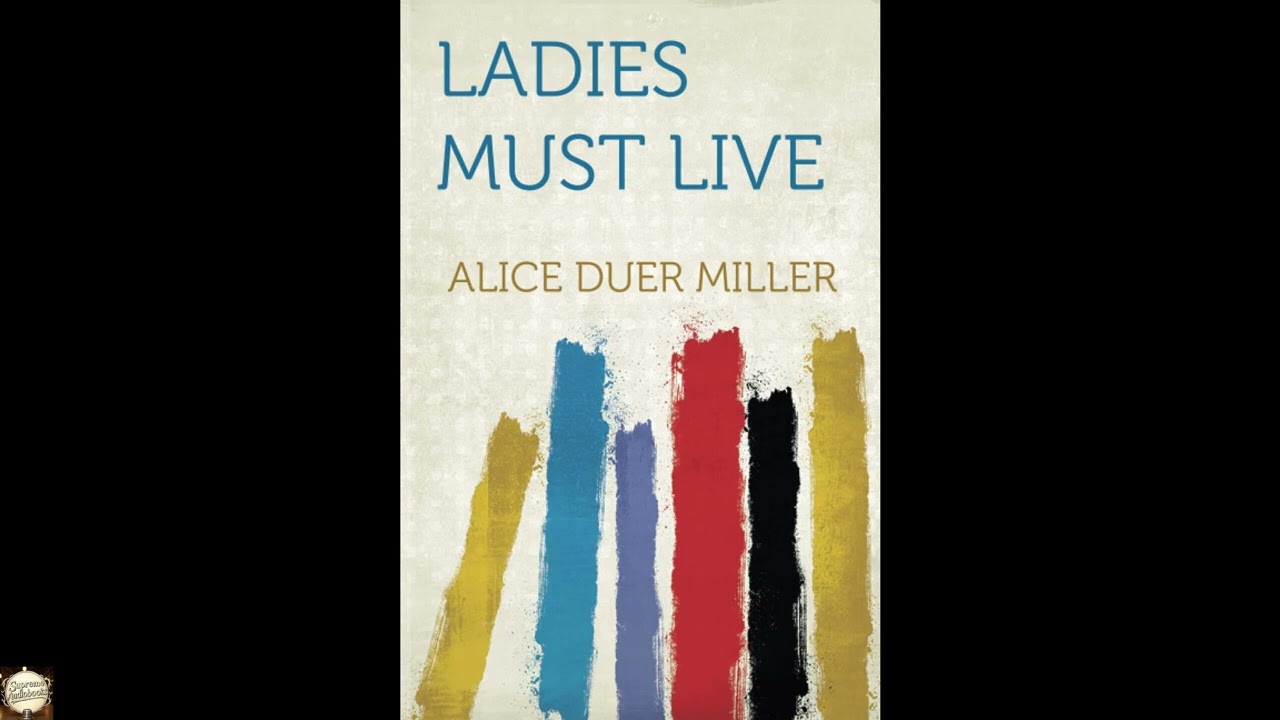
Ladies Must Live
The provocative title, Ladies Must Live, an early 20th-century novel by the sharp-witted Alice Duer Miller, announces its subject with an almost bracing directness. Far from being a mere relic of its time, this remarkable work resonates profoundly even a century later, offering a keen-eyed look at the fundamental questions women face about independence, marriage, and the societal pressures that shape their destinies. It asks, with a knowing wink and a serious underlying current, what exactly a woman must do to not just survive, but truly thrive, in a world that often seeks to define her. This is not a quaint period piece but a vibrant social commentary, as relevant today in its observations on self-determination and the compromises inherent in love and status as it was upon its original publication. Set against the glittering backdrop of New York City's high society just before the tumultuous changes of the First World War, Ladies Must Live introduces us to Anne Harmon, a woman of means, intelligence, and an independent spirit that quietly chafes against the rigid expectations of her social circle. Anne, though well-positioned, finds herself at a crossroads. She is desired by several eligible bachelors, each representing a different pathway—some offering security and status, others a more unconventional form of companionship, and still others a challenge to her very notion of self. Her world is one of elegant drawing rooms, whispered gossip, and the unspoken rules of etiquette that dictate everything from dress to marriage proposals. The central conflict arises from Anne's reluctance to simply fall into the role prescribed for her. She grapples with the prevailing wisdom that a woman’s ultimate purpose is to secure a respectable and advantageous marriage. Miller skillfully portrays Anne’s internal struggle, balancing her genuine desire for love and partnership with an equally strong yearning for personal autonomy and a life defined on her own terms. The story follows Anne as she navigates these complex romantic entanglements and social machinations, experiencing moments of doubt, defiance, and a growing understanding of the subtle power dynamics at play in her relationships and within her community. We observe her interactions with a cast of memorable secondary characters who embody various societal ideals and foibles, all serving to highlight Anne's unique position. Alice Duer Miller, born in New York City in 1874, was a woman whose life and career mirrored many of the evolving ideals of her era. A graduate of Vassar College, then a leading institution for women's education, she married Henry Wise Miller in 1899. Her literary career blossomed in the early decades of the 20th century, placing her firmly within the "New Woman" movement which championed women’s increased social, economic, and political independence. Miller was a vocal advocate for women's suffrage, actively participating in campaigns that ultimately led to the 19th Amendment. Her progressive views were often woven into the fabric of her popular fiction, allowing her to reach a wide audience with her insightful social commentary. Miller was a prolific writer, penning numerous novels, short stories, and poetry. Many of her works found their way to the silver screen, demonstrating her popularity and the broad appeal of her narratives. For example, her novel Come Out of the Kitchen! was adapted into a successful film starring Rudolph Valentino, and Manslaughter became a major Cecil B. DeMille production. Perhaps her most enduring legacy outside of her social novels is the patriotic poem The White Cliffs, which captured the hearts of millions during World War II and was also adapted into a film. Miller's ability to blend entertainment with shrewd observation secured her a significant place in American letters, bridging the gap between more traditional Victorian storytelling and the burgeoning modern novel. She passed away in 1942, leaving behind a body of work that continues to illuminate the complexities of the human condition and, particularly, the female experience. At its core, Ladies Must Live serves as a piercing examination of women’s independence and autonomy versus the stifling expectations of society. Anne Harmon's internal monologues and her forthright responses to her suitors illustrate the intense pressure on women to define themselves through marriage rather than self-fulfillment. For instance, her refusal to accept a proposal based solely on financial security, even when it would resolve many of her social dilemmas, underscores her commitment to a more authentic existence. The novel further critiques marriage as an economic and social institution, rather than solely a partnership of love. Characters openly discuss the advantages of marrying into wealth or status, treating the act as a calculated strategy for survival or upward mobility, a harsh reality Miller presents with both wit and empathy. Another key theme is the emergence of the "New Woman" ideal, a concept that Anne herself, with her education and independent thought, embodies. She grapples with the freedoms and constraints this emerging identity brings, contrasting her own desires with the more traditional lives of women around her. The narrative also functions as a sharp social satire, lampooning the superficiality and hypocrisy of New York high society. Through clever dialogue and pointed observations, Miller exposes the often absurd rituals, the unspoken rules, and the class distinctions that govern her characters’ lives, often drawing a laugh even as she highlights deeper truths about human nature and societal structures. The era in which Ladies Must Live was conceived and published, 1917, was a fascinating and transformative period in American history. Though the United States had not yet fully entered World War I, the winds of change were blowing across the globe, and at home, the Progressive Era was in full swing. This period saw significant social reform movements, and none was more prominent or impactful for women than the suffrage movement, which was nearing its successful conclusion. Public discourse was heavily engaged with the "woman question"—debates about women's roles in public life, their access to education, their economic independence, and their right to vote. Miller’s novel, therefore, emerged at a critical juncture, providing a fictional platform for these very real, pressing discussions. It captured the zeitgeist, reflecting the anxieties and aspirations of women who were pushing against established norms. The novel gave voice to the individual experience within these larger societal shifts, exploring how these seismic changes manifested in the daily lives and personal choices of women in privileged positions. It was a time when authors like Miller could both entertain and educate, using the popularity of fiction to engage with profound cultural and political transformations. To experience Ladies Must Live as an audiobook is to immerse oneself in a world brought vividly to life through sound. A skilled narrator breathes nuance into Alice Duer Miller's famously sharp dialogue and subtle social commentary, allowing the listener to catch every ironic inflection and heartfelt plea. Over its several hours of listening, the story unfolds at a measured pace, perfectly suited for thoughtful engagement during a daily commute, a relaxing afternoon, or as companionship during chores. The unique atmosphere of early 20th-century New York high society—its elegant drawing rooms, its hushed conversations, and its undercurrents of wit and judgment—is enhanced by the spoken word, painting a rich picture for the imagination. Listen for the precise phrasing that exposes societal absurdities, the quiet moments of Anne’s introspection, and the distinct voices that differentiate her many suitors, each contributing to a truly engaging and memorable auditory experience.
Enjoyed Ladies Must Live? A few ways to support us
Audible & Amazon links are affiliate; we may earn a small commission at no extra cost.
About this production
Human narration by a volunteer reader from LibriVox.org, the public-domain audiobook project. LibriVox volunteers record literary works whose copyright has expired in the United States, releasing the resulting recordings into the public domain.
Ladies Must Live by Alice Duer Miller. The underlying text is in the U.S. public domain. We do not republish any modern copyrighted edition, translation, or commentary.
The 4K cinematic visuals accompanying this audiobook are generated by an AI image model from prompts derived from the source text. No copyrighted photos, paintings, or stock footage are used. AI generation is disclosed on every video on our YouTube channel as required by YouTube's altered/synthetic content policy.
English subtitles are transcribed from the LibriVox recording with OpenAI Whisper. Translations into the 11 other supported languages are produced by Meta's NLLB-200 neural translation model. No human translator's copyrighted translation is used.
Questions about sourcing or rights? See our DMCA & Sourcing policy or contact us.
Enjoyed this audiobook?
If you'd like to own a copy of Ladies Must Live or hear a professionally produced edition, the links below help support free audiobook production at no extra cost to you.
As an Amazon Associate we earn from qualifying purchases. Audible / print links are affiliate.