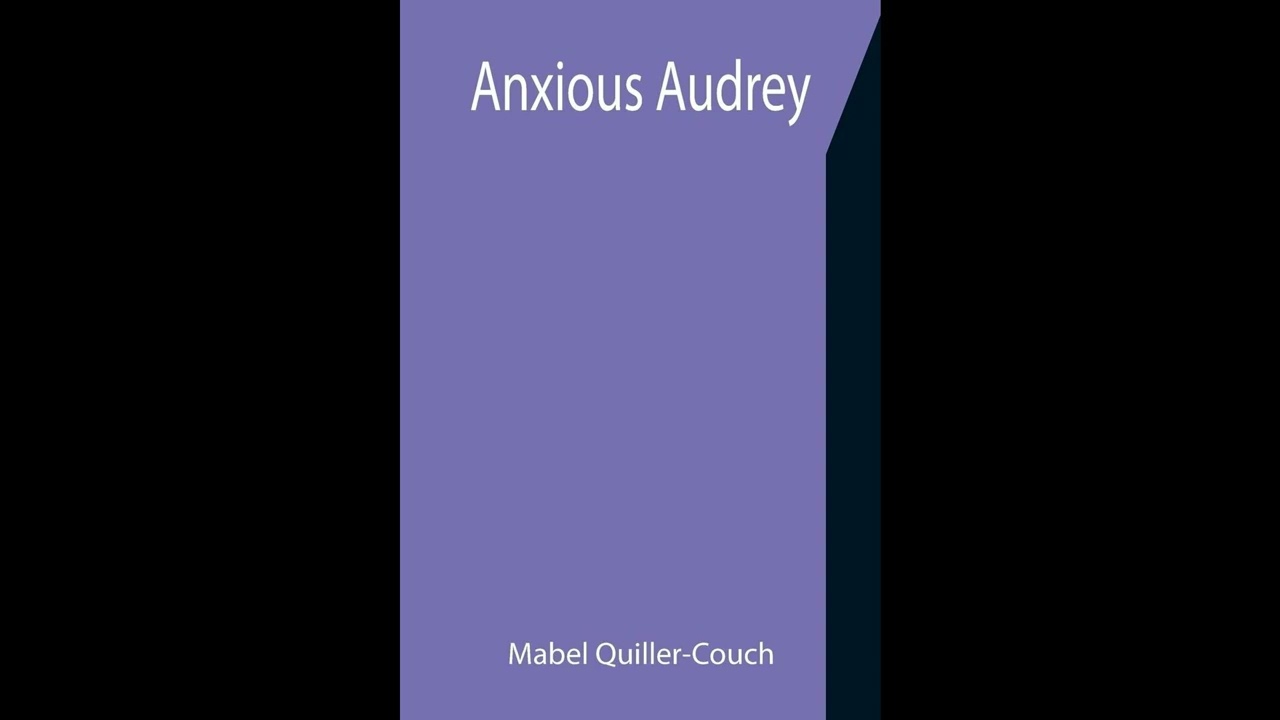
Anxious Audrey
"Anxious Audrey" offers a profound glimpse into the often-hidden struggles of the human spirit, a poignant character study that feels startlingly contemporary despite its historical setting. This is not merely a tale from another era; it is an intimate portrait of a young woman grappling with an inner disquiet that many listeners will recognize within themselves or their loved ones today. Mabel Quiller-Couch’s sensitivity in portraying Audrey’s internal world invites us to consider the silent battles fought every day, making this a story that resonates with empathy and understanding, asking us to look beyond outward appearances to the quiet anxieties that shape lives. It reminds us that the quest for self-acceptance and peace of mind is a constant human endeavor, regardless of the century. The story unfolds in the structured, polite society of an English provincial town during the late Victorian or early Edwardian period. Here we meet Audrey Penhaligon, a young woman whose delicate sensibilities are often mistaken for timidity or a lack of spirit by her well-meaning but unperceptive family. Audrey’s true struggle lies deeper: a persistent, unnamed anxiety that shadows her every thought and interaction, manifesting as a physical tremor in social settings, a racing heart during ordinary tasks, and a pervasive sense of dread that isolates her even in a crowded room. She longs for connection and a sense of belonging, but her fears often compel her to withdraw, creating a cycle of misunderstanding and self-reproach. The central conflict arises when Audrey’s family, eager to see her settled and socially adept, presses her into a series of engagements designed to "bring her out." An impending visit from a charming, but rather self-assured, cousin, and the prospect of a grand annual ball, become overwhelming mountains in Audrey’s private landscape of worry. The narrative gently traces Audrey's attempts to navigate these social labyrinths, her small acts of rebellion against her own fears, and her quiet observations of the world around her. She finds fleeting moments of solace in nature and in the occasional understanding glance from an unexpected quarter, hinting at a path toward self-discovery that is both challenging and ultimately affirming, without revealing the eventual outcome of her struggle. Mabel Quiller-Couch, the author, emerged as a notable voice in English literature during the late nineteenth and early twentieth centuries. Born into a family with a strong literary tradition—her cousin was the acclaimed Sir Arthur Quiller-Couch—Mabel inherited a keen eye for human nature and a gift for storytelling. Though not as widely recognized today as some of her contemporaries, her contributions to domestic fiction and children’s literature were significant in her time. She spent much of her life in Cornwall, a region whose landscapes and close-knit communities often subtly influenced the settings and character dynamics in her work, lending them an authentic sense of place and lived experience. Quiller-Couch was known for her sympathetic portrayal of characters, particularly women and children, often giving voice to those who might otherwise be overlooked or misunderstood within the societal confines of her era. Her bibliography includes titles like "A Household of Girls," which captured the lives and aspirations of young women, and "The Romance of the Cornish Coast," showcasing her regional affections. Her writing style, characterized by its clear prose and psychological insights, positions her as a quiet bridge between the more moralistic tones of high Victorianism and the burgeoning psychological realism that would define much of early twentieth-century literature. She excelled at depicting the intricacies of family life and the internal lives of her characters, making her work ripe for re-evaluation. "Anxious Audrey" skillfully addresses several enduring themes, beginning most prominently with the nature of anxiety and the often-unseen battles of inner life. The text vividly portrays Audrey’s internal monologue, allowing us to witness the spiraling thoughts and physical sensations that accompany her dread, such as when she describes the simple act of entering a drawing-room as feeling like a battlefield. This internal depiction highlights the profound disconnect between how Audrey feels and how society perceives her, challenging the era’s often simplistic views of mental distress. Another significant theme is the weight of societal expectations, particularly on women, and the pressure to conform. Audrey’s family, while loving, inadvertently exacerbates her anxiety by pushing her towards conventional social graces and a 'respectable' marriage, rather than truly understanding her unique temperament. For instance, her mother’s constant urging for Audrey to simply “be cheerful” demonstrates the prevailing belief that such feelings could be willed away. The narrative also thoughtfully considers the theme of quiet courage and self-acceptance, demonstrating that bravery isn't always about grand heroic gestures. Audrey's courage is found in small, daily acts: choosing to attend an event despite her fear, offering a genuine opinion, or simply enduring a difficult conversation. Her path is not one of dramatic transformation, but of gradual, hard-won self-compassion and the subtle assertion of her authentic self, offering a nuanced perspective on strength. The emergence of "Anxious Audrey" is best understood within the historical and cultural currents of the late nineteenth and early twentieth centuries. This period, often called the fin de siècle and early Edwardian era, was a time of immense social change and intellectual ferment. Scientifically, fields like psychology were beginning to gain traction, though public understanding of mental health remained rudimentary, often clouded by moral judgments or simplistic diagnoses like "neurasthenia," particularly for women. Socially, while the traditional roles for women were still deeply entrenched, there was a growing undercurrent of questioning, with discussions around women's suffrage and greater personal autonomy gaining momentum. Literarily, the novel reflects a shift from the overt didacticism of earlier Victorian fiction toward a more subtle psychological realism. Authors were increasingly interested in the inner lives of their characters, the nuances of their emotions, and the impact of societal pressures on individual psyches. "Anxious Audrey" fits into this evolving landscape by giving a serious, empathetic voice to an experience that might have previously been dismissed or caricatured. It speaks to a growing awareness that individual suffering was often tied to unexamined societal norms and the absence of a language to articulate complex internal states. The work arises from a moment when literature began to gently push the boundaries of what was considered a suitable subject for serious contemplation, moving beyond purely external events to the landscape of the mind. Listening to "Anxious Audrey" as an audiobook offers a singular opportunity to fully immerse oneself in the delicate emotional landscape of the story. The skill of the narrator becomes paramount here, as they are tasked with conveying not just the spoken dialogue, but the unspoken anxieties that constantly swirl within Audrey. A talented reader can use subtle shifts in vocal tone, pacing, and inflection to differentiate between Audrey's outward composure and her internal turmoil, allowing listeners to truly feel the weight of her struggles. The run length provides ample time to settle into the period atmosphere, giving space for the nuances of character and setting to unfold. Listen for the way the narrator uses pauses and variations in tempo to emphasize Audrey's moments of introspection, or the tension in a social interaction. The distinct voices given to supporting characters will bring the provincial town and its inhabitants vividly to life, creating an atmospheric experience that is both intellectually stimulating and deeply moving.
Enjoyed Anxious Audrey? A few ways to support us
Audible & Amazon links are affiliate; we may earn a small commission at no extra cost.
About this production
Human narration by a volunteer reader from LibriVox.org, the public-domain audiobook project. LibriVox volunteers record literary works whose copyright has expired in the United States, releasing the resulting recordings into the public domain.
Anxious Audrey by Mabel Quiller-Couch. The underlying text is in the U.S. public domain. We do not republish any modern copyrighted edition, translation, or commentary.
The 4K cinematic visuals accompanying this audiobook are generated by an AI image model from prompts derived from the source text. No copyrighted photos, paintings, or stock footage are used. AI generation is disclosed on every video on our YouTube channel as required by YouTube's altered/synthetic content policy.
English subtitles are transcribed from the LibriVox recording with OpenAI Whisper. Translations into the 11 other supported languages are produced by Meta's NLLB-200 neural translation model. No human translator's copyrighted translation is used.
Questions about sourcing or rights? See our DMCA & Sourcing policy or contact us.
Enjoyed this audiobook?
If you'd like to own a copy of Anxious Audrey or hear a professionally produced edition, the links below help support free audiobook production at no extra cost to you.
As an Amazon Associate we earn from qualifying purchases. Audible / print links are affiliate.