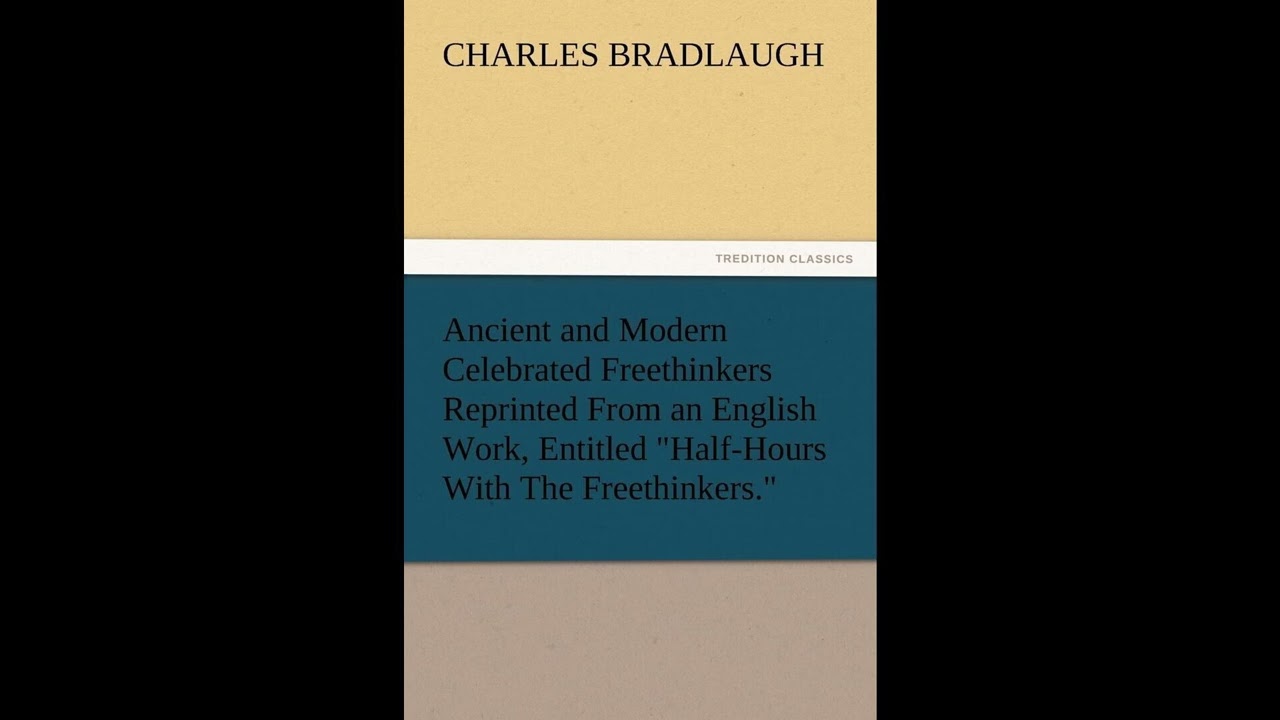
Ancient and Modern Celebrated Freethinkers Reprinted From an English Work, Entitled
What does it mean to think freely? What happens when an individual dares to question the established norms of their time, whether those norms are religious dogmas, scientific orthodoxies, or political conventions? This profound question lies at the heart of Ancient and Modern Celebrated Freethinkers, a compelling anthology that stands as a testament to the enduring human spirit of inquiry and dissent. Far from a dry historical chronicle, this work presents a vibrant panorama of intellectual courage, tracing the lineage of those who, across centuries and cultures, prioritized reason and evidence over blind faith and tradition. It is a book for anyone who believes that challenging the status quo is not just an act of defiance, but a necessary engine of human progress, offering a powerful reminder that the path to knowledge is often paved by those willing to walk it alone. This singular collection unfolds as a series of biographical sketches, each presenting a life dedicated to intellectual independence. Rather than a singular narrative, the listener encounters a succession of distinct voices and perspectives, spanning the classical world to more recent eras. The "story" here is the grand sweep of human thought, framed through the lives of individuals who often paid a high price for their convictions. We meet philosophers, scientists, reformers, and social critics—figures who challenged prevailing beliefs about the divine, the natural world, and the organization of society. Each profile functions as a miniature drama, illustrating the specific societal pressures and intellectual landscapes that confronted these thinkers. The collection implicitly posits a central conflict: the eternal struggle between individual liberty of thought and the powerful forces of conformity, whether those forces are state-sponsored religion, social custom, or academic dogma. The arc of the collection is not one of a fictional hero’s quest, but a historical progression, moving from the earliest proponents of rationalism and skepticism to those who spearheaded more modern movements for intellectual and social emancipation. While the specifics of each profile vary, a common thread emerges: the willingness to question received wisdom, to demand evidence, and to articulate an alternative vision, often in the face of significant personal risk. The book paints a picture of a continuous intellectual tradition, demonstrating that the impulse to think independently is not a fleeting phenomenon but a fundamental aspect of the human condition, passed down and reinterpreted through generations. The culmination of these individual stories is a collective narrative that underscores the persistent tension between belief and reason, and the often solitary pursuit of truth. The original compiler or author of Ancient and Modern Celebrated Freethinkers remains unknown, a circumstance that lends a certain universality to the work itself. Like many important classical texts that have come to us through various hands, the true "authorship" lies more in the act of selection, presentation, and popularization. This volume is explicitly described as "Reprinted From an English Work, Entitled," suggesting it was already a significant compilation in its original form, deserving a wider audience. The act of reprinting such a work speaks volumes about the intellectual climate into which it was released, indicating a desire to propagate these ideas and celebrate these figures at a particular historical moment. It suggests a movement or intellectual circle that valued this lineage of independent thought, and sought to make it accessible to a broader readership, solidifying its place as a cornerstone text for those interested in the history of rationalism and secularism. The anonymous nature underscores that the ideas themselves, and the courage of the individuals profiled, transcend any single voice or personal agenda. The primary themes that resonate throughout this collection include the fundamental conflict between faith and reason, the concept of intellectual courage, and the evolution of human knowledge. The book repeatedly illustrates, for instance, how ancient philosophers like Epicurus or Lucretius dared to propose materialist cosmologies that eschewed divine intervention, risking societal censure by questioning the gods and myths of their time. Their lives, as presented in these pages, exemplify the bravery required to articulate a worldview grounded in observation rather than superstition. Another profound theme is the personal cost of independent thought. The collection will undoubtedly feature individuals who faced exile, imprisonment, or social ostracization for their beliefs, such as Giordano Bruno’s execution for heresy or Baruch Spinoza’s excommunication for his pantheistic philosophy. These stories provide concrete examples of the immense pressure to conform and the fortitude required to resist. Furthermore, the work highlights the ongoing process of intellectual liberation. It shows how the groundwork laid by early skeptics paved the way for later scientific revolutionaries and Enlightenment thinkers. For example, the arguments of an ancient Greek philosopher who challenged supernatural explanations can be seen as an intellectual precursor to the methodologies adopted by early modern scientists who insisted on empirical evidence. This demonstrates not just a succession of individuals, but a cumulative tradition of critical inquiry, where each generation builds upon—or critically re-evaluates—the ideas of its predecessors. The book thereby chronicles the slow, often painstaking progress of reason as it gradually chipped away at ignorance and dogma, fostering a more nuanced understanding of the world and humanity's place within it. This collection emerged and gained prominence during a period of significant intellectual and social ferment, likely the late 19th or early 20th century, when challenges to established religious and social authorities were becoming increasingly widespread. The scientific advancements of the era, particularly Darwin's theory of evolution, profoundly shook traditional religious narratives, leading to a surge of interest in alternative philosophies and secular thought. This was a time when various secularist, rationalist, and freethought movements were gaining momentum, advocating for reason, scientific inquiry, and individual liberty against what they perceived as the stifling influence of organized religion. Reprints of works celebrating historical freethinkers served as intellectual ammunition and inspirational texts for these movements, providing a lineage of respected figures who had similarly questioned societal norms and religious dogma. The widespread literacy and the growth of publishing at this time meant that such anthologies could reach a broader audience, fostering public debate and solidifying a collective identity among those who championed independent thought. Politically, the era also saw debates around church and state separation, education reform, and social justice, all of which benefited from an intellectual framework that prioritized human reason and ethical considerations over divine command. Thus, the reprinting and popularization of Ancient and Modern Celebrated Freethinkers was not merely an academic exercise, but a significant cultural event, reflecting and shaping the intellectual currents of its time by offering a historical defense and celebration of non-conformist thinking. Listening to Ancient and Modern Celebrated Freethinkers as an audiobook offers a uniquely direct and intimate way to engage with these powerful ideas and influential lives. The narration experience transforms what might otherwise be a dense historical text into a series of engaging intellectual encounters. A skilled narrator can bring clarity and appropriate weight to the varied arguments and biographical details, ensuring that the listener remains intellectually engaged without feeling overwhelmed by the breadth of the material. Over several hours of listening, the consistent voice can help to stitch together the disparate lives into a cohesive narrative of intellectual pursuit. Pay attention to how the narrator articulates the philosophical distinctions and the emotional resonance of each thinker's struggle, allowing the inherent drama of these intellectual battles to come alive. This format provides an ideal companion for focused study, quiet reflection, or even as a backdrop for daily tasks, allowing the profound questions posed by these historical figures to permeate and challenge one's own worldview at a measured, contemplative pace.
Enjoyed Ancient and Modern Celebrated Freethinkers Reprinted From an English Work, Entitled? A few ways to support us
Audible & Amazon links are affiliate; we may earn a small commission at no extra cost.
About this production
Human narration by a volunteer reader from LibriVox.org, the public-domain audiobook project. LibriVox volunteers record literary works whose copyright has expired in the United States, releasing the resulting recordings into the public domain.
Ancient and Modern Celebrated Freethinkers Reprinted From an English Work, Entitled by Charles Bradlaugh. The underlying text is in the U.S. public domain. We do not republish any modern copyrighted edition, translation, or commentary.
The 4K cinematic visuals accompanying this audiobook are generated by an AI image model from prompts derived from the source text. No copyrighted photos, paintings, or stock footage are used. AI generation is disclosed on every video on our YouTube channel as required by YouTube's altered/synthetic content policy.
English subtitles are transcribed from the LibriVox recording with OpenAI Whisper. Translations into the 11 other supported languages are produced by Meta's NLLB-200 neural translation model. No human translator's copyrighted translation is used.
Questions about sourcing or rights? See our DMCA & Sourcing policy or contact us.
Enjoyed this audiobook?
If you'd like to own a copy of Ancient and Modern Celebrated Freethinkers Reprinted From an English Work, Entitled or hear a professionally produced edition, the links below help support free audiobook production at no extra cost to you.
As an Amazon Associate we earn from qualifying purchases. Audible / print links are affiliate.