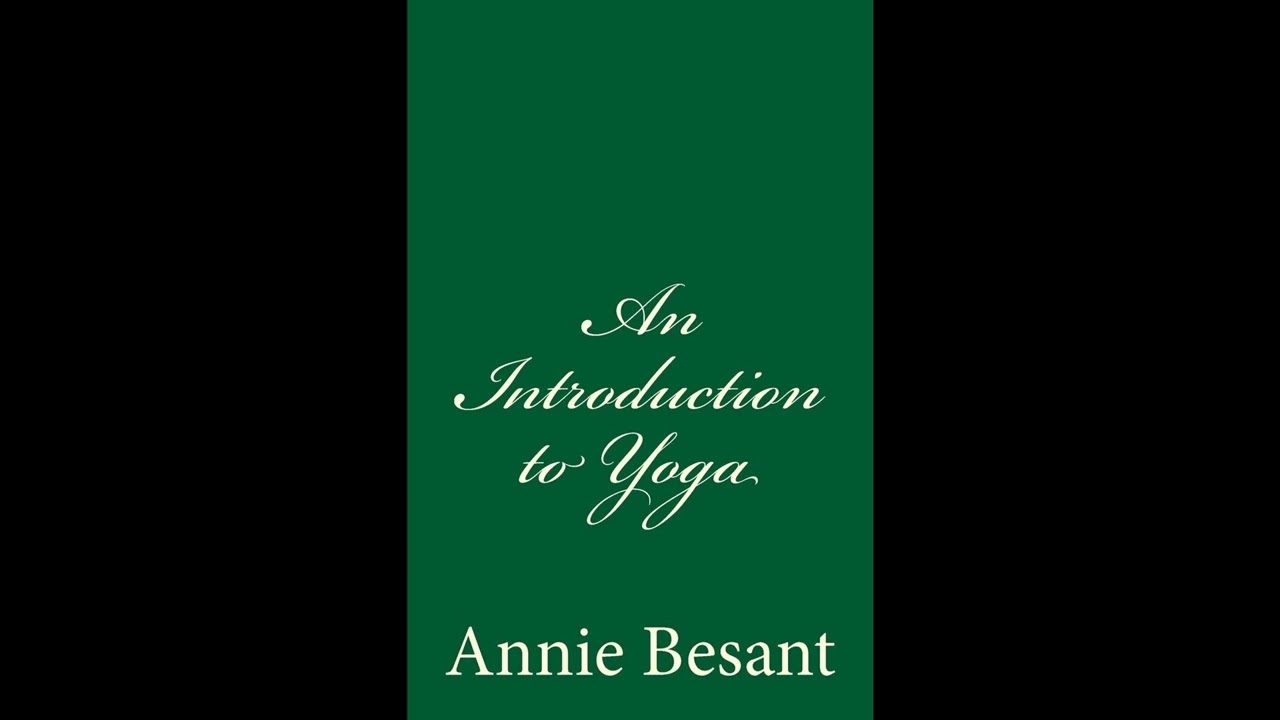
An Introduction to Yoga By Annie Besant
For those drawn to the ancient wisdom of Yoga, yet perhaps accustomed to its modern, often physical interpretations, Annie Besant’s "An Introduction to Yoga" offers a profound and necessary reorientation. This foundational text, penned by one of the most remarkable spiritual intellects of the early twentieth century, strips away superficial understandings to reveal Yoga in its original, potent form: a systematic path to spiritual realization and union with the divine. It stands as a beacon for anyone seeking to understand the deeper philosophical underpinnings and practical methods that transcend mere physical exercise, presenting a coherent framework for inner transformation that remains as relevant and powerful today as it was when first conceived. Besant’s exposition unfolds within the philosophical landscape where Eastern mysticism encountered Western inquiry, establishing itself as a rigorous guide for the earnest seeker. The work begins by meticulously defining Yoga itself, moving beyond a simple set of postures to articulate its true essence as "union"—the merging of the individual consciousness with the universal Spirit. She delineates the various branches of Yoga, such as Karma Yoga (the path of selfless action), Bhakti Yoga (the path of devotion), and Jnana Yoga (the path of knowledge), though her primary focus, reflecting her own Theosophical leaning, centers on Raja Yoga, the royal path of mental discipline and meditation. The central conflict, if one can call it that in a work of instruction, is the human mind's inherent tendency towards distraction and illusion, and the systematic method Yoga provides to overcome these obstacles to spiritual clarity. The author then guides the reader through the intricate anatomy of human consciousness, introducing concepts like the koshas, or sheaths of being, which veil the true Self, and the functions of the mind (Manas), intellect (Buddhi), and ego (Ahamkara). With precision and clarity, Besant elucidates the progressive stages of Raja Yoga, often drawing parallels with Patanjali’s Eight Limbs. These limbs – beginning with the ethical precepts of Yama (restraints) and Niyama (observances), moving through Asana (posture) and Pranayama (breath control), and culminating in the stages of inner withdrawal (Pratyahara), concentration (Dharana), meditation (Dhyana), and finally, union (Samadhi) – are presented not as isolated practices, but as an integrated, cumulative system designed to purify the entire being. The arc of the narrative builds steadily, promising not an immediate answer, but a disciplined method for achieving profound insight and ultimately, a state of spiritual liberation. Annie Besant herself was a figure of extraordinary intellect and fierce conviction, whose life spanned from 1847 to 1933. Born in London, her early life was marked by her passionate advocacy for social justice, women's rights, and workers' rights. She was a prominent socialist, freethinker, and Malthusian, famously campaigning for birth control alongside Charles Bradlaugh, facing public outcry and legal challenges for disseminating information on family planning. Her political activities led her to a close association with the Fabian Society, a prominent socialist organization. However, a transformative encounter with Helena Blavatsky, co-founder of the Theosophical Society, redirected her formidable energies from political reform to spiritual inquiry. Besant became a leading figure in the Theosophical movement, eventually succeeding Blavatsky as the international President of the Theosophical Society. This shift saw her relocate to India, where she immersed herself in Eastern philosophies and spiritual traditions. Her commitment to India extended beyond Theosophy; she became a vocal proponent of Indian Home Rule, establishing schools, including the Central Hindu College in Varanasi, and actively participating in the Indian independence movement. Her prolific output included numerous books and essays such as "Esoteric Christianity," "Thought Forms" (co-authored with C.W. Leadbeater), and countless lectures, establishing her as one of the most influential expositors of Eastern spiritual traditions to the Western world. She stood as a bridge between cultures, demonstrating how ancient wisdom could speak to the modern mind. "An Introduction to Yoga" enacts several profound themes. First is the theme of self-transformation, viewing Yoga not as a casual pursuit, but as a rigorous discipline aimed at the purification and elevation of consciousness. Besant articulates this through her detailed discussion of the Yamas and Niyamas, explaining how ethical conduct forms the indispensable foundation for any genuine spiritual progress, stating that without these moral underpinnings, the higher practices become hollow. Another core theme is universal spirituality, arguing that the truths revealed by Yoga are not exclusive to any single religion or culture but represent fundamental principles of existence found, in various guises, across all great spiritual traditions. She implicitly suggests that Yoga offers a scientific approach to spiritual realization, appealing to the rational minds of her time who might have been disillusioned by traditional dogma. A third prominent theme is mind control and concentration. Besant meticulously outlines the techniques of Dharana (concentration) and Dhyana (meditation), stressing that mastery over the mind's incessant fluctuations is the essential key to unlocking deeper states of awareness. She gives concrete advice on how to focus the scattered energies of thought, likening the undisciplined mind to a wild horse that must be trained. Finally, the work consistently points towards the ultimate goal of spiritual liberation or enlightenment, promising the possibility of transcending the limitations of the ego and experiencing union with the Absolute, a state of Samadhi where suffering ceases and pure consciousness prevails. The book’s lasting significance lies in its clear, systematic presentation of a complex subject, making the esoteric accessible and paving the way for Yoga’s widespread acceptance and practice in the West. The period in which "An Introduction to Yoga" emerged—the late nineteenth and early twentieth centuries—was a time of immense intellectual and cultural ferment. The British Empire maintained its powerful presence in India, facilitating a two-way exchange, however unequal, of ideas and practices. Western scholars and spiritual seekers were increasingly looking beyond the confines of orthodox Christianity and the burgeoning materialism of the scientific age, seeking alternative philosophical frameworks and spiritual experiences. The Theosophical Society, founded in 1875 by Blavatsky, Henry Steel Olcott, and William Quan Judge, became a major vehicle for introducing Eastern spiritual traditions—including Hinduism, Buddhism, and, crucially, Yoga—to a curious Western audience. This era also witnessed a growing interest in comparative religion and esotericism, offering fertile ground for Besant's synthesizing approach. Her work spoke directly to a generation yearning for meaning beyond the conventional, providing a structured, intellectual entry point into a spiritual practice previously shrouded in mystery for most Westerners. Listening to "An Introduction to Yoga" as an audiobook offers a particularly rewarding experience. The measured pace of a skilled narrator allows the listener to absorb Besant’s intricate philosophical arguments and practical instructions with greater depth and contemplation than a quick reading might permit. Over its several hours of runtime, the voice can provide a steady anchor, guiding one through concepts that require time to settle and resonate. Listen for the careful enunciation of Sanskrit terms, the calm authority in the tone as complex ideas are unpacked, and the deliberate pauses that invite reflection. This auditory presentation allows the listener to engage with the text not merely as information, but as a form of spoken meditation, encouraging a mindset conducive to understanding and integrating the profound teachings on inner discipline and spiritual evolution.
Enjoyed An Introduction to Yoga By Annie Besant? A few ways to support us
Audible & Amazon links are affiliate; we may earn a small commission at no extra cost.
About this production
Human narration by a volunteer reader from LibriVox.org, the public-domain audiobook project. LibriVox volunteers record literary works whose copyright has expired in the United States, releasing the resulting recordings into the public domain.
An Introduction to Yoga By Annie Besant by Annie Besant. The underlying text is in the U.S. public domain. We do not republish any modern copyrighted edition, translation, or commentary.
The 4K cinematic visuals accompanying this audiobook are generated by an AI image model from prompts derived from the source text. No copyrighted photos, paintings, or stock footage are used. AI generation is disclosed on every video on our YouTube channel as required by YouTube's altered/synthetic content policy.
English subtitles are transcribed from the LibriVox recording with OpenAI Whisper. Translations into the 11 other supported languages are produced by Meta's NLLB-200 neural translation model. No human translator's copyrighted translation is used.
Questions about sourcing or rights? See our DMCA & Sourcing policy or contact us.
Enjoyed this audiobook?
If you'd like to own a copy of An Introduction to Yoga By Annie Besant or hear a professionally produced edition, the links below help support free audiobook production at no extra cost to you.
As an Amazon Associate we earn from qualifying purchases. Audible / print links are affiliate.