An Essay on the Trial
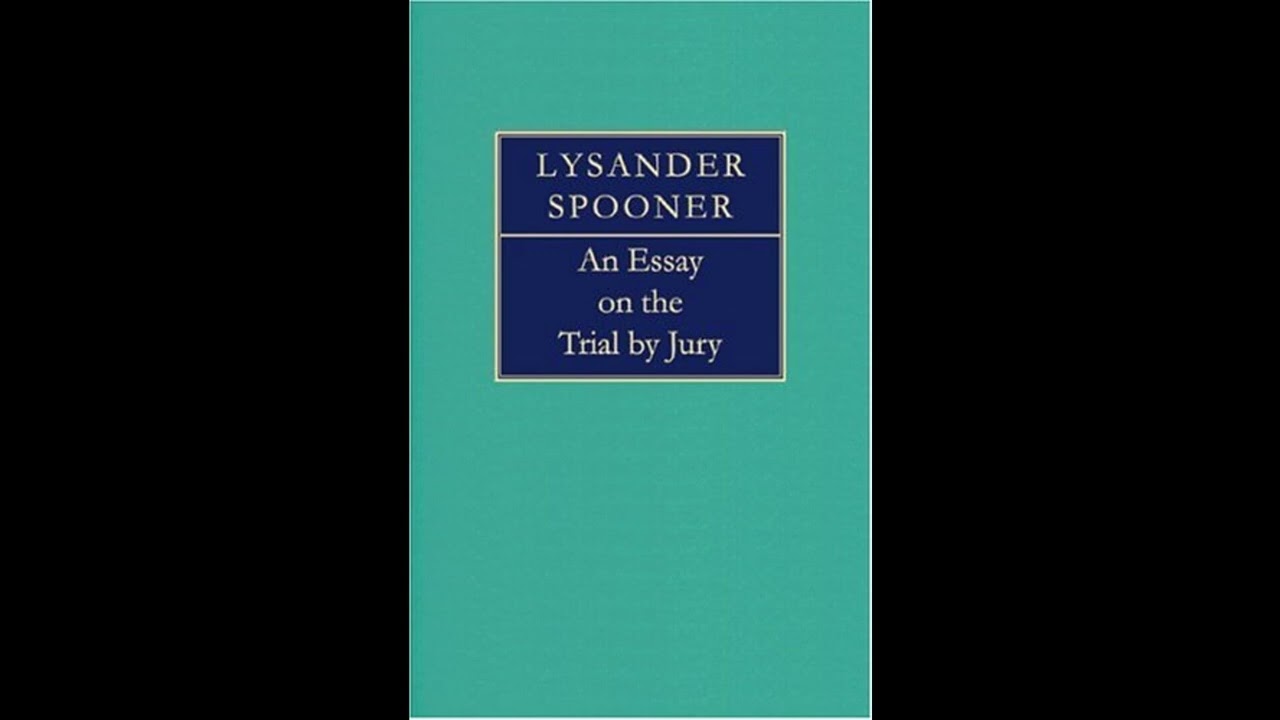
What does it mean to be truly free in a society governed by laws? How much power should the state wield over the individual, and what safeguards exist to protect the citizen from potential tyranny? These foundational questions reverberate through the pages of Lysander Spooner’s profound and still-provocative work, “An Essay on the Trial by Jury.” Far from a dry legal treatise, Spooner’s essay is a passionate and meticulously reasoned argument for the radical potential of the common law jury as the ultimate bastion of individual liberty. Listening to this essential text today offers a startling re-evaluation of our legal systems, inviting contemplation on the very nature of justice, the erosion of individual rights, and the checks and balances we often assume are inherent in democratic governance. It challenges modern assumptions about the law, showing us a vision of justice where the citizen, not the state, holds the final sway. Spooner’s intellectual journey within the essay begins by transporting the reader to the very foundations of the common law tradition, particularly as it evolved in England and was transplanted to America. He establishes the historical understanding of a trial by jury not merely as a process for determining facts, but as a mechanism through which ordinary citizens could judge the justice of the law itself, in addition to the guilt or innocence of the accused. The central "character" of this argument is the sovereign individual, endowed with natural rights, standing opposite the ever-expanding authority of the state. Spooner posits a foundational conflict: the inherent tension between a government’s desire to enforce its decrees and the individual’s right to resist laws deemed unjust or oppressive. As the argument unfolds, Spooner meticulously details how this original, robust power of the jury – the right to nullify laws that conflicted with natural justice or common sense – was gradually, systematically, and surreptitiously undermined. He presents a compelling case that judicial instructions, legislative enactments, and the very structure of legal education began to strip juries of their essential function, reducing them to mere automatons tasked only with verifying factual claims. The essay builds its case with historical examples and logical deductions, showing how what was once a powerful check on state power became, in his view, a tool for its enforcement. The arc of his argument is a call to restore the jury to its rightful place, empowering citizens to be the ultimate arbiters of justice and liberty, ensuring that no law, however enacted, could trample upon fundamental rights without popular consent. The author, Lysander Spooner (1808-1887), was a figure whose life exemplified the very principles of individual liberty and resistance to authority that he so eloquently championed. Born in Athol, Massachusetts, Spooner became a self-taught legal scholar, famously challenging the established legal profession by opening his own law office without a formal degree, arguing successfully that the state’s licensing requirements were a monopoly. His independent spirit led him to become a staunch abolitionist, publishing powerful critiques of slavery’s legality, most notably "The Unconstitutionality of Slavery," which argued that the U.S. Constitution, correctly interpreted, did not support the institution. Spooner’s commitment to individual freedom extended beyond the legal realm. He became a pioneering entrepreneur, founding the American Letter Mail Company in 1844, directly challenging the U.S. Post Office’s government monopoly by offering cheaper and more efficient mail service. Although eventually forced out of business by government action, his venture underscored his lifelong belief in free markets and voluntary association. Throughout his life, Spooner penned numerous influential pamphlets and books on law, economics, and political philosophy, firmly establishing himself as a prominent, though often iconoclastic, voice in the individualist anarchist tradition. His influence, while not always immediately apparent in mainstream political discourse, continued to resonate with those who valued radical self-ownership and skepticism toward state power. "An Essay on the Trial by Jury" enacts several profound themes that resonate with urgency even centuries after its initial publication. One central theme is individual sovereignty and the concept of natural rights. Spooner argues forcefully that the individual possesses inherent rights that precede and supersede any government decree. He illustrates this by showing how a jury, properly empowered, serves as the final barrier between a person and an unjust law, allowing them to judge the law’s legitimacy based on their own conscience and understanding of justice, not merely by its state-sanctioned existence. For instance, he refers to historical cases where juries acquitted individuals who broke what were perceived as oppressive or morally wrong laws, demonstrating the jury’s original function as a moral compass. Another significant theme is the danger of concentrated power and judicial usurpation. Spooner’s text meticulously documents how judges incrementally eroded the jury’s power, turning it from an active check on state authority into a passive instrument of the court. He shows, through historical analysis, how judges began to instruct juries that they must accept the law as laid down by the bench, thereby removing the jury’s right to judge the law itself. This gradual shift, for Spooner, represented a profound subversion of the original intent of trial by jury, transforming a shield for the citizen into a mere procedural step in the state’s machinery. To engage with a work of such intellectual density and historical reach as an audiobook offers a unique advantage. The sustained, precise articulation of Spooner's arguments becomes particularly compelling when delivered through a narrator's voice. Listeners can fully immerse themselves in the logical progression of his reasoning, allowing the sophisticated legal and philosophical concepts to unfold at a natural pace that supports deep understanding. The several hours of content encourage a focused, reflective engagement, whether during quiet contemplation or as a companion to daily routines. The clarity of the narration allows listeners to appreciate the nuance in Spooner's language and the force of his rhetorical construction, transforming what might otherwise be a challenging read into an accessible and thought-provoking experience, enhancing appreciation for this vital contribution to political thought. Spooner’s essay emerged in the crucible of mid-nineteenth century America, a period marked by intense debates over federal power, individual liberty, and the pressing issue of slavery. Published at a time when the Fugitive Slave Act of 1850 had recently inflamed passions across the nation, his arguments for the jury’s right to judge both the law and the facts took on profound relevance. Many abolitionists and ordinary citizens found themselves grappling with the moral imperative to resist laws they considered unjust, making Spooner’s articulation of jury nullification a powerful theoretical underpinning for civil disobedience. Culturally, the era was characterized by a robust tradition of individualistic thought and skepticism toward centralized authority, fueled by the legacies of the American Revolution and Enlightenment ideals. Spooner's writing stood firmly within this tradition, offering a radical defense of individual autonomy against what he perceived as increasing government encroachment. His ideas resonated with those who felt that the spirit of the Constitution—designed to limit government power—was being increasingly disregarded, making his essay not just a historical curiosity, but a potent commentary on the enduring struggle between the individual and the state.
Enjoyed An Essay on the Trial? A few ways to support us
Audible & Amazon links are affiliate; we may earn a small commission at no extra cost.
About this production
Human narration by a volunteer reader from LibriVox.org, the public-domain audiobook project. LibriVox volunteers record literary works whose copyright has expired in the United States, releasing the resulting recordings into the public domain.
An Essay on the Trial by Jury by Lysander Spooner. The underlying text is in the U.S. public domain. We do not republish any modern copyrighted edition, translation, or commentary.
The 4K cinematic visuals accompanying this audiobook are generated by an AI image model from prompts derived from the source text. No copyrighted photos, paintings, or stock footage are used. AI generation is disclosed on every video on our YouTube channel as required by YouTube's altered/synthetic content policy.
English subtitles are transcribed from the LibriVox recording with OpenAI Whisper. Translations into the 11 other supported languages are produced by Meta's NLLB-200 neural translation model. No human translator's copyrighted translation is used.
Questions about sourcing or rights? See our DMCA & Sourcing policy or contact us.
Enjoyed this audiobook?
If you'd like to own a copy of An Essay on the Trial or hear a professionally produced edition, the links below help support free audiobook production at no extra cost to you.
As an Amazon Associate we earn from qualifying purchases. Audible / print links are affiliate.