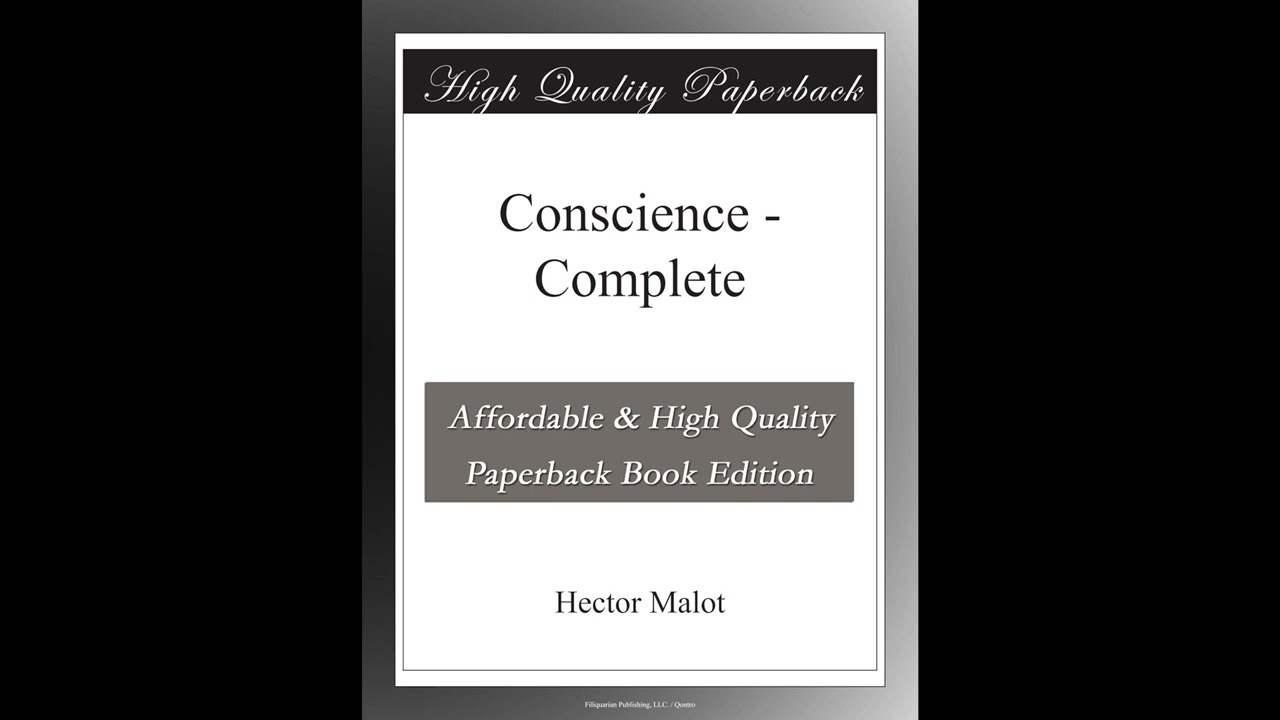
Conscience - Complet
Hector Malot’s Conscience - Complet plunges listeners into the profound depths of human morality, posing a timeless question: what happens when the inner judge becomes one’s harshest jailer? This gripping narrative, born from the fertile literary ground of late 19th-century France, is far more than a simple tale of crime and consequence. It is a meticulous study of the psychological torment that follows transgression, a testament to the inescapable power of guilt, and an exploration of how a single act can ripple through a lifetime, affecting not just the individual but all who surround them. For anyone who has ever pondered the true cost of a secret or the relentless pursuit of inner peace, Malot’s work resonates with an unnerving clarity, reminding us that some burdens cannot simply be shed, no matter how carefully one tries to hide them from the world. The story unfolds within the ostensibly respectable circles of Parisian society, introducing us to an individual who, driven by circumstance and perhaps a moment of desperation, commits an act that deviates sharply from the moral code. We meet our central figure as they grapple with the immediate aftermath, not of legal detection, but of the internal upheaval that threatens to shatter their very existence. The setting moves between the bustling, anonymous streets of the capital and more intimate, secluded spaces, reflecting the protagonist’s desire to both vanish into the crowd and escape the confines of their own mind. Initially, there might be a fragile sense of relief, a belief that the misdeed has been successfully concealed, that the physical evidence has vanished, and that life can resume its normal course. However, Malot skillfully reveals that true escape is an illusion. The central conflict swiftly shifts from external threat to an agonizing internal battle. The protagonist's conscience, once perhaps a dormant whisper, begins to stir, growing louder with each passing day. It manifests in sleepless nights, in strained relationships, in the sudden, unsettling reappearance of details thought long forgotten. Every conversation becomes fraught with double meaning, every gaze a potential accusation. The narrative tracks this agonizing deterioration, showing how the weight of the secret distorts perceptions, poisons innocent interactions, and ultimately isolates the individual in a self-made prison of anxiety and fear. The dramatic arc focuses intently on this psychological erosion, examining the protagonist’s desperate attempts to rationalize, to suppress, or even to confess, all while the truth threatens to erupt from within. Hector Malot, born in La Bouille, France, in 1830, lived a life dedicated to observation and storytelling. Though he initially studied law, his true calling lay in literature and journalism, fields he pursued with remarkable vigor. His career as a novelist began in earnest in the 1850s, and he quickly established himself as a prolific and popular writer, known for his keen insight into human nature and his compassionate portrayal of the struggles faced by ordinary people. Malot’s works often depicted the social realities of 19th-century France, addressing themes of poverty, justice, and the resilience of the human spirit. He authored over 100 novels, but it was his ability to craft compelling narratives with a strong moral core that truly set him apart. Malot’s place in the literary canon is most prominently secured by his internationally acclaimed novel Sans Famille (Nobody’s Boy), published in 1878, which tells the heart-wrenching story of the orphan Remi and his travels across France. He followed this with En famille (Nobody’s Girl). While these child-centric tales are his most famous, Conscience showcases a different facet of his talent, moving from the broad canvas of societal injustice to the intense, localized struggle within an adult’s mind. Throughout his life, which concluded in 1907, Malot remained a consistent voice for humane values, blending realism with a hopeful outlook, often giving his characters the chance for redemption or a better future, even amidst hardship. Conscience - Complet illuminates several profound themes. Foremost among them is, of course, the theme of guilt and its devastating psychological impact. Malot demonstrates this through the protagonist’s inability to find peace, even in moments of apparent calm. A passing stranger, a casual remark, or even a particular scent might trigger a vivid flashback, forcing the character to relive the defining moment of their transgression. This constant internal replay serves as a relentless form of self-punishment, far more potent than any external judgment. Another significant theme is the illusion of escape. The novel shows how attempts to physically distance oneself from the scene of the action or to bury the past beneath new experiences are ultimately futile. For instance, the protagonist might relocate to a tranquil countryside retreat, only to find the quiet solitude amplifies the internal noise of their guilt, proving that there is no geographical cure for a tormented mind. The book also addresses moral responsibility and the often-blurred lines between right and wrong. While the central act might be definitively unethical, Malot invites us to consider the underlying motivations and the complex web of circumstances that led to it, prompting reflection on individual culpability versus situational pressures. This is further complicated by the protagonist's subsequent struggle with self-deception, where they construct elaborate mental narratives to justify their actions or minimize their severity. These internal dialogues, depicted through the character’s thoughts and reflections, reveal the human capacity for denial and the often-futile attempts to bargain with one’s own moral compass. Hector Malot wrote and published Conscience in 1888, during a period of considerable social and intellectual ferment in France. The Third Republic, established in 1870, was still solidifying its democratic institutions following the upheavals of the Second Empire and the Paris Commune. This era saw rapid industrialization, burgeoning scientific advancements, and a growing interest in psychology as a field of study. In literature, realism and naturalism were dominant forces, with authors like Émile Zola and Gustave Flaubert striving for an unflinching depiction of life as it truly was, often focusing on the struggles of the working class and the underbelly of society. Malot, while often sharing the realists' commitment to accurate portrayal, distinguished himself with a more accessible style and a strong, often humanitarian, ethical foundation. Conscience emerged from this environment of intellectual curiosity, reflecting a societal preoccupation with justice, individual liberty, and the internal mechanisms of the human mind, particularly when confronted with the consequences of its own choices. It also tapped into a wider public fascination with criminal psychology and moral dilemmas, providing a more introspective counterpoint to the sensationalist crime reporting of the day. Listening to Conscience - Complet as an audiobook offers a uniquely intimate and immersive experience. The length, spanning several hours, allows for a gradual unfolding of the psychological drama, giving the listener ample time to sink into the protagonist’s deepening internal struggle. A skilled narrator brings a crucial dimension to the text, transforming the written words into a living, breathing internal monologue. The narrator’s pacing can underscore the slow, creeping dread or the sudden, sharp pangs of memory that define the character’s torment. Listen for the subtle shifts in tone and inflection that convey the protagonist’s evolving mental state—the initial facade of composure, the growing anxiety, the desperate attempts at self-justification, and the eventual, perhaps inevitable, confrontation with truth. The spoken word enhances the atmosphere of quiet desperation and relentless introspection, making the listener a privileged witness to the profound and unsettling journey of a troubled mind.
Enjoyed Conscience - Complet? A few ways to support us
Audible & Amazon links are affiliate; we may earn a small commission at no extra cost.
About this production
Human narration by a volunteer reader from LibriVox.org, the public-domain audiobook project. LibriVox volunteers record literary works whose copyright has expired in the United States, releasing the resulting recordings into the public domain.
Conscience - Complet by Hector Malot. The underlying text is in the U.S. public domain. We do not republish any modern copyrighted edition, translation, or commentary.
The 4K cinematic visuals accompanying this audiobook are generated by an AI image model from prompts derived from the source text. No copyrighted photos, paintings, or stock footage are used. AI generation is disclosed on every video on our YouTube channel as required by YouTube's altered/synthetic content policy.
English subtitles are transcribed from the LibriVox recording with OpenAI Whisper. Translations into the 11 other supported languages are produced by Meta's NLLB-200 neural translation model. No human translator's copyrighted translation is used.
Questions about sourcing or rights? See our DMCA & Sourcing policy or contact us.
Enjoyed this audiobook?
If you'd like to own a copy of Conscience - Complet or hear a professionally produced edition, the links below help support free audiobook production at no extra cost to you.
As an Amazon Associate we earn from qualifying purchases. Audible / print links are affiliate.