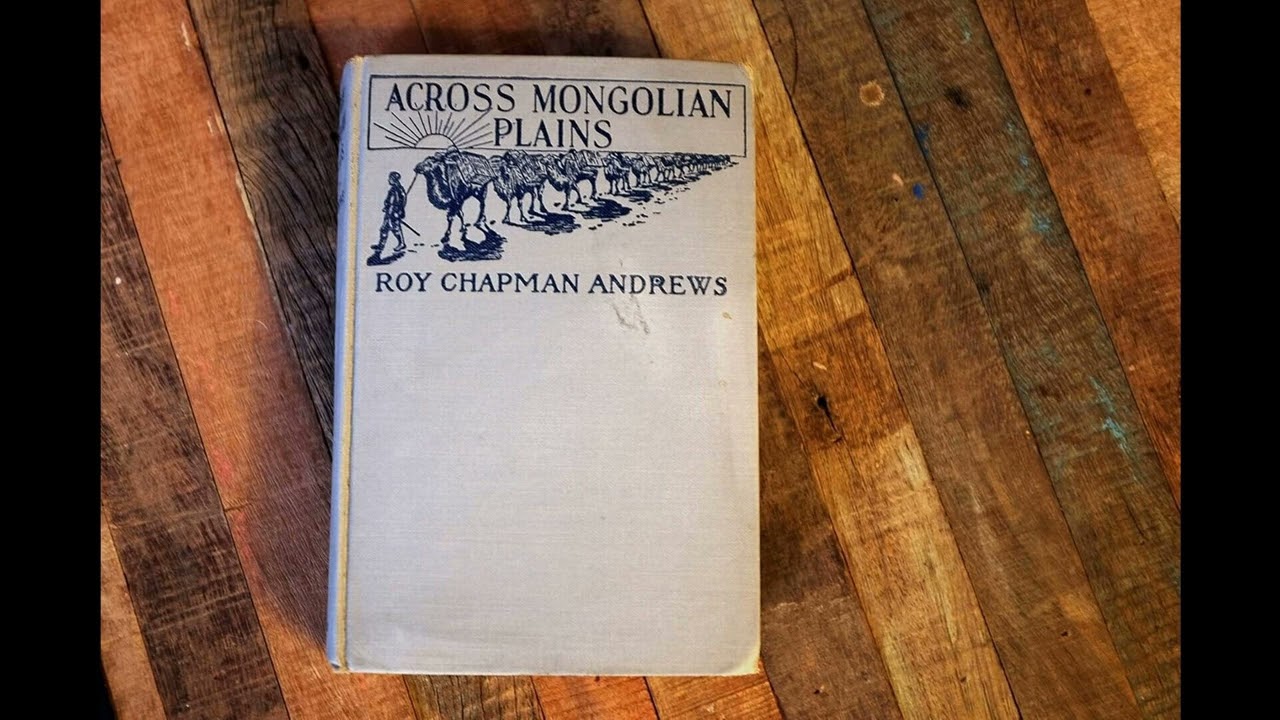
Across Mongolian Plains: A Naturalist's Account of China's "Great Northwest"
Step back in time to an era when vast swathes of the globe remained tantalizingly beyond the reach of conventional maps, when intrepid naturalists ventured into the unknown with little more than their wits, a pen, and an unquenchable thirst for knowledge. Roy’s Across Mongolian Plains: A Naturalist's Account of China's "Great Northwest" is more than just a travelogue; it is a meticulously observed portrait of a world on the cusp of change, a testament to the enduring human spirit of discovery, and a foundational document for understanding the ecology and cultures of one of Earth’s most formidable regions. For today’s listener, it offers a profound connection to the raw majesty of nature, a rare glimpse into historical scientific method, and a poignant reminder of landscapes and ways of life that have, in many respects, faded into history. The story unfolds as Roy, our observant protagonist, leads an expedition into the heart of what was then known as China's "Great Northwest" — a region dominated by the colossal expanse of the Mongolian plains, stretching far beyond the familiar boundaries of civilization. The setting is stark and beautiful: immense, windswept steppes giving way to barren deserts, punctuated by isolated mountain ranges and the occasional, ephemeral oasis. From the moment the team departs the comparative comfort of more settled regions, a sense of profound isolation settles in, becoming a constant companion. Roy’s main companions are his trusted guides and porters, individuals intimately familiar with the unforgiving terrain and its hidden dangers, whose local knowledge proves invaluable at every turn. The central narrative arc follows the expedition's progress through this formidable landscape. It is not a tale driven by a singular dramatic confrontation but by a relentless series of daily challenges: navigating treacherous sandstorms, enduring extreme temperatures, locating scarce water sources, and tracking elusive wildlife. Roy details the meticulous work of a field naturalist – collecting specimens, sketching geological formations, charting the movements of nomadic tribes, and painstakingly recording the calls of unfamiliar birds. The unfolding narrative is a chronological account of observation and survival, punctuated by moments of awe at the natural world and poignant interactions with the local inhabitants. The true conflict lies in the subtle struggle against the indifference of nature and the race against time to document a natural world that, even then, felt vulnerable to the encroaching forces of change. The reader witnesses the painstaking accumulation of data, the quiet triumphs of scientific insight, and the profound personal transformation that comes from prolonged immersion in the wild. While specific biographical details about the author, Roy, may not be widely known today, his work firmly places him among the ranks of the great naturalists and scientific explorers who characterized the late 19th and early 20th centuries. This was an era defined by a surging global interest in scientific documentation and geographical understanding. Figures like Roy were driven by a profound sense of curiosity, a desire to fill in the blank spaces on the map, and a commitment to empirical observation. They often possessed a remarkable combination of academic rigor, physical endurance, and a literary flair for description, enabling them to bring their findings to both scientific communities and the general public. Roy's position within the canon of classic literature stems from the enduring value of these pioneering accounts. Such works are invaluable not only for their scientific contributions, but also as historical records of environments and cultures that have since undergone significant transformation. He represents a type of scholar-adventurer who bridged the academic world with the visceral reality of fieldwork, often funding their own expeditions or receiving support from burgeoning scientific institutions eager to document the world's biodiversity before it was irrevocably altered. Across Mongolian Plains enacts several profound themes. One prominent theme is the sublime power and indifference of the natural world. Roy’s descriptions of the endless horizons, the sudden, violent gales that sweep across the steppe, and the sheer scale of the Gobi desert demonstrate humanity's inherent smallness against the grandeur of nature. For instance, he recounts witnessing a massive sandstorm that blotted out the sun, forcing the expedition to huddle for days, conveying the overwhelming force of the elements and the fragile nature of human endeavor in such environments. Another key theme is meticulous scientific observation and classification. Roy doesn't merely describe; he classifies, measures, and cross-references. He spends pages detailing the plumage of an unknown lark, the geological strata of a newly discovered mountain range, or the feeding habits of gazelles, providing a window into the naturalist's dedication to precise, empirical understanding. A third theme woven throughout the account is cultural encounter and respectful ethnography. As Roy and his team traverse the plains, they inevitably interact with the nomadic Mongolian peoples. His descriptions of their yurt encampments, their methods of herding livestock, their unique spiritual practices, and their resilience in an austere environment offer a fascinating, often empathetic, portrayal of a culture deeply attuned to its surroundings. He chronicles the exchange of goods, the shared meals, and the mutual curiosity between his expedition and the locals, highlighting a spirit of human connection across significant cultural divides. Finally, an implicit theme of conservation and the transient nature of wilderness permeates the text. Though not explicitly an environmental plea, the very act of documenting a thriving, untouched ecosystem suggests a nascent awareness of its preciousness. Roy’s detailed inventories of abundant wildlife — wild camels, Przewalski's horses, vast herds of saiga antelope — evoke a world that, even a century ago, felt boundless but which we now know has faced immense pressures. The historical context of Across Mongolian Plains is critical to appreciating its significance. The period roughly from the 1880s to the 1920s was a golden age for scientific exploration, particularly in regions considered "unmapped" by Western powers. Imperial rivalries, like the "Great Game" played out across Central Asia, spurred interest in geographical intelligence, but alongside this political drive was a genuine scientific fervor. Institutions like the Royal Geographical Society and burgeoning natural history museums funded expeditions to gather specimens and knowledge from every corner of the globe. Scientists and adventurers were often celebrated public figures, and their published accounts, like Roy’s, were eagerly consumed by a public fascinated by the unknown. This was also a time when photography was becoming more widespread, allowing for visual documentation alongside written descriptions, though the power of descriptive prose remained paramount in conveying the sheer scale and experience of these remote lands. Roy’s work emerges from this specific confluence of scientific ambition, public interest, and technological capability, offering a foundational text from a particularly dynamic period in global history. Listening to Across Mongolian Plains as an audiobook transforms the experience into something deeply immersive. The narrator's voice becomes the very lens through which we perceive Roy's journey, capable of conveying the scientific precision of his observations alongside the awe he felt in the face of nature’s raw power. With several hours of listening time, the audiobook allows for an extended contemplation of the vast, open spaces Roy describes, making it an ideal companion for long commutes or quiet evenings. A skilled narrator can modulate their voice to reflect the measured cadence of scientific recording, the occasional exclamations of wonder at a rare discovery, and the respectful tone used when describing cultural interactions. Listen for the subtle shifts in pacing – moments of steady, factual reporting contrasted with more evocative passages describing a sunset over the steppe or the quiet intensity of an animal encounter. The right narration brings the sounds of the wind, the rustle of dry grass, and the calls of exotic birds to life, creating an atmosphere that pulls the listener directly into the heart of China’s "Great Northwest."
Enjoyed Across Mongolian Plains: A Naturalist's Account of China's "Great Northwest"? A few ways to support us
Audible & Amazon links are affiliate; we may earn a small commission at no extra cost.
About this production
Human narration by a volunteer reader from LibriVox.org, the public-domain audiobook project. LibriVox volunteers record literary works whose copyright has expired in the United States, releasing the resulting recordings into the public domain.
Across Mongolian Plains: A Naturalist's Account of China's "Great Northwest" by Roy. The underlying text is in the U.S. public domain. We do not republish any modern copyrighted edition, translation, or commentary.
The 4K cinematic visuals accompanying this audiobook are generated by an AI image model from prompts derived from the source text. No copyrighted photos, paintings, or stock footage are used. AI generation is disclosed on every video on our YouTube channel as required by YouTube's altered/synthetic content policy.
English subtitles are transcribed from the LibriVox recording with OpenAI Whisper. Translations into the 11 other supported languages are produced by Meta's NLLB-200 neural translation model. No human translator's copyrighted translation is used.
Questions about sourcing or rights? See our DMCA & Sourcing policy or contact us.
Enjoyed this audiobook?
If you'd like to own a copy of Across Mongolian Plains: A Naturalist's Account of China's "Great Northwest" or hear a professionally produced edition, the links below help support free audiobook production at no extra cost to you.
As an Amazon Associate we earn from qualifying purchases. Audible / print links are affiliate.