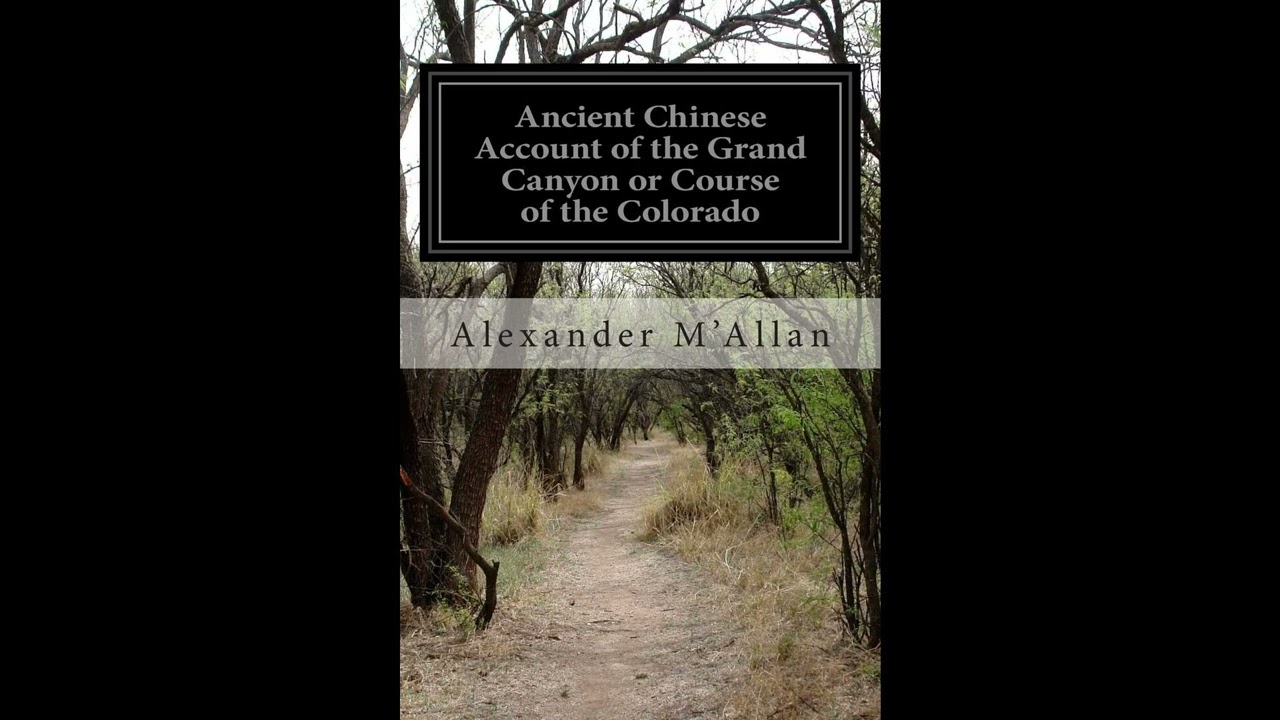
Ancient Chinese Account of the Grand Canyon or Course of the Colorado
The idea that ancient Chinese navigators might have reached the North American continent millennia ago remains one of history's most compelling and contested mysteries. "Ancient Chinese Account of the Grand Canyon or Course of the Colorado," presented by Alexander M-, plunges listeners into the heart of this very speculation, offering a narrative that purports to be a firsthand chronicle from an era long past. This unique literary artifact challenges our understanding of pre-Columbian exploration and the limits of ancient knowledge, beckoning us to reconsider the forgotten chapters of human ambition and discovery. It is a work that, regardless of its ultimate veracity, stands as a testament to the enduring human fascination with the unknown, the power of myth, and the profound majesty of nature. The narrative unfolds through the eyes of an unnamed, erudite Chinese scholar-official, dispatched by his emperor on a mission of intellectual curiosity and imperial expansion. Leaving the relative comfort of the Middle Kingdom, the expedition faces the daunting prospect of traversing immense, uncharted lands to the west, seeking knowledge, resources, and perhaps even the fabled edges of the world. The early stages of their quest detail encounters with diverse landscapes and peoples, carefully recorded with a blend of meticulous observation and ancient Chinese philosophical interpretation. The central conflict arises as the travelers push further, encountering terrain that increasingly defies their established worldview – vast deserts, towering mountain ranges, and ultimately, an unparalleled geological wonder that will forever alter their perception of the earth itself. As the journey progresses, the expedition's goal narrows, driven by rumors and the sheer, magnetic pull of the unknown. They follow a mighty river – the "Course of the Colorado" – through increasingly rugged and spectacular canyons, their initial intellectual detachment slowly giving way to awe, fear, and profound spiritual contemplation. The narrative meticulously chronicles their daily struggles, their dwindling supplies, the harsh elements, and the growing sense of isolation from their known world. The climax of their physical and intellectual ordeal arrives with the first glimpse of the "Grand Canyon" – described in terms of its impossible scale, its myriad colors, and its power to dwarf human endeavor. The account becomes a testament to human resilience in the face of the sublime, a struggle to comprehend the truly incomprehensible. The story closes not with a resolution, but with the travelers facing the humbling immensity of their discovery, their perspective forever altered. While the "Ancient Chinese Account of the Grand Canyon or Course of the Colorado" is attributed to Alexander M-, the work itself positions him not as the original ancient author but as the individual responsible for bringing this extraordinary narrative to modern attention. His contribution lies in his role as a compiler, translator, or perhaps the modern author who crafted this plausible "account" during a period intensely interested in alternative histories and the potential for ancient civilizations to have reached far beyond their traditionally accepted boundaries. Alexander M- represents an intellectual current prevalent in the late nineteenth and early twentieth centuries, an era marked by burgeoning archaeological discoveries, burgeoning global travel, and a growing romanticism for the unknown and the exotic. Authors and researchers of this time often engaged with speculative history, challenging established narratives and proposing bold new theories about ancient global connections. Alexander M-'s work, therefore, stands within a tradition that seeks to expand the historical imagination, whether through meticulous research of obscure texts, the presentation of compelling (if unverified) historical theories, or the creation of detailed historical fiction. He embodies the spirit of an era that relished the potential for monumental shifts in our understanding of the past. His decision to present this "ancient account" speaks to a particular strain of scholarship or creative writing that values the provocative question over the definitive answer, leaving the listener to ponder the tantalizing possibilities presented by such a remarkable "discovery." Several potent themes emerge from the narrative, making it more than just a historical curiosity. One undeniable theme is humanity's visceral relationship with the sublime natural world. The descriptions of the Grand Canyon, for example, portray it not merely as a geological formation but as an entity that commands reverence and instills existential dread. The ancient Chinese travelers, accustomed to the ordered beauty of their own cultivated landscapes, confront a wilderness that utterly overwhelms their senses and intellectual frameworks, forcing a re-evaluation of their place within the cosmos. The endless strata of rock, the deafening silence of the chasm, and the river's relentless power become characters in themselves, shaping the psychological landscape of the expedition. Another significant theme is the clash of cultural understanding and the limits of human knowledge. The Chinese observers attempt to categorize and interpret the alien flora, fauna, and geological formations through their existing philosophical and scientific lenses, often finding them inadequate. This struggle highlights the inherent ethnocentrism of any culture and the profound challenge of integrating truly novel phenomena into an established worldview. For instance, the descriptions of animals unlike any known in China reveal a fascinating tension between careful observation and the limitations of their descriptive vocabulary. This cultural encounter, even when primarily with landscape rather than people, underscores the universal human desire to comprehend and categorize, even when faced with the truly unprecedented. A third theme is the unyielding spirit of discovery and the allure of the unknown. Despite immense hardship, the expedition presses forward, driven by a thirst for knowledge and a sense of imperial mission, pushing the boundaries of their known world and their own endurance. The context in which this "ancient account" was presented by Alexander M- is crucial to appreciating its impact. The late nineteenth and early twentieth centuries were periods of immense global change, marked by the rapid expansion of Western imperial powers, scientific advancements, and a growing interest in archaeology and anthropology. It was a time when the "discovery" of ancient civilizations (like Troy or the Egyptian pharaohs) captured the public imagination, fueling a desire for more untold histories. Theories of pre-Columbian contact, often fueled by incomplete archaeological evidence or cultural similarities, gained traction among certain scholars and the general public. Against the backdrop of America's own expansion westward and the burgeoning fascination with its natural wonders, an "ancient Chinese account" of the Grand Canyon would have resonated deeply, tapping into both a national pride in its landscape and an international curiosity about its origins. It emerged from an era that eagerly consumed narratives that challenged conventional history and celebrated the triumph of human exploration against formidable odds. Listening to "Ancient Chinese Account of the Grand Canyon or Course of the Colorado" as an audiobook offers a uniquely immersive experience, perfectly suited to its contemplative and expansive nature. The several hours of narration provide ample opportunity to sink into the measured pacing of the prose, allowing the listener to truly visualize the epic scale of the journey and the magnificent descriptions of the landscape. A skilled narrator can convey the ancient formality of the account, the scholar's meticulous observations, and the growing sense of wonder and exhaustion that grips the expedition. The nuanced voice can highlight the philosophical ponderings of the travelers as they grapple with the unknown, lending gravitas to their cultural interpretations and the sheer enormity of their discovery. It is an experience that transports the listener not just to a different place, but to a different time, allowing for sustained reflection on the enduring mysteries of human history and the awesome power of the natural world.
Enjoyed Ancient Chinese Account of the Grand Canyon or Course of the Colorado? A few ways to support us
Audible & Amazon links are affiliate; we may earn a small commission at no extra cost.
About this production
Human narration by a volunteer reader from LibriVox.org, the public-domain audiobook project. LibriVox volunteers record literary works whose copyright has expired in the United States, releasing the resulting recordings into the public domain.
Ancient Chinese Account of the Grand Canyon or Course of the Colorado by Alexander M. The underlying text is in the U.S. public domain. We do not republish any modern copyrighted edition, translation, or commentary.
The 4K cinematic visuals accompanying this audiobook are generated by an AI image model from prompts derived from the source text. No copyrighted photos, paintings, or stock footage are used. AI generation is disclosed on every video on our YouTube channel as required by YouTube's altered/synthetic content policy.
English subtitles are transcribed from the LibriVox recording with OpenAI Whisper. Translations into the 11 other supported languages are produced by Meta's NLLB-200 neural translation model. No human translator's copyrighted translation is used.
Questions about sourcing or rights? See our DMCA & Sourcing policy or contact us.
Enjoyed this audiobook?
If you'd like to own a copy of Ancient Chinese Account of the Grand Canyon or Course of the Colorado or hear a professionally produced edition, the links below help support free audiobook production at no extra cost to you.
As an Amazon Associate we earn from qualifying purchases. Audible / print links are affiliate.
More Audiobooks

In the Heart of the Rockies; a Story of Adventure in Colorado
The Pony Rider Boys in the Grand Canyon - Or, The Mystery of Bright Angel Gulch
A Wayfarer in China: Impressions of a Trip Across West China and Mongolia
Chinese Folk-Lore Tales