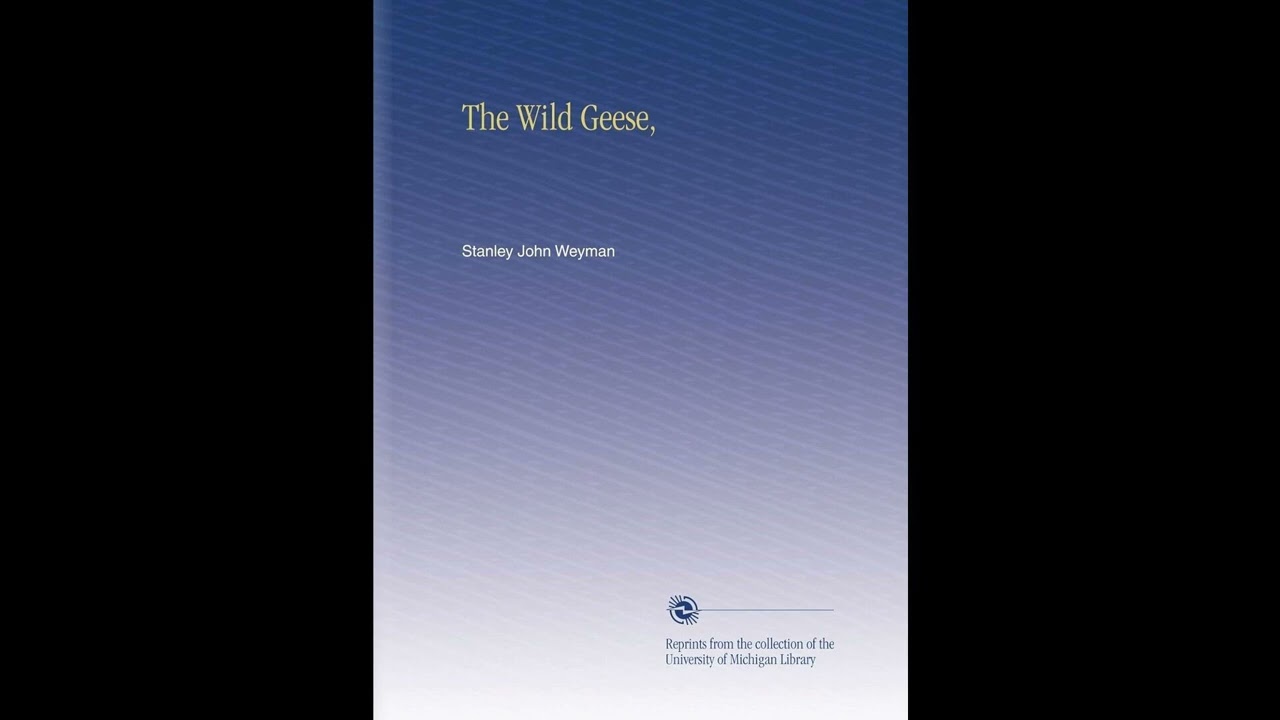
The Wild Geese
Step into the tumultuous heart of 17th-century Ireland, a land scarred by conflict and defined by unwavering loyalties, with Stanley John Weyman's compelling historical drama, "The Wild Geese." This acclaimed novel, a celebrated entry in classic literature, pulls listeners into a world where personal survival is inextricably linked to political fate, where love is a dangerous gamble, and where courage is the only currency. Weyman’s narrative prowess, his meticulous attention to historical detail, and his ability to craft characters whose struggles resonate across centuries make this more than just a tale of adventure; it is a profound examination of national identity, sacrifice, and the enduring human spirit in the face of profound adversity. For those who appreciate historical fiction that is both thrillingly plotted and deeply reflective, "The Wild Geese" offers a resonant experience that speaks to universal themes of belonging and resistance even today. The story unfolds in the rugged, beautiful landscape of County Clare, Ireland, in the aftermath of the Williamite War, a period marked by land confiscations and the forced exile of many Irish gentry and soldiers. At its center is the formidable and fiercely independent Lady Betty Carew, a woman of indomitable will tasked with the near-impossible mission of preserving her family’s ancestral estate, Moylish, from forfeiture. Her brother, Colonel John Carew, a former Jacobite officer, has fled to France as one of the "Wild Geese"—the thousands of Irish soldiers who left their homeland to serve in continental European armies. His absence, and the political climate, leave Lady Betty vulnerable to the avarice of her calculating cousin, Maurice Carew, who schemes to claim Moylish for himself. Maurice, however, is not the only threat; the estate is also eyed by the English authorities, making Lady Betty’s position increasingly precarious. Caught in this web of familial betrayal and national upheaval, Lady Betty finds an unlikely and ambiguous ally in Captain FitzGerald, a handsome and enigmatic figure who seems to operate outside the clear lines of loyalty. Is he a protector, an opportunist, or something far more complex? As Lady Betty navigates the treacherous political landscape, she must contend with spies, betrayals, and the constant threat of violence, all while wrestling with her own heart. The narrative follows her desperate attempts to secure Moylish, protect her family’s legacy, and uncover the true motives of those around her, leading her through a series of harrowing confrontations and moral quandaries. The tension builds steadily as alliances shift and secrets come to light, revealing the profound personal costs of a nation divided. Stanley John Weyman, born in 1855 in Ludlow, Shropshire, England, established himself as one of the preeminent historical novelists of the late Victorian and Edwardian eras. Weyman’s early life saw him educated at Shrewsbury School and Christ Church, Oxford, where he read Modern History. He initially pursued a career in law, being called to the bar in 1881, but his passion for storytelling soon eclipsed his legal practice. By the early 1890s, he had fully committed to writing, quickly gaining recognition for his meticulously researched and dramatically compelling historical romances. Weyman was known for his dedication to historical accuracy, often drawing on primary sources to lend authenticity to his narratives, a characteristic that distinguished his work and earned him a loyal readership. Weyman’s extensive bibliography includes a number of enduringly popular titles, many of which are set against the backdrop of French history, earning him comparisons to Alexandre Dumas. His 1893 novel, A Gentleman of France, set during the French Wars of Religion, was a breakout success, solidifying his reputation. Other notable works include Under the Red Robe (1894), a tale of Richelieu's France, and The Red Cockade (1895), which plunges into the French Revolution. Weyman's unique contribution to literature lies in his ability to blend swashbuckling adventure and genuine human drama with a rigorous historical sensibility. He continued writing successfully into the 20th century, producing a body of work that cemented his place as a master of the historical genre, influencing generations of writers and readers. He passed away in 1928, leaving behind a legacy of enthralling historical fiction. "The Wild Geese" powerfully demonstrates several central themes. One prominent theme is the concept of loyalty versus betrayal. Lady Betty’s unwavering commitment to her family and her ancestral home stands in stark contrast to the duplicity of Maurice Carew, whose self-serving actions threaten to undo centuries of family history. The narrative constantly weighs personal allegiances against political expediency, forcing characters to make difficult, often heart-wrenching choices. Another compelling theme is resilience in adversity. Lady Betty herself embodies this, facing down powerful adversaries and immense personal danger with remarkable fortitude. For instance, her refusal to simply abandon Moylish, despite the overwhelming odds stacked against her, highlights her sheer determination and grit, providing a powerful example of human strength under pressure. The book also grapples with questions of identity and belonging. The historical context of the "Wild Geese" itself points to a fracturing of Irish identity—those who stayed and those who left, each group facing its own struggles and questions about their place in a changing world. Lady Betty, by fighting for her land, is fighting for an identity tied to her heritage and country, while the scattered "Wild Geese" represent a people dispersed but holding onto their sense of self. Furthermore, the novel skillfully portrays the complexities of love and duty. Lady Betty’s personal feelings are often at odds with her obligations to her family and estate, creating internal conflicts that add depth to her character. Her struggle to trust and her reluctant affection for Captain FitzGerald are constantly tested by the demands of her dire circumstances, illustrating how deeply intertwined personal desire and societal expectation can become. When "The Wild Geese" was published in 1908, the literary landscape was undergoing significant shifts. The Edwardian era, though still valuing traditional narrative forms, was also witnessing the nascent stirrings of modernism. While some authors were experimenting with form and psychological realism, a broad readership still found immense pleasure and intellectual stimulation in well-crafted historical novels. Weyman’s work emerged from a tradition that found value in looking back, often to periods of great national or continental upheaval, to understand the present. The historical setting of "The Wild Geese"—late 17th-century Ireland—was a particularly fertile ground for drama, offering readers a glimpse into a period of profound political and social reconfiguration, a time when the very fabric of society was being rewoven. This historical reflection resonated with an audience often grappling with the rapid changes of the early 20th century, providing both an escape and a lens through which to consider enduring human struggles for self-determination and stability. Listening to "The Wild Geese" as an audiobook brings an unparalleled intimacy to Weyman's robust prose and vivid characterizations. The narrator’s voice becomes the conduit for the story’s tension and emotional depth, particularly crucial in a novel where whispers of conspiracy and overt acts of defiance drive the plot. A skilled performance can bring distinct life to characters like the defiant Lady Betty, the ambiguous FitzGerald, and the conniving Maurice, making their dialogue crackle with period authenticity and dramatic weight. The sustained run length, spanning several hours, is perfectly suited for focused immersion, allowing listeners to fully lose themselves in the rich historical atmosphere. The pacing, as the narrator guides you through Weyman's meticulously constructed world, allows for moments of quiet reflection and sudden, heart-pounding action, ensuring that every twist and turn of Lady Betty's struggle is felt with immediate impact.
Enjoyed The Wild Geese? A few ways to support us
Audible & Amazon links are affiliate; we may earn a small commission at no extra cost.
About this production
Human narration by a volunteer reader from LibriVox.org, the public-domain audiobook project. LibriVox volunteers record literary works whose copyright has expired in the United States, releasing the resulting recordings into the public domain.
The Wild Geese by Stanley John Weyman. The underlying text is in the U.S. public domain. We do not republish any modern copyrighted edition, translation, or commentary.
The 4K cinematic visuals accompanying this audiobook are generated by an AI image model from prompts derived from the source text. No copyrighted photos, paintings, or stock footage are used. AI generation is disclosed on every video on our YouTube channel as required by YouTube's altered/synthetic content policy.
English subtitles are transcribed from the LibriVox recording with OpenAI Whisper. Translations into the 11 other supported languages are produced by Meta's NLLB-200 neural translation model. No human translator's copyrighted translation is used.
Questions about sourcing or rights? See our DMCA & Sourcing policy or contact us.
Enjoyed this audiobook?
If you'd like to own a copy of The Wild Geese or hear a professionally produced edition, the links below help support free audiobook production at no extra cost to you.
As an Amazon Associate we earn from qualifying purchases. Audible / print links are affiliate.