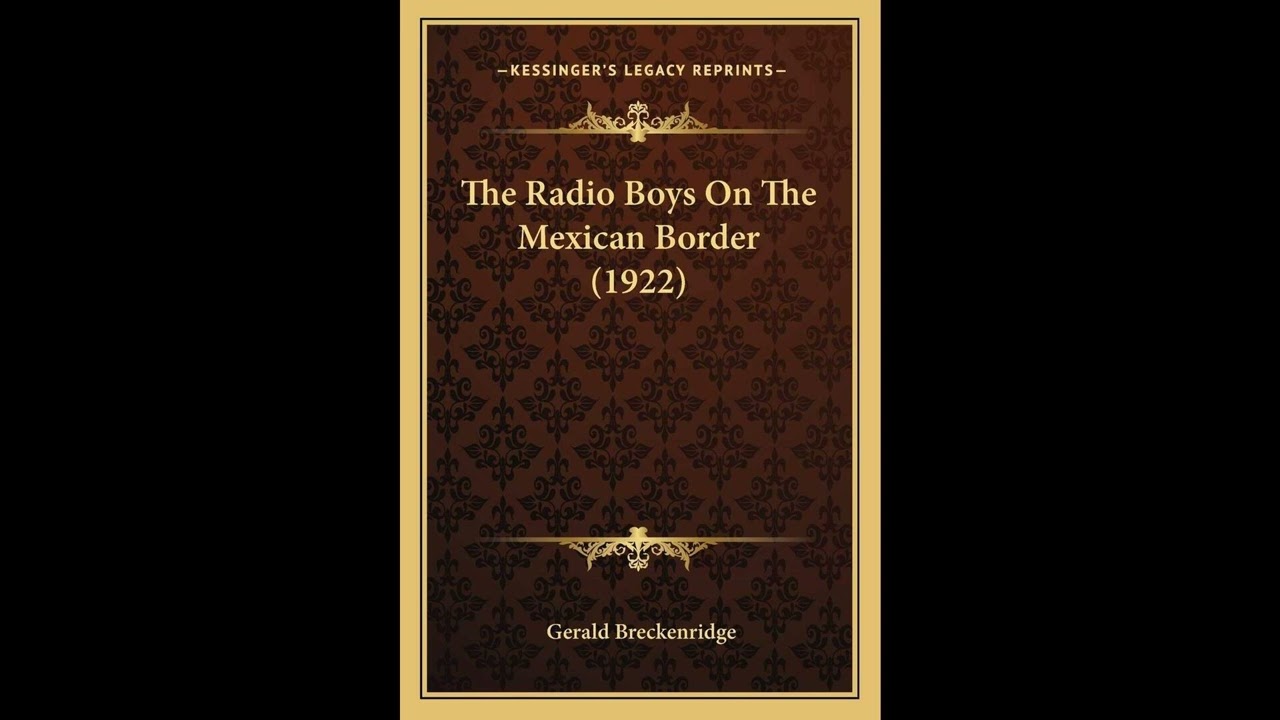
The Radio Boys On The Mexican Border (1922)
Step back into a simpler, yet thrilling, era with The Radio Boys On The Mexican Border, a classic tale of youthful adventure and technological ingenuity from 1922. This audiobook offers more than just a nostalgic escape; it’s a vivid snapshot of early twentieth-century America, showcasing the boundless optimism surrounding new inventions like amateur radio, and the enduring spirit of courage and curiosity. For anyone who appreciates the foundational stories that shaped generations of young readers, or who simply desires a wholesome, exciting narrative propelled by clever minds and daring exploits, this narrative provides a fascinating window into a bygone world where boys, their homemade gadgets, and a dash of daring could conquer almost any challenge. It’s a compelling listen that proves some adventures truly never fade. The story opens in the sun-drenched, often desolate, landscape of the American Southwest, a region teeming with both natural beauty and the shadowy implications of its proximity to the Mexican border. Our protagonists are Frank Faraday, Willie Jones, and Harry Dale—the eponymous "Radio Boys"—a trio of bright, resourceful teenagers with an insatiable passion for the nascent science of radio communication. They spend their days tinkering with circuits, stringing up antennae, and eagerly listening to the crackle of distant signals, a hobby that sets them apart from their peers and, as fate would have it, plunges them into an unexpected drama. Their peaceful existence is shattered when strange signals begin to pepper the airwaves, cryptic messages that hint at something far more sinister than mere amateur chatter. Driven by curiosity and a growing sense of unease, the boys soon discover that their advanced radio equipment has stumbled upon a network of smugglers operating in the rugged terrain between the two countries. These are not just petty criminals; they represent a significant threat to local law and order, and perhaps even national security, given the turbulent political climate of the era. Frank, Willie, and Harry find themselves inadvertently drawn into a dangerous game of cat and mouse, using their wits and their beloved radio sets to monitor the outlaws' movements, decipher their coded communications, and try to alert the authorities without putting themselves in undue peril. The narrative ratchets up the tension with each intercepted message and close call, transforming the boys' innocent pastime into a vital tool for justice as they race against time to expose the culprits and prevent a major illicit operation from succeeding. The name Gerald Breckenridge, like many authors of popular juvenile series from the early twentieth century, likely served as a house pseudonym for a syndicate of writers producing a consistent stream of adventure stories. This practice was common during the period when mass-market publishing for young readers boomed, aiming to create a recognizable "brand" for series that could be sustained across many titles and years. While specific biographical details for a single individual named Gerald Breckenridge are elusive, the body of work attributed to this name—primarily the "Radio Boys" series—firmly establishes its place within the tradition of didactic and entertaining fiction for boys. These authors, whether one person or many, were adept at weaving educational elements, particularly in science and technology, into thrilling narratives, reflecting a public fascination with innovation and progress. The authors behind the Breckenridge pseudonym contributed to a significant literary movement focused on shaping the character and intellect of young American males. Their works often emphasized courage, ingenuity, moral uprightness, and an appreciation for scientific principles. This approach aligned with a broader cultural effort to instill virtues and practical knowledge in the next generation. Other notable series from this period, such as the Tom Swift adventures, similarly highlighted scientific invention and the spirit of enterprise. While not typically studied in the academic canon of "high literature," these books formed the bedrock of many children's reading experiences, acting as powerful cultural artifacts that illustrate the values and interests of their time. They provided both escapism and instruction, encouraging boys to be resourceful, ethical, and engaged with the rapidly changing world around them. At its core, The Radio Boys On The Mexican Border enacts several compelling themes. Foremost among these is technological ingenuity and the power of innovation. The narrative consistently highlights how the boys’ mastery of amateur radio—then a cutting-edge technology—becomes their primary means of solving complex problems. For instance, early in the story, their ability to set up a hidden, long-range transmitter allows them to track the smugglers’ movements across vast, unpatrolled distances, a feat impossible for the conventional authorities of the time. This demonstrates how a keen understanding of new tools can empower individuals to make a significant difference. Another prominent theme is civic responsibility and patriotism. The Radio Boys, though young, feel a deep obligation to protect their community and assist law enforcement. They don't shy away from danger but rather confront it with a youthful idealism, seeing their efforts as a crucial contribution to maintaining order. A clear example of this is when they intercept a coded message indicating a large shipment of illegal goods is about to cross the border; instead of retreating, they meticulously work to decode it and get the vital information to the overwhelmed local sheriff, showcasing their commitment to upholding the law even at personal risk. This sense of duty, combined with their self-reliance, paints a picture of admirable young heroes. The year 1922 marked a fascinating moment in American history, nestled squarely in the early years of the "Roaring Twenties." Culturally, the nation was experiencing a post-World War I boom, characterized by a burgeoning consumer economy and an explosion of interest in new technologies. Radio, in particular, was undergoing a massive transformation from a specialized military and commercial tool to a household staple. KDKA in Pittsburgh had just begun broadcasting in 1920, and the airwaves were quickly filling with experimental stations, music, and news. This popular fascination with wireless communication provided fertile ground for stories like The Radio Boys, which capitalized on public excitement and a desire to understand this revolutionary technology. Politically, the period also saw ongoing concerns regarding border security, especially along the extensive US-Mexico border. The aftermath of the Mexican Revolution (which officially ended in 1920, but left residual instability) and the enforcement of Prohibition, which spurred widespread smuggling, made the border region a focal point for both legitimate trade and illicit activities. Against this backdrop, a story featuring resourceful American boys thwarting cross-border criminals would have resonated strongly with audiences, tapping into both nationalistic sentiments and a pervasive interest in law and order. The book emerged as a direct reflection of these contemporary anxieties and enthusiasms, perfectly blending technological wonder with frontier adventure. Listening to The Radio Boys On The Mexican Border as an audiobook brings this early twentieth-century adventure to life in a distinct way. The narration expertly captures the earnest, slightly formal tone of the period, allowing the listener to fully immerse themselves in the world of crackling radio signals and dusty border towns. With a run length of several hours, it's an ideal companion for a long drive, an afternoon of chores, or simply unwinding with a compelling story that unfolds at a brisk, engaging pace. The voice work for the different characters brings out the youthful enthusiasm of the boys, the gruff determination of the adults, and the subtle menace of the antagonists. Pay particular attention to how the narrator handles the technical descriptions, making them accessible and exciting, and how the dialogue, with its period-specific phrasing, creates an authentic atmosphere that transports you directly to an age when a few wires, a battery, and a spark of ingenuity could truly change the course of events.
Enjoyed The Radio Boys On The Mexican Border (1922)? A few ways to support us
Audible & Amazon links are affiliate; we may earn a small commission at no extra cost.
About this production
Human narration by a volunteer reader from LibriVox.org, the public-domain audiobook project. LibriVox volunteers record literary works whose copyright has expired in the United States, releasing the resulting recordings into the public domain.
The Radio Boys On The Mexican Border (1922) by Gerald Breckenridge. The underlying text is in the U.S. public domain. We do not republish any modern copyrighted edition, translation, or commentary.
The 4K cinematic visuals accompanying this audiobook are generated by an AI image model from prompts derived from the source text. No copyrighted photos, paintings, or stock footage are used. AI generation is disclosed on every video on our YouTube channel as required by YouTube's altered/synthetic content policy.
English subtitles are transcribed from the LibriVox recording with OpenAI Whisper. Translations into the 11 other supported languages are produced by Meta's NLLB-200 neural translation model. No human translator's copyrighted translation is used.
Questions about sourcing or rights? See our DMCA & Sourcing policy or contact us.
Enjoyed this audiobook?
If you'd like to own a copy of The Radio Boys On The Mexican Border (1922) or hear a professionally produced edition, the links below help support free audiobook production at no extra cost to you.
As an Amazon Associate we earn from qualifying purchases. Audible / print links are affiliate.