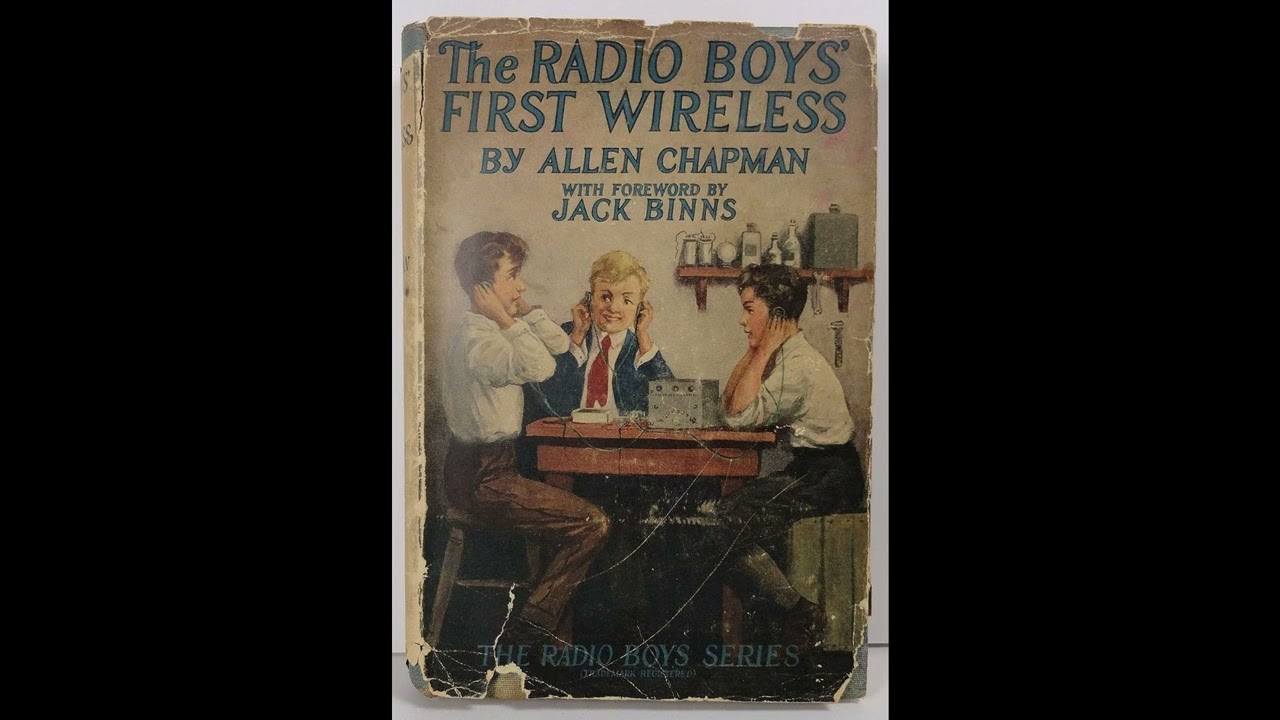
The Radio Boys' First Wireless, or, Winning the Ferberton Prize
The dawn of the 20th century was a period of astonishing scientific leaps, and nowhere was this sense of wonder more palpable than in the burgeoning field of wireless communication. The Radio Boys' First Wireless, or, Winning the Ferberton Prize by Allen Chapman transports listeners back to this exciting era, inviting them to experience the thrill of invention and the spirit of youthful enterprise. This classic of juvenile fiction captures a pivotal moment when the airwaves were transforming from an abstract scientific concept into a practical tool, connecting the world in unprecedented ways. It is a story that, despite its period setting, resonates with anyone who has ever been fascinated by new technology, striven to master a complex skill, or simply yearned for adventure with good friends. It is a reminder that even the most advanced innovations begin with curiosity, dedication, and a bit of ingenuity. Our story introduces us to two inseparable young friends, Frank and Harry, who share an insatiable curiosity for the then-revolutionary science of wireless telegraphy. Their small town of Ferberton, a quintessentially American setting, becomes the backdrop for their ambitious endeavors. Equipped with little more than an instruction manual, a healthy dose of youthful optimism, and a collection of salvaged parts, the boys set out to build their very own wireless receiving and transmitting station. Their immediate goal is not just to understand the magic of radio waves, but to win the prestigious Ferberton Prize—a local competition designed to encourage ingenuity and scientific advancement among the town's youth. This prize offers not only recognition but also a substantial financial reward, which would be life-changing for the boys and their families. As Frank and Harry immerse themselves in the intricacies of coils, aerials, and detectors, they encounter a series of formidable challenges. Building a reliable wireless set proves to be far more complex than they initially imagined, testing their patience, their technical skills, and their friendship. Adding to their difficulties are the machinations of rivals, who are not above underhanded tactics to secure victory in the Ferberton Prize competition. The boys must navigate technical setbacks, financial constraints, and the jealousy of others, all while trying to decipher the mysterious signals crackling through the ether. Their progression from hopeful beginners to competent wireless operators forms the central arc of the story, as they learn that true success often requires more than just cleverness—it demands perseverance and a steadfast belief in one's own capabilities. Allen Chapman is not a single author in the traditional sense, but rather a pseudonym employed by the Stratemeyer Syndicate, a prolific and highly influential producer of juvenile literature in the early 20th century. Founded by Edward Stratemeyer, a visionary writer and entrepreneur, the syndicate revolutionized children's books by applying mass-production principles to storytelling. Stratemeyer developed detailed plot outlines and character descriptions, which were then fleshed out into full novels by a stable of uncredited ghostwriters. This method allowed for the rapid creation of long-running, serialized adventures that captured the imaginations of generations of young readers across America and beyond. The syndicate’s approach ensured a consistent style and moral message across its many popular series, which included The Rover Boys, Tom Swift, The Bobbsey Twins, and Nancy Drew, among dozens of others. These books often featured resourceful, morally upright young protagonists who solved mysteries, overcame obstacles, and embraced new technologies or explored exotic locales. The Radio Boys series, published in the 1920s, perfectly exemplifies the syndicate's commitment to presenting contemporary advancements, in this case, the then-new and exciting world of radio, through engaging narratives designed to educate and inspire its young audience. The enduring popularity of these works speaks to Stratemeyer’s genius in understanding what young readers desired—adventure, ingenuity, and a sense of progress. The Radio Boys' First Wireless masterfully explores several enduring themes that remain pertinent today. A primary theme is the spirit of technological innovation and the boundless possibilities it offers. We see this in Frank and Harry’s fascination with wireless telegraphy, a technology that was truly cutting-edge at the time. Their excitement as they meticulously assemble components and strain to hear the first faint signals exemplifies humanity's drive to understand and harness new discoveries. The very act of building the wireless set, piece by piece, wire by wire, becomes a testament to human ingenuity and the pursuit of knowledge. Another significant theme is resourcefulness and self-reliance. The boys operate with limited funds and materials, often improvising solutions from everyday objects or salvaging discarded parts. For instance, they might turn a simple household item into a crucial component for their radio, demonstrating how quick thinking and an inventive mindset can overcome material constraints. This highlights the value of practical skills and the ability to adapt, showcasing that true innovation often springs from necessity and the creative repurposing of what is available. The narrative also underlines the importance of friendship and teamwork, as Frank and Harry consistently rely on each other's strengths and support to navigate the complex technical challenges and competitive pressures they face. Their cooperative spirit, even amidst disagreements, proves essential to their progress. When this book was first published, the world was still reeling from the aftermath of the First World War, but also looking forward with a burgeoning sense of optimism and a profound belief in progress. The 1920s, often called the Roaring Twenties, was a decade characterized by rapid social and technological change. Radio, in particular, was experiencing an explosion in popularity and accessibility. What began as a tool for military and maritime communication quickly became a source of entertainment and information for the average household, fostering a sense of national community and shared experience. Families would gather around their crystal sets, marveling at broadcasts from distant cities, much like people today might stream content from across the globe. Against this backdrop, books like The Radio Boys' First Wireless served a vital cultural purpose. They not only entertained but also educated young readers about the wonders of science and technology, encouraging them to pursue scientific hobbies and careers. The book reflects the era's pervasive fascination with invention and the optimistic belief that science held the key to a better future. It also mirrored the period’s emphasis on character development, presenting wholesome role models who embodied virtues like perseverance, honesty, and a strong work ethic—qualities seen as essential for the nation's rising generation. Listening to The Radio Boys' First Wireless as an audiobook offers a unique opportunity to immerse oneself in this bygone era of youthful enthusiasm and scientific discovery. The "several hours" of runtime make it an ideal companion for long car trips, extended walks, or even as a comforting presence during quiet evenings at home. A skilled narrator brings the spirited dialogue of Frank and Harry to life, capturing their excitement, their frustrations, and their unwavering determination with a voice that evokes the earnest innocence of early 20th-century boyhood. The pacing allows the listener to savor the meticulous descriptions of the boys' experiments and the unfolding drama of their competition, building atmosphere through the crisp clarity of the narration. You can almost hear the faint crackle of the early wireless signals as the story unfolds, pulling you into a world where scientific wonder was truly a new frontier.
Enjoyed The Radio Boys' First Wireless, or, Winning the Ferberton Prize? A few ways to support us
Audible & Amazon links are affiliate; we may earn a small commission at no extra cost.
About this production
Human narration by a volunteer reader from LibriVox.org, the public-domain audiobook project. LibriVox volunteers record literary works whose copyright has expired in the United States, releasing the resulting recordings into the public domain.
The Radio Boys' First Wireless, or, Winning the Ferberton Prize by Allen Chapman. The underlying text is in the U.S. public domain. We do not republish any modern copyrighted edition, translation, or commentary.
The 4K cinematic visuals accompanying this audiobook are generated by an AI image model from prompts derived from the source text. No copyrighted photos, paintings, or stock footage are used. AI generation is disclosed on every video on our YouTube channel as required by YouTube's altered/synthetic content policy.
English subtitles are transcribed from the LibriVox recording with OpenAI Whisper. Translations into the 11 other supported languages are produced by Meta's NLLB-200 neural translation model. No human translator's copyrighted translation is used.
Questions about sourcing or rights? See our DMCA & Sourcing policy or contact us.
Enjoyed this audiobook?
If you'd like to own a copy of The Radio Boys' First Wireless, or, Winning the Ferberton Prize or hear a professionally produced edition, the links below help support free audiobook production at no extra cost to you.
As an Amazon Associate we earn from qualifying purchases. Audible / print links are affiliate.
More by Allen Chapman
More Audiobooks
Radio Boys in the Thousand Islands or the Yankee-Canadian Wireless Trail
J. W. Duffield
The Radio Boys On The Mexican Border (1922)
The Radio Boys at Mountain Pass; Or, The Midnight Call for Assistance
The Radio Boys Under the Sea; or The Hunt for Sunken Treasure
The Young Engineers on the Gulf Or, The Dread Mystery of the Million Dollar Breakwat- Full Audiobook