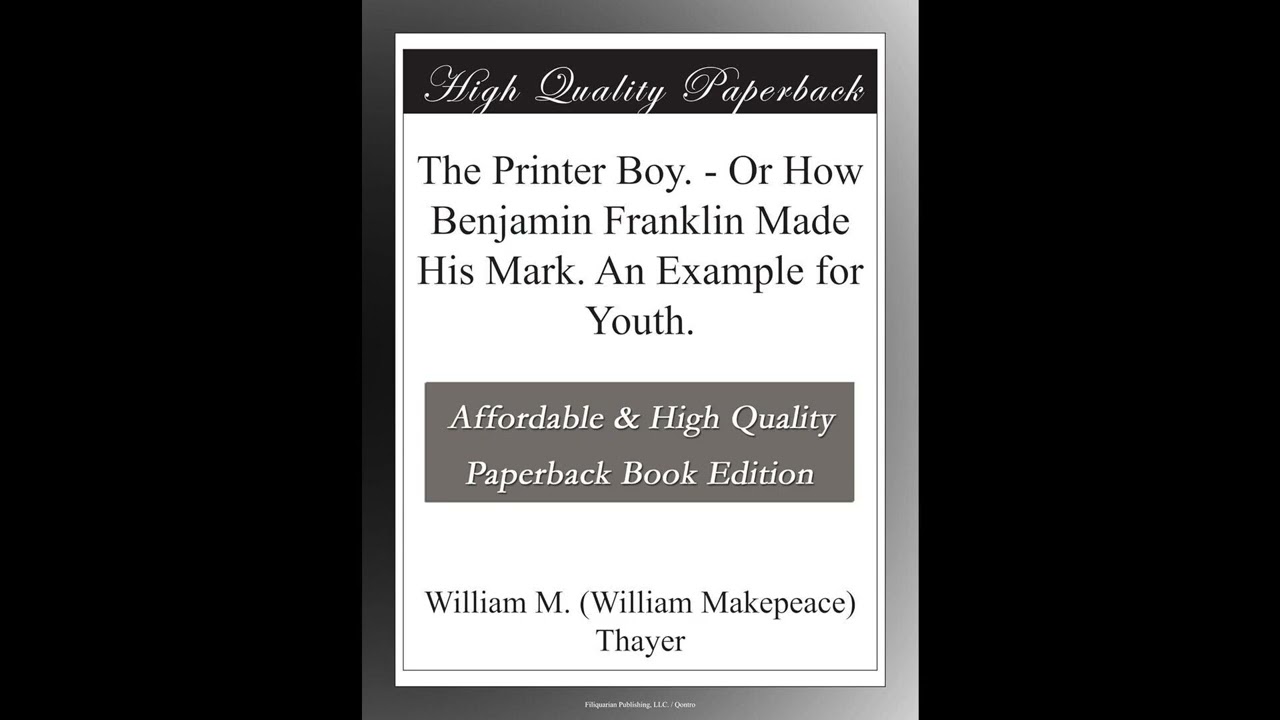
The Printer Boy - Or How Benjamin Franklin Made His Mark. An Example for Youth
Long before he was a statesman, a scientist, or a diplomat, Benjamin Franklin was a printer boy. "The Printer Boy - Or How Benjamin Franklin Made His Mark. An Example for Youth" brings listeners into the formative years of one of America's most celebrated figures, offering an inspiring look at the principles and choices that set him on a course for greatness. This narrative, crafted for young people, distills the essence of Franklin's early life into a series of vivid anecdotes, illustrating how hard work, ingenuity, and a thirst for knowledge can transform humble beginnings into extraordinary achievement. It is a foundational story in American lore, reminding us that the seeds of future impact are often sown in the daily diligence and moral choices of youth, making it a compelling listen for anyone seeking inspiration from history's exemplars. The story begins in Boston, in the early eighteenth century, introducing young Benjamin Franklin as a curious and bright child in a large, industrious family. His father, Josiah Franklin, a tallow chandler and soap maker, struggled to find a suitable trade for his intellectually restless son. After brief apprenticeships that proved ill-suited to Ben's temperament, he was bound to his older brother, James, a printer. This new environment, while offering access to books and the world of letters, also presented its own set of challenges. James, often harsh and demanding, frequently clashed with his independent-minded younger brother, who yearned for intellectual freedom and the opportunity to express his own ideas. This period showcases Ben's earliest attempts at writing, including the famous "Silence Dogood" letters, satirical essays he secretly submitted to his brother's newspaper under a pseudonym, which were published to public acclaim, much to James's unwitting amusement and eventual anger. Driven by a desire for independence and a growing sense of his own capabilities, Ben makes the momentous decision to leave Boston. With only a few coins in his pocket and his wits to guide him, he sets off for Philadelphia, a burgeoning city that promised new opportunities. This pivotal moment in the story is often remembered for the iconic image of young Franklin arriving in Philadelphia, disheveled and hungry, walking through the streets with three large loaves of bread under his arms, a symbol of his practical frugality and humble beginnings. The narrative follows his initial struggles to find work, his eventual success in various print shops, and his determined efforts to improve his mind through voracious reading and self-education. It describes his earnest attempts to live frugally, often subsisting on a vegetarian diet to save money for books, and his relentless pursuit of self-improvement, establishing him as a hardworking, ambitious, and morally upright young man determined to make his way in the world. While the specific author of "The Printer Boy" remains unknown, the work itself stands firmly within a cherished tradition of American literature designed to educate and inspire young minds. This kind of instructive biography, often published anonymously or under a general attribution, was a common literary form in the nineteenth century, particularly after the Civil War. During this period, America was undergoing rapid industrialization and social change, and there was a significant cultural emphasis on the virtues of self-reliance, industry, and moral rectitude as pathways to success. Books like "The Printer Boy" served as moral compasses for generations of American children, shaping their understanding of what it meant to be a contributing citizen and a successful individual. These narratives frequently drew upon the lives of historical figures—Franklin, George Washington, Abraham Lincoln—who embodied the ideals of the burgeoning nation, presenting their stories as blueprints for personal and civic achievement. The very anonymity of the author reinforced the focus on the message and the exemplary life of the subject, rather than the individual writer. The story of Benjamin Franklin's youth, as presented here, powerfully enacts several enduring themes. Foremost among these is self-improvement and autodidacticism. Listeners witness Franklin's tireless efforts to educate himself, from his secret consumption of books in his brother's print shop to his methodical practice of improving his prose by rewriting passages from The Spectator. He devises elaborate systems for moral perfection, meticulously tracking his progress against a list of virtues like temperance and industry, illustrating a deeply held belief in the power of continuous personal development. Another prominent theme is industry and frugality. Franklin's disciplined work ethic is consistently highlighted, whether he is working diligently at the printing press or making prudent financial decisions that allow him to purchase books and eventually start his own business. His choice to live simply and save money, vividly portrayed in his early days in Philadelphia, stands as a testament to the value of careful management of resources. The book also underscores the theme of social mobility through hard work, a cornerstone of the American ideal. Franklin's journey from a humble Boston apprentice to an aspiring printer in Philadelphia, and later to a successful businessman, exemplifies the possibility of rising above one's station through sheer determination and wit. His story encourages the belief that talent and effort, rather than birthright, are the true determinants of success. A nascent sense of civic virtue also emerges, as even in his youth, Franklin shows an interest in public discourse and community betterment. His "Silence Dogood" letters, though youthful and satirical, represent an early engagement with public opinion, hinting at his later profound contributions to civil society through institutions like the Junto club, which he founded for mutual improvement and public service. These themes, presented through Franklin's accessible biography, made him an enduring model for American youth for centuries. This work emerged during a fascinating period in American literary and cultural history, likely in the mid-to-late nineteenth century, when the genre of children's literature was firmly establishing itself with a distinctly didactic bent. Following the industrial boom and westward expansion, there was a national yearning for stories that codified the values of the self-made man and the industrious citizen. Authors and publishers recognized the need for literature that would not only entertain but also instruct young people in the virtues necessary for personal success and national prosperity. Franklin, with his humble origins, insatiable curiosity, and eventual monumental achievements, was the perfect historical figure to embody these ideals. His life story resonated deeply with the spirit of American progress and the belief in individual agency. This particular period saw a proliferation of similar inspirational biographies and moral tales, aiming to instill qualities like perseverance, integrity, and ingenuity in the next generation. The emergence of "The Printer Boy" at this time was a direct response to a cultural demand for narratives that reinforced the foundational principles of American exceptionalism and the Protestant work ethic. Listening to "The Printer Boy" as an audiobook offers a unique opportunity to connect with this historical narrative in a deeply personal way. The story, structured around a series of illustrative episodes, lends itself wonderfully to oral delivery. A skilled narrator can bring the colonial atmosphere to life, from the clatter of the printing press to the bustling streets of Philadelphia, allowing the listener to truly inhabit young Ben's world. The run length, several hours, makes it an ideal companion for a variety of activities—whether on a long drive, during household chores, or as an enriching listen during quiet reflection. Listen for the narrator's interpretation of Franklin's earnest self-dialogue and the distinct voices given to the various characters, such as the strict brother James or the kindly mentors Franklin encounters. The straightforward prose, designed for clarity and moral impact, gains an added layer of immediacy and warmth when spoken aloud, allowing the inspiring message of Franklin's youthful ambition and disciplined pursuit of excellence to truly resonate.
Enjoyed The Printer Boy - Or How Benjamin Franklin Made His Mark. An Example for Youth? A few ways to support us
Audible & Amazon links are affiliate; we may earn a small commission at no extra cost.
About this production
Human narration by a volunteer reader from LibriVox.org, the public-domain audiobook project. LibriVox volunteers record literary works whose copyright has expired in the United States, releasing the resulting recordings into the public domain.
The Printer Boy - Or How Benjamin Franklin Made His Mark. An Example for Youth by Or How Benjamin Franklin Made His Mark. An Example for Youth. The underlying text is in the U.S. public domain. We do not republish any modern copyrighted edition, translation, or commentary.
The 4K cinematic visuals accompanying this audiobook are generated by an AI image model from prompts derived from the source text. No copyrighted photos, paintings, or stock footage are used. AI generation is disclosed on every video on our YouTube channel as required by YouTube's altered/synthetic content policy.
English subtitles are transcribed from the LibriVox recording with OpenAI Whisper. Translations into the 11 other supported languages are produced by Meta's NLLB-200 neural translation model. No human translator's copyrighted translation is used.
Questions about sourcing or rights? See our DMCA & Sourcing policy or contact us.
Enjoyed this audiobook?
If you'd like to own a copy of The Printer Boy - Or How Benjamin Franklin Made His Mark. An Example for Youth or hear a professionally produced edition, the links below help support free audiobook production at no extra cost to you.
As an Amazon Associate we earn from qualifying purchases. Audible / print links are affiliate.
More Audiobooks
Helping Himself: Or, Grant Thornton's Ambition
In School And Out: Or The Conquest Of Richard Grant, A Story For Young People
Herbert Carter's Legacy, Or, the Inventor's Son
The Life Of Benjamin Franklin