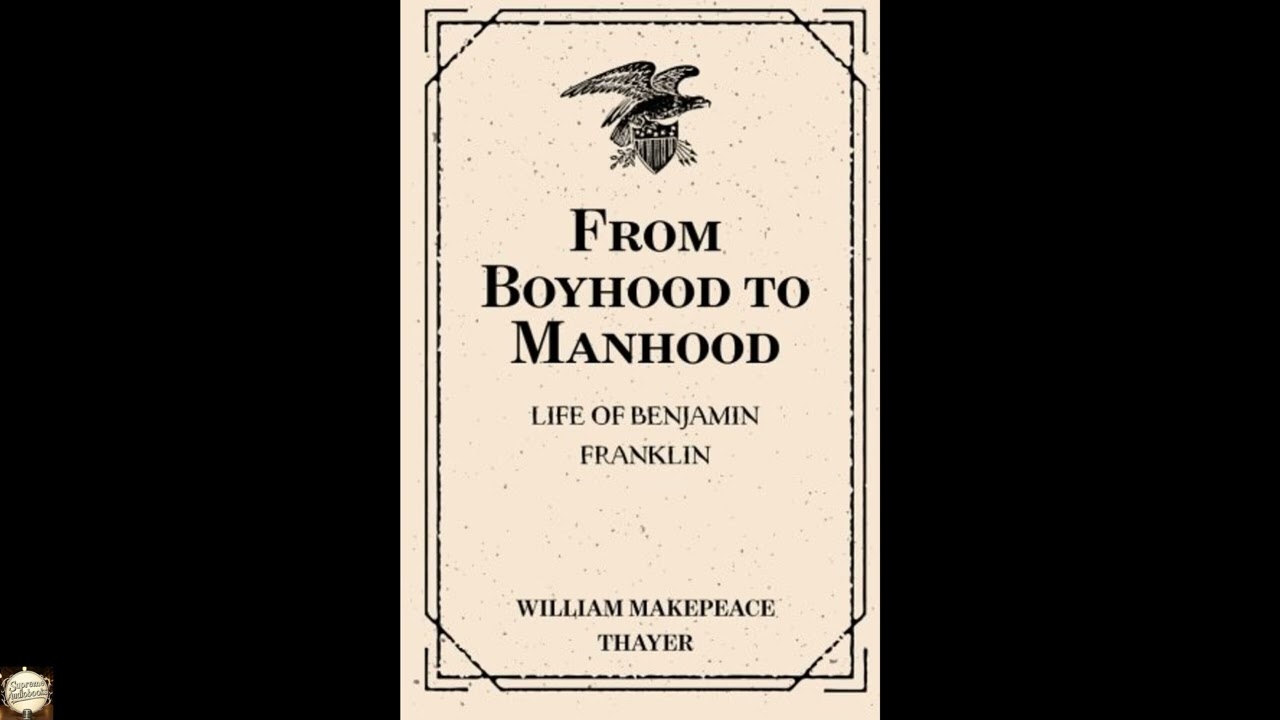
From Boyhood to Manhood: Life of Benjamin Franklin
What does it truly mean to rise from humble beginnings, to shape not only one's own destiny but the very foundations of a nation? William Makepeace Thayer's "From Boyhood to Manhood: Life of Benjamin Franklin" invites listeners to consider just that, offering an illuminating account of one of America's most celebrated polymaths. Far from a dry historical chronicle, Thayer presents Franklin as an accessible, inspiring figure whose relentless pursuit of knowledge, self-improvement, and public service remains profoundly relevant in any era marked by ambition and the desire for social good. This biography is a chance to connect with the spirit of American ingenuity and perseverance through the story of an individual who embodied its earliest ideals. The narrative opens in colonial Boston, introducing Benjamin Franklin as a precocious boy in a large family, destined for a life as a candlemaker alongside his father. Young Ben quickly chafes against this predetermined path, displaying an insatiable appetite for reading and a budding talent for writing. His early years are marked by a pivotal apprenticeship to his brother, James, a printer, an experience that proves both formative and fraught. The demanding nature of the print shop, coupled with the restrictive family dynamics, ultimately propels Franklin to make a bold decision: to leave Boston for the greener pastures of Philadelphia. This migration marks a crucial turning point, setting the stage for Franklin's remarkable ascent. In Philadelphia, Franklin begins as a penniless printer, a stranger in a new city. He methodically applies himself to his craft, cultivating a reputation for diligence, frugality, and sharp intellect. Listeners follow his burgeoning career as he establishes his own printing business, publishes "Poor Richard's Almanack" with its enduring wisdom, and becomes a prominent voice in the colonial press. His story then expands to encompass his scientific curiosity, leading to groundbreaking experiments with electricity and inventions that improve everyday life. As his influence grows, so does his commitment to civic improvement—founding libraries, fire departments, and academies. The arc of his life takes him across the Atlantic to England and France, not merely as a colonial agent but as a respected diplomat and statesman, tirelessly advocating for the rights and eventual independence of the American colonies. The book carefully builds toward his monumental contributions to the birth of the United States, showcasing his strategic mind and persuasive charm without revealing the complete outcome of his later, critical endeavors. William Makepeace Thayer, born in 1820, was an American clergyman and prolific author who dedicated much of his literary career to penning inspirational biographies. Writing primarily in the latter half of the nineteenth century, Thayer’s books were immensely popular, often targeting younger readers with their emphasis on moral character and the virtues of hard work and self-reliance. He held pastorates in various Congregational churches across New England before fully committing to writing, and his works frequently reflected his strong evangelical convictions and didactic purpose. Thayer passed away in 1898, leaving behind a substantial body of work that shaped the perception of American heroes for generations. Thayer’s specific approach to biography, exemplified here, was to present the lives of great individuals as exemplars of moral rectitude and practical success. He wrote widely on figures such like Abraham Lincoln, Ulysses S. Grant, and James A. Garfield, always seeking to draw clear lessons from their achievements and struggles. His prose, though straightforward, possessed a compelling earnestness that resonated with a public eager for stories of character building and national pride in the wake of the Civil War and during a period of rapid industrialization. His biographies consistently positioned their subjects as models for personal development and civic responsibility, firmly placing him within a tradition of didactic American literature. "From Boyhood to Manhood" profoundly enacts themes of autodidacticism and self-improvement. Franklin's unquenchable thirst for knowledge, evidenced by his tireless reading as a boy and his later scientific experiments, forms the bedrock of his character. A vivid scene details his "moral perfectibility" project, wherein he systematically attempts to master thirteen virtues, keeping a daily ledger of his progress and failings. This methodical pursuit of personal excellence, driven entirely by his own will and intellect, underscores a belief in the individual's capacity for growth. Another central theme is civic virtue and public service. Franklin's establishment of the first circulating library, his organizing of Philadelphia's fire department, and his pivotal role in creating a postal system—all spring from a deep-seated commitment to the common good. Listeners see him not just as an individual, but as a community builder, tirelessly working to improve the lives of his fellow citizens. The book also highlights ingenuity and pragmatism. Franklin's practical inventions, such as the lightning rod, bifocals, and the Franklin stove, serve as concrete examples of his innovative spirit directed towards solving real-world problems. He didn't just theorize; he applied scientific principles to make life better and safer. This practical bent extends to his diplomatic efforts, where his shrewd negotiating skills and ability to connect with people from all walks of life proved invaluable in securing crucial foreign aid during the Revolution. His enduring maxims from "Poor Richard's Almanack"—proverbs like "A penny saved is a penny earned" or "Early to bed, early to rise, makes a man healthy, wealthy, and wise"—further distill his pragmatic philosophy, emphasizing diligence, thrift, and wisdom as pathways to success. William Makepeace Thayer published "From Boyhood to Manhood" during the late nineteenth century, a period in American history profoundly shaped by the aftermath of the Civil War, the expansion of industry, and a widespread emphasis on moral uplift and character development. The Gilded Age, while often seen as a time of vast economic disparity, also fostered a strong popular belief in the "self-made man"—an ideal perfectly embodied by Franklin. Thayer’s biographies met a cultural demand for narratives that glorified individual initiative, perseverance against adversity, and the attainment of success through hard work and good morals. His work provided comforting, inspirational models in an era of rapid social and economic change, reinforcing traditional values of industry and piety as cornerstones of personal and national prosperity. Listening to "From Boyhood to Manhood" as an audiobook offers a unique way to experience Franklin's inspiring life story. The several hours of narration provide ample opportunity for a truly immersive experience, allowing the listener to settle into the historical narrative at a comfortable pace. A skilled narrator can bring Thayer's earnest prose to life, capturing the nuances of the author's admiration for Franklin while conveying the spirit of the various historical settings—from the bustling streets of colonial Philadelphia to the refined salons of Enlightenment Paris. Listeners can focus on the evolution of Franklin's character, paying close attention to the pivotal moments of decision and innovation, and the way Thayer carefully constructs a portrait of a man who continually reinvented himself, always striving for improvement, both personal and communal. The sustained duration is perfect for reflective listening, perhaps during commutes, household tasks, or quiet evenings.
Enjoyed From Boyhood to Manhood: Life of Benjamin Franklin? A few ways to support us
Audible & Amazon links are affiliate; we may earn a small commission at no extra cost.
About this production
Human narration by a volunteer reader from LibriVox.org, the public-domain audiobook project. LibriVox volunteers record literary works whose copyright has expired in the United States, releasing the resulting recordings into the public domain.
From Boyhood to Manhood: Life of Benjamin Franklin by William Makepeace Thayer. The underlying text is in the U.S. public domain. We do not republish any modern copyrighted edition, translation, or commentary.
The 4K cinematic visuals accompanying this audiobook are generated by an AI image model from prompts derived from the source text. No copyrighted photos, paintings, or stock footage are used. AI generation is disclosed on every video on our YouTube channel as required by YouTube's altered/synthetic content policy.
English subtitles are transcribed from the LibriVox recording with OpenAI Whisper. Translations into the 11 other supported languages are produced by Meta's NLLB-200 neural translation model. No human translator's copyrighted translation is used.
Questions about sourcing or rights? See our DMCA & Sourcing policy or contact us.
Enjoyed this audiobook?
If you'd like to own a copy of From Boyhood to Manhood: Life of Benjamin Franklin or hear a professionally produced edition, the links below help support free audiobook production at no extra cost to you.
As an Amazon Associate we earn from qualifying purchases. Audible / print links are affiliate.