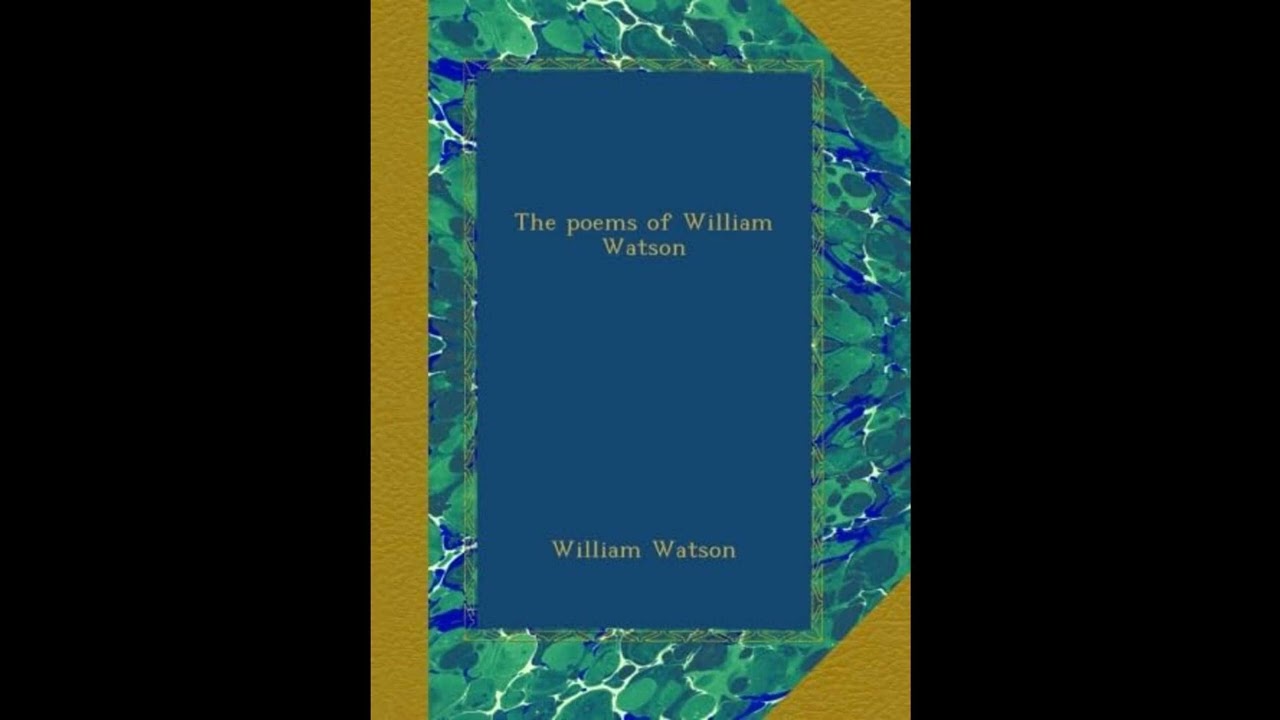
The poems of William Watson
Enter the world of William Watson, a poet whose commanding voice and classical discipline offer a compelling counterpoint to the shifting sands of the late Victorian era. This collection, a testament to his artistry, invites listeners to encounter a mind deeply engaged with beauty, justice, and the enduring power of verse. Far from a dusty relic, Watson's poems speak with a clarity and formal elegance that resonate profoundly today, providing a soothing yet stimulating experience for anyone seeking eloquence and thoughtful reflection in a world often starved for both. Here is a poet who believed in the moral weight of language, whose carefully wrought lines still challenge and uplift. Listeners opening this collection will find themselves drawn into a diverse landscape of poetic thought, unified by Watson's distinctive blend of traditional form and earnest sentiment. The poems move with a measured grace, often beginning with an observation of the natural world—a solitary bird, a gathering storm, the stillness of a winter landscape—before gently guiding the reader toward profound philosophical or ethical considerations. You will encounter odes that sing the praises of past literary giants, elegies that mourn the loss of cherished figures, and sonnets that distill complex ideas into fourteen meticulously crafted lines. There are verses that celebrate the quiet majesty of the English countryside and others that grapple with the clamor of political events, demonstrating a poetic consciousness acutely aware of both the personal and the public spheres. The arc of Watson's poetic voice, as presented across these pages, reveals a steadfast dedication to his craft. He moves from the lyrical beauty of his early work, demonstrating a sensitive ear for melody and rhythm, to more impassioned and often critical pronouncements in response to the world around him. The collection showcases a poet who was not content to merely observe, but felt a responsibility to comment, to persuade, and to articulate a moral vision through the precision of his art. It is an experience of encountering a poetic temperament that, while upholding classical virtues, was nonetheless keenly alive to the intellectual and social currents of its own time, creating a dialogue between tradition and modernity. William Watson, born in 1858 in Wharfedale, Yorkshire, was a self-made man of letters whose formal education ended early, yet his intellectual curiosity and devotion to literature were boundless. He immersed himself in the works of the great English poets, particularly Wordsworth, whose influence is often discernible in Watson's love of nature and his contemplative bent. His early career saw him gain significant critical recognition, especially with the publication of Wordsworth's Grave and Other Poems, which established his reputation as a poet of considerable skill and sensibility. Watson was known for his staunchly independent spirit and his occasional bouts of ill health, including periods of mental distress, which nonetheless did not diminish his dedication to writing. Despite his acclaimed talent, Watson never achieved the pinnacle of official recognition, famously being passed over for the Poet Laureateship on several occasions. He was seen as a bulwark of traditionalism at a time when literary tastes were beginning to shift, yet his commitment to formal excellence and a clear, unadorned style earned him admirers among his contemporaries. His life, marked by both literary success and personal struggle, positioned him as a significant, if sometimes overlooked, figure connecting the grand traditions of Victorian poetry with the emerging sensibilities of the early twentieth century. His body of work includes collections like The Purple East, where his political convictions found powerful expression, and Lachrymae Musarum, a collection that further cemented his reputation for elegiac grace. A central theme running through Watson's poetry is the dignity of the past and the enduring power of literary tradition. He often pays homage to poetic forbears, as seen in his odes to figures like Tennyson or Wordsworth, reflecting on their legacies and the lessons their work still offers. For instance, he might frame a quiet scene in nature not just as a beautiful vista, but as a place where the echoes of poetic giants still resonate, reminding us of the continuity of human expression. Another prominent theme is moral conscience and political responsibility. Watson was not shy about using his verse to address contemporary injustices, such as the Armenian massacres, or to critique imperial overreach and social hypocrisy. He deployed his precise language not merely for aesthetic pleasure, but as a tool for ethical persuasion, arguing for compassion and integrity on a global scale. His verse also frequently addresses the solace and wisdom found in nature. While not a Romantic in the purest sense, Watson’s poems often find a quiet grandeur in the natural world, using a detailed description of a landscape or a seasonal change as a gateway to broader reflections on life, loss, and the passage of time. The simple beauty of a sunrise or the steadfastness of a tree can become a metaphor for human endurance or a source of spiritual comfort. Finally, there is the recurring question of the poet's role in society. Watson's work often muses on the responsibility of the artist to speak truth, to uphold beauty, and to offer clarity amidst confusion. He presents poetry not as a mere diversion, but as a serious endeavor, a sacred trust meant to elevate and inform. Watson's poetry emerged from a fascinating and tumultuous period in British history: the fin de siècle, the cusp of the twentieth century. This was an era grappling with the fading glory of the Victorian age, marked by anxieties about empire, rapid social change, and the burgeoning challenges to traditional religious and moral frameworks. Culturally, it was a time of both aestheticism and reaction, with some artists retreating into art for art's sake, while others, like Watson, felt a duty to engage with the pressing issues of the day. His classical restraint and commitment to formal verse stood in contrast to the emerging free verse movements, placing him firmly in the tradition of poets who believed in the power of meter and rhyme to convey profound meaning with discipline and grace. His critiques of political events like the Boer War positioned him as a conscientious objector within the often jingoistic atmosphere of the time. To experience William Watson's poems as an audiobook is to gain an immediate, visceral appreciation for his masterful control of rhythm and sound. The narrator's voice becomes the essential instrument, bringing forth the carefully chosen cadences and the subtle interplay of assonance and alliteration that might be missed on the silent page. You can settle into the measured pacing of an ode, allowing its arguments to unfold with natural eloquence, or feel the emotional weight carried by the well-placed caesura in a sonnet. The narrator's interpretation illuminates the emotional depths, from moments of quiet contemplation to passages of righteous indignation. This format transforms the reading experience into a listening encounter, allowing the listener to absorb the beauty and intellectual rigor of Watson's verse in a sustained, immersive way, perfect for reflection during a quiet evening or a contemplative stroll.
Enjoyed The poems of William Watson? A few ways to support us
Audible & Amazon links are affiliate; we may earn a small commission at no extra cost.
About this production
Human narration by a volunteer reader from LibriVox.org, the public-domain audiobook project. LibriVox volunteers record literary works whose copyright has expired in the United States, releasing the resulting recordings into the public domain.
The poems of William Watson by William Watson. The underlying text is in the U.S. public domain. We do not republish any modern copyrighted edition, translation, or commentary.
The 4K cinematic visuals accompanying this audiobook are generated by an AI image model from prompts derived from the source text. No copyrighted photos, paintings, or stock footage are used. AI generation is disclosed on every video on our YouTube channel as required by YouTube's altered/synthetic content policy.
English subtitles are transcribed from the LibriVox recording with OpenAI Whisper. Translations into the 11 other supported languages are produced by Meta's NLLB-200 neural translation model. No human translator's copyrighted translation is used.
Questions about sourcing or rights? See our DMCA & Sourcing policy or contact us.
Enjoyed this audiobook?
If you'd like to own a copy of The poems of William Watson or hear a professionally produced edition, the links below help support free audiobook production at no extra cost to you.
As an Amazon Associate we earn from qualifying purchases. Audible / print links are affiliate.