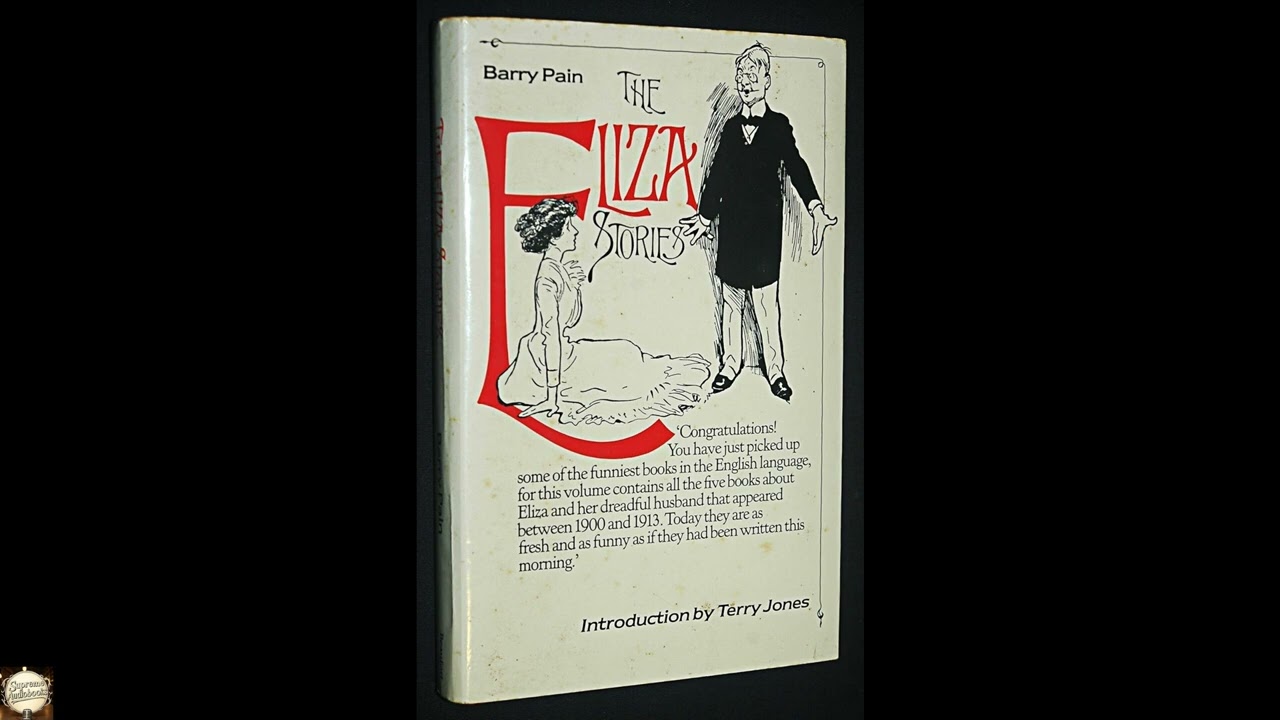
The Eliza Stories
Step into the slightly chaotic, endlessly charming world of Eliza, a suburban homemaker whose good intentions invariably lead to domestic comedy. Barry Pain's "The Eliza Stories" presents a delightful collection of vignettes, narrated by her long-suffering, yet deeply affectionate, husband. These tales offer a window into the everyday absurdities of early twentieth-century English life, painting a picture of marital dynamics, social expectations, and the enduring humor found in common human experience. Far from a dusty relic, Eliza's predicaments and her husband's dry observations resonate strongly even today, reminding us that the foibles of home life and human interaction are, indeed, universal. This is a chance to spend several hours in the company of characters who feel as real and as comically exasperating as any acquaintance. The setting for "The Eliza Stories" is unmistakably the English suburbs at the dawn of the twentieth century – a world of aspiring middle-class households, garden parties, and the quiet dramas of daily existence. Our central figures are Eliza herself, a woman of boundless energy and a somewhat questionable grasp of practicalities, and her unnamed husband, the narrator, whose witty, often ironic commentary frames each tale. Eliza's efforts to manage her household, entertain guests, or simply navigate the mundane tasks of life regularly spiral into humorous mishaps. Whether she's attempting to save money with disastrous results, offering unsolicited (and usually misguided) advice, or misunderstanding social cues, her husband is there to recount the unfolding comedy with a mixture of resignation and genuine fondness. There is no grand, overarching plot in the traditional sense, but rather a series of episodic adventures, each a self-contained exploration of Eliza's particular brand of charm and calamity. From arguments over household expenses to comical encounters with tradesmen, or even attempts at amateur theatricals, Eliza's world is one of constant, gentle upheaval. Her husband, often a passive participant in her schemes, provides the audience's perspective – a man who has learned to anticipate the inevitable complications that follow his wife's pronouncements, yet who remains devoted to her peculiar spirit. The arc of the "story" then becomes a continuous revelation of character, a prolonged, affectionate gaze at a marriage defined by its endearing eccentricities and the shared laughter that arises from life's smaller indignities. The creator of this enduring comedic duo was Barry Pain, born Edward Barry Pain in Cambridge, England, in 1864. After attending Corpus Christi College at Cambridge University, where he edited the undergraduate newspaper Granta, Pain initially pursued a career in journalism and teaching. His early promise as a writer was quickly recognized, and he became a prolific contributor to various prominent periodicals of his time, including the venerable Punch magazine, The Speaker, and Black and White. Pain quickly established a reputation for his light verse, parodies, and satirical sketches, often employing a subtly droll wit to comment on contemporary society. Throughout his career, Pain demonstrated a versatile talent, penning ghost stories, serious novels like The Winding Road, and collections of short fiction such as Stories in Grey. However, it was his keen observational humor, particularly evident in his domestic comedies, that secured his place in the literary landscape. Pain’s ability to find the comedy in everyday situations and to craft relatable characters like Eliza and her husband marked him as a distinctive voice among Edwardian humorists. He died in 1928, leaving behind a body of work that, while perhaps less widely known than some of his contemporaries, offers a unique and engaging glimpse into the comedic sensibilities of his era. Several potent themes emerge from these stories, providing more than just superficial amusement. Pain deftly illuminates the intricacies of domestic life and marital dynamics, showcasing the constant negotiation, affection, and occasional exasperation that define a long-term relationship. One might recall Eliza's attempts to "economize" by making her husband's clothes, resulting in garments that are a source of public embarrassment and private amusement, a scene that perfectly encapsulates the loving friction between them. Another core idea is social aspiration and class consciousness, particularly as experienced by the rising middle class. Eliza often grapples with maintaining appearances or adhering to perceived standards of gentility, frequently with comical misunderstandings. Her insistence on a certain type of dinner party, for instance, despite her husband's preference for simplicity, highlights these underlying social anxieties. Beyond these specifics, the stories reveal a profound understanding of the humor of the mundane. Pain consistently finds comedy in minor domestic crises – a forgotten umbrella, a mislaid item, a misunderstood instruction – demonstrating how even the smallest events can become sources of shared laughter or gentle conflict. Furthermore, the portrayal touches upon gender roles of the period. Eliza, with her spirited independence and often impractical suggestions, both embodies and playfully challenges the conventional image of the Edwardian wife, while her husband’s quiet resignation offers a counterpoint. These stories are not just funny; they are shrewd observations on the human condition, subtly encouraging reflection on our own relationships and social worlds. "The Eliza Stories" emerged during a fascinating transitional period in British history, primarily in the years just before and after the turn of the twentieth century. This was an era marked by the continued expansion of the suburban middle class, a segment of society whose domestic lives and social aspirations became fertile ground for writers like Barry Pain. The increasing literacy rates and the burgeoning popularity of magazines and periodicals created a substantial market for light, humorous fiction that offered gentle social commentary. As the Victorian era gave way to the Edwardian, there was a noticeable shift in sensibility, a move away from some of the heavier moralizing of earlier literature towards a lighter, more satirical tone that nonetheless held a mirror up to society. Pain's work fits squarely within this tradition, offering sketches that were both entertaining and subtly reflective of the cultural nuances of the time, allowing readers to see their own lives, albeit exaggerated, on the printed page. Listening to "The Eliza Stories" as an audiobook is a particularly rewarding experience. The humor, much like in a stage play, relies heavily on timing, inflection, and the interplay of voices. A skilled narrator can truly bring Eliza's boundless, sometimes misguided, enthusiasm to life, alongside her husband's dry wit and barely concealed fondness. The run length, several hours, makes it an ideal companion for a long drive, a series of household tasks, or simply a relaxed evening spent with a cup of tea. Listeners will appreciate the pacing, which allows each anecdote to unfold naturally, giving space for the subtle comedic beats and the narrator's knowing asides. Pay attention to the nuanced dialogue, the shifts in tone between Eliza's confident pronouncements and her husband's resigned observations, all of which contribute to an atmosphere of warm, intelligent amusement. This is a chance to truly immerse oneself in a bygone era, brought vividly to life through the spoken word.
Enjoyed The Eliza Stories? A few ways to support us
Audible & Amazon links are affiliate; we may earn a small commission at no extra cost.
About this production
Human narration by a volunteer reader from LibriVox.org, the public-domain audiobook project. LibriVox volunteers record literary works whose copyright has expired in the United States, releasing the resulting recordings into the public domain.
The Eliza Stories by Barry Pain. The underlying text is in the U.S. public domain. We do not republish any modern copyrighted edition, translation, or commentary.
The 4K cinematic visuals accompanying this audiobook are generated by an AI image model from prompts derived from the source text. No copyrighted photos, paintings, or stock footage are used. AI generation is disclosed on every video on our YouTube channel as required by YouTube's altered/synthetic content policy.
English subtitles are transcribed from the LibriVox recording with OpenAI Whisper. Translations into the 11 other supported languages are produced by Meta's NLLB-200 neural translation model. No human translator's copyrighted translation is used.
Questions about sourcing or rights? See our DMCA & Sourcing policy or contact us.
Enjoyed this audiobook?
If you'd like to own a copy of The Eliza Stories or hear a professionally produced edition, the links below help support free audiobook production at no extra cost to you.
As an Amazon Associate we earn from qualifying purchases. Audible / print links are affiliate.
![by Margaret [Harriet Margaret Stone Lothrop]. Sidney by Unknown — free full audiobook](https://img.youtube.com/vi/k_Gr_WSxsPA/maxresdefault.jpg)