Stories of Red Hanrahan - W. B. Yeats
Step into a realm where the veil between the ordinary and the enchanted is gossamer-thin, where the songs of ancient Ireland still echo, and where the human heart wrestles with the pull of the supernatural. Stories of Red Hanrahan, by the towering figure of Irish literature, W. B. Yeats, offers just such a passage. This collection of tales introduces us to an unforgettable character, an itinerant poet and schoolmaster named Owen Hanrahan, whose life becomes a poignant testament to the enduring power of myth, the artist's consuming quest for beauty, and the melancholic beauty of a world steeped in magic. To listen to these stories today is to understand not just the Ireland of a bygone era, but the universal human yearning for meaning and the often-perilous pursuit of a vision beyond the everyday. The setting for these narratives is the rural Ireland of the late 17th and early 18th centuries, a landscape rich with folklore, mist-shrouded hills, and cottages warmed by peat fires. It is a world where the Sidhe, the fae folk of Irish myth, are never far, their presence a constant, sometimes benevolent, often dangerous, influence on human lives. At the heart of these tales is Owen Hanrahan, a man of profound poetic passion and considerable learning, yet cursed with a restless spirit and a tendency towards ill-fated decisions. He is a figure of tragic grandeur, forever caught between his love for women and human companionship, and an overwhelming desire for spiritual knowledge and mystical experiences that often lead him astray. Hanrahan’s story unfolds across a series of interconnected episodes, each a vignette sketching another facet of his extraordinary, often sorrowful, existence. We witness his youthful romantic entanglements, his wanderings as a schoolmaster and then a vagrant poet, and his fateful encounters with figures from Irish legend. Whether he is spellbound by a mysterious deck of cards that foretell the future, drawn into the dance of the fae, or wrestling with the consequences of a past curse, Hanrahan’s life is a constant oscillation between moments of inspired poetic insight and periods of profound despair. His path is marked by a longing for the unattainable, leaving him perpetually adrift from worldly success and lasting peace, always shadowed by the ancient magic he so passionately pursues. The creator of these evocative stories was William Butler Yeats, one of the most significant literary figures of the 20th century. Born in Dublin in 1865, Yeats's childhood was deeply shaped by summers spent in County Sligo, in the west of Ireland, a region whose landscapes and folklore infused his imagination and became the wellspring of much of his creative output. The eldest son of the painter John Butler Yeats, he grew up in a household where art and intellectual discussion were paramount. His early life saw him drawn to mysticism and the occult, becoming involved with societies like the Theosophical Society and the Hermetic Order of the Golden Dawn, influences that undeniably appear in the supernatural elements of Stories of Red Hanrahan. Yeats's life was a testament to his passionate dedication to Ireland, both culturally and politically. He was a driving force behind the Irish Literary Revival, a movement that sought to create a distinctively Irish literature, drawing on native myths, legends, and history. In 1904, he co-founded the Abbey Theatre in Dublin, which became a vital institution for Irish drama. His long, unrequited love for the Irish revolutionary Maud Gonne informed much of his early poetry, lending it a profound emotional intensity. Yeats would later serve as a Senator of the Irish Free State, an independent Ireland he helped envision through his artistic endeavors. He was awarded the Nobel Prize in Literature in 1923, cementing his place as a global literary titan. Beyond these tales, his poetic collections such as The Wind Among the Reeds, The Tower, and The Winding Stair and Other Poems, alongside plays like Cathleen ni Houlihan, represent a remarkable body of work that transitioned from the lyrical romanticism of his youth to a starker, more modernist style in his later years. At their core, the Hanrahan stories give form to several potent literary themes. One prominent current is the lure of the supernatural and folklore, constantly demonstrating how the ancient, unseen world intersects with the lives of mortals. Hanrahan, for example, is given a mystical deck of cards by the Sidhe, which, when consulted, reveals not just the future of those he loves, but the dire consequences of his own choices, binding his fate inextricably to the magical realm. Another significant theme is the artist's isolation and suffering. Hanrahan's poetic sensibility, while a source of profound inspiration, often isolates him from conventional society, making him a perpetual wanderer, misunderstood and at times scorned, his art both a gift and a heavy burden. The tales also poignantly enact unrequited love and tragic romance. Hanrahan's passionate affections, such as his devotion to Mary Gillis, are consistently thwarted, not always by external forces, but often by his own spiritual distractions or the intervention of the supernatural, preventing him from finding simple, earthly happiness. Furthermore, a melancholic sense of the decline of traditional Ireland and its pagan past permeates the collection. Yeats often portrays a fading world of ancient magic and heroic sagas, slowly giving way to a more mundane, modern existence. This reflects his own sorrow for a spiritual heritage he felt was being lost, as he used these stories to re-enchant his homeland. These tales established a unique voice within Irish literature, blending genuine folk tradition with a profound poetic sensibility, serving as a prose counterpoint to Yeats’s early symbolic verse and furthering his goal of forging a modern Irish mythology. The historical backdrop against which Stories of Red Hanrahan emerged is crucial to understanding its resonance. The initial version of some of these tales appeared in The Secret Rose in 1897, with the revised and expanded collection appearing under its current title in 1904 and 1905. This period, the late 19th and early 20th centuries, was a time of immense cultural and political ferment in Ireland. The rise of Irish nationalism was gaining momentum, with figures like Yeats at the forefront of a movement to reclaim and reinvent Irish cultural identity after centuries of British rule. Organizations like the Gaelic League and the Irish Literary Theatre (later the Abbey) were dedicated to promoting Irish language, folklore, and drama, seeking to forge a new sense of national consciousness. This push for cultural self-definition led to a fervent revival of interest in ancient Irish myths, legends, and the broader spiritual heritage of the island. The Celtic Revival, in which Yeats was a central figure, was a direct response to this yearning, seeking to create a distinctly Irish literature that drew its strength from native themes, mythology, and linguistic patterns. It was also, in many ways, a reaction against the realism prevalent in Victorian literature, favoring instead symbolism, mysticism, and a romantic vision of a more heroic past. Stories of Red Hanrahan thus emerged from a deep cultural need: to define Ireland not just politically, but spiritually and aesthetically, by looking to its rich, mystical past to envision a powerful future. To experience Stories of Red Hanrahan as an audiobook is to gain an entirely new dimension of appreciation for Yeats’s lyrical prose and the powerful oral traditions that inspired him. The collection’s length—several hours—is perfect for focused listening, allowing the listener to fully immerse themselves in the distinct atmosphere of a mystical, rural Ireland. A skilled narrator can bring to life the nuanced cadences of Yeats’s writing, which often echoes the rhythms of Irish speech, making the folklore terms and names resonate with authenticity. Listen for how the narrator's voice conveys Hanrahan’s melancholic beauty, his moments of inspired poetic insight, and the subtle, often eerie, humor that weaves through the tales. The spoken word effortlessly bridges the gap between the listener and the ancient, magical world of Hanrahan, making the spirit of the stories tangibly present.
Enjoyed Stories of Red Hanrahan - W. B. Yeats? A few ways to support us
Audible & Amazon links are affiliate; we may earn a small commission at no extra cost.
About this production
Human narration by a volunteer reader from LibriVox.org, the public-domain audiobook project. LibriVox volunteers record literary works whose copyright has expired in the United States, releasing the resulting recordings into the public domain.
Stories of Red Hanrahan - W. B. Yeats by W. B. Yeats. The underlying text is in the U.S. public domain. We do not republish any modern copyrighted edition, translation, or commentary.
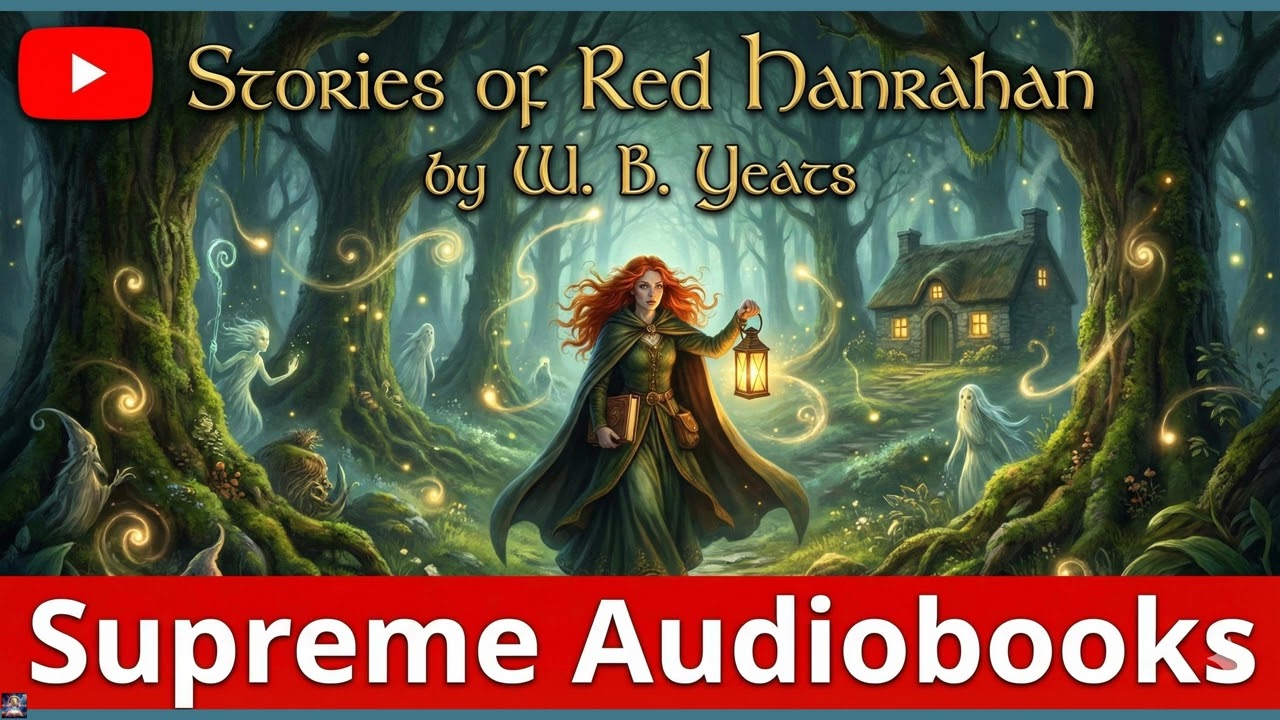
The 4K cinematic visuals accompanying this audiobook are generated by an AI image model from prompts derived from the source text. No copyrighted photos, paintings, or stock footage are used. AI generation is disclosed on every video on our YouTube channel as required by YouTube's altered/synthetic content policy.
English subtitles are transcribed from the LibriVox recording with OpenAI Whisper. Translations into the 11 other supported languages are produced by Meta's NLLB-200 neural translation model. No human translator's copyrighted translation is used.
Questions about sourcing or rights? See our DMCA & Sourcing policy or contact us.
Enjoyed this audiobook?
If you'd like to own a copy of Stories of Red Hanrahan - W. B. Yeats or hear a professionally produced edition, the links below help support free audiobook production at no extra cost to you.
As an Amazon Associate we earn from qualifying purchases. Audible / print links are affiliate.