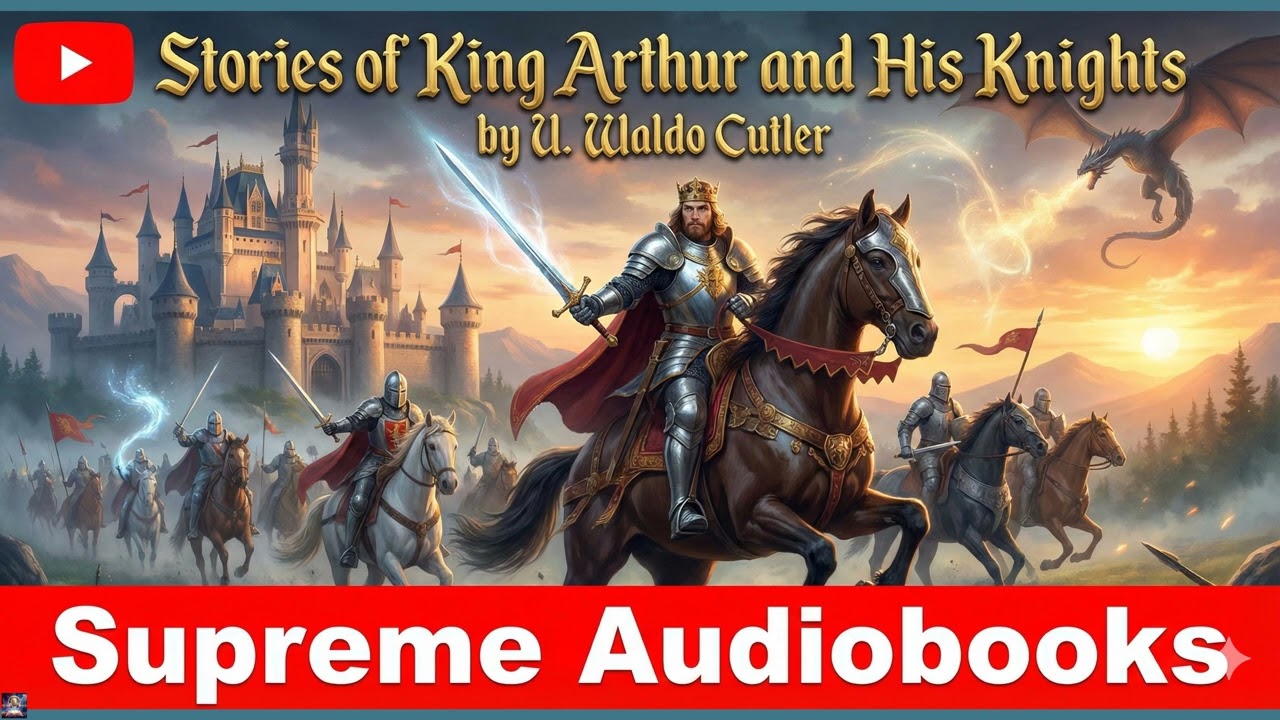
Stories of King Arthur and His Knights - U. Waldo Cutler
The legends of King Arthur and his Knights of the Round Table represent one of the most enduring and universally beloved cycles of storytelling in Western culture. More than mere folklore, these tales form a foundational myth—a powerful narrative about leadership, duty, courage, and the perennial struggle to establish a just society against the tide of chaos and human frailty. U. Waldo Cutler's "Stories of King Arthur and His Knights" offers a compelling entry point into this legendary world, presenting the saga with clarity and verve. It is an opportunity to reconnect with the archetypal hero who pulls the sword from the stone, the wise wizard who guides destiny, and the noble company who swore an oath to honor and truth. These tales confront timeless questions of what it means to be good, to lead, and to build something lasting, reminding us why they have resonated for centuries and continue to shape our understanding of heroism and morality today. The narrative begins with a glimpse into a tumultuous, fractured Britain, shadowed by ancient magic and plagued by warring factions. In this uncertain time, a young boy named Arthur, raised in ignorance of his true parentage, unexpectedly draws the legendary sword Excalibur from a stone, thereby revealing his rightful claim to the throne. Guided by the enigmatic sorcerer Merlin, Arthur sets out to unify the realm, establish peace, and create a kingdom founded on justice and chivalry. He gathers around him the finest warriors in the land—noble figures like Sir Lancelot, Sir Gawain, Sir Kay, and Sir Perceval—forming the legendary fellowship of the Round Table, where all knights sit as equals, bound by a sacred oath to protect the weak, uphold righteousness, and pursue truth. As Arthur's reign strengthens, Camelot becomes a beacon of civilization and virtue. The knights undertake perilous quests, battling fearsome beasts, wicked sorcerers, and treacherous foes, each adventure testing their courage, loyalty, and faith. We witness the grandeur of tournaments, the solemnity of vows, and a world still touched by enchantment. These stories illustrate the early triumphs of Arthur's court, depicting the forging of a golden age where ideals seem attainable and heroism shines brightly. Beneath this flourishing kingdom, however, seeds of future challenges are sown, hinting at the difficult choices and human frailties that even noble intentions cannot always overcome, setting the stage for more complex dramas. The ancient origins of the King Arthur tales are largely unknown, born from a tradition stretching back centuries. U. Waldo Cutler, however, is the dedicated reteller responsible for this particular collection. The legend itself evolved from a complex lineage, rooted in early Welsh chronicles and bardic poetry, gaining significant momentum with Geoffrey of Monmouth's pseudo-historical "Historia Regum Britanniae" in the 12th century. From there, French poets like Chrétien de Troyes embellished the narratives with courtly love and detailed knightly adventures, introducing beloved characters such as Lancelot. Later, Sir Thomas Malory famously compiled and synthesized many of these disparate threads into "Le Morte d'Arthur" in the 15th century, creating the most comprehensive and influential version of the tales that largely shaped the legend as we know it. U. Waldo Cutler, an American educator and writer born in 1876, distinguished himself by making classic literature and myth accessible to a broader audience, particularly younger readers. His work emerged in the early 20th century, when there was a keen interest in moral education and the transmission of cultural heritage through engaging retellings of foundational stories. Cutler's approach was to distill the grandeur and complexity of these centuries-old narratives into clear, compelling prose, ensuring the essential spirit and moral lessons of the Arthurian legends remained intact while being easily understood. He served as a bridge, connecting new generations to the wisdom and wonder embedded in these traditional narratives, much as many before him reinterpreted and preserved these foundational myths. His contribution lies in crafting a version that serves as both an introduction and a loving homage to the tradition. The Arthurian legends, as presented here, resonate with several profound and enduring themes. Central among them is the concept of chivalry and honor. This is evident in the strict code of conduct sworn by the Knights of the Round Table, who pledge mercy, protection for the weak, and truth. A concrete example appears in the many jousts and duels, where knights fight not merely for victory, but to uphold vows and demonstrate prowess in service of justice, often extending mercy to a defeated foe. These instances highlight the ideal of a warrior guided by a moral compass beyond simple conquest. Another powerful theme is that of destiny versus free will, particularly embodied in Arthur's own story. His destiny to rule is foretold by Merlin and confirmed by the miraculous drawing of the sword from the stone, yet his reign requires constant effort, strategic decisions, and the exercise of his own will to unite a fractured kingdom. The legends also wrestle with the burden of kingship, showcasing Arthur's struggle to balance personal desires with the needs of his realm, and the constant threat of internal strife. Finally, magic and the supernatural pervade the tales, from Merlin's prophecies and enchantments to Excalibur and the Lady of the Lake, grounding earthly struggles in wonder and cosmic significance, suggesting powers beyond human comprehension that guide or disrupt mortal affairs. U. Waldo Cutler's retelling of the Arthurian stories appeared in the early 20th century, a period marked by cultural shifts and a re-evaluation of national heritage. The turn of the century saw a blossoming of interest in medieval romance and folklore, partly fueled by the earlier Romantic movement and the Pre-Raphaelite Brotherhood, which idealized a purer, more noble past. This era also coincided with a growing emphasis on public education and the cultivation of character among young people. In America, where Cutler worked, there was particular interest in compiling and disseminating classic tales that could instill virtues like courage, loyalty, and integrity, deemed essential for citizens in a modernizing society. Such retellings served multiple purposes: they provided moral instruction, offered accessible engagement with literary classics, and contributed to a shared cultural identity. As societies grappled with rapid technological advancement and social change, returning to foundational myths offered continuity, a connection to timeless ideals, and a comforting reminder of heroism. Cutler's rendition fit neatly into this pedagogical and cultural landscape, offering a clear, engaging, and ethically resonant version of Britain's most cherished myth for a new generation. Experiencing "Stories of King Arthur and His Knights" as an audiobook offers a particularly immersive and powerful way to connect with these epic tales. The spoken word breathes new life into the ancient narratives, allowing the listener to absorb the grandeur of Camelot, the tension of a knightly duel, or the subtle wisdom of Merlin's counsel with immediacy. A skilled narrator brings distinct voices to the valiant knights and wise figures, enhancing dramatic exchanges and rendering mythical landscapes more vivid. The run length of several hours allows the listener to become fully enveloped in Arthur's world, following the arc of the kingdom's founding and the noble quests of its champions at an unhurried pace. This auditory format makes these stories ideal for quiet contemplation, during a commute, or on a long journey, allowing the age-old magic and moral weight of the legends to resonate personally.
Enjoyed Stories of King Arthur and His Knights - U. Waldo Cutler? A few ways to support us
Audible & Amazon links are affiliate; we may earn a small commission at no extra cost.
About this production
Human narration by a volunteer reader from LibriVox.org, the public-domain audiobook project. LibriVox volunteers record literary works whose copyright has expired in the United States, releasing the resulting recordings into the public domain.
Stories of King Arthur and His Knights - U. Waldo Cutler by U. Waldo Cutler. The underlying text is in the U.S. public domain. We do not republish any modern copyrighted edition, translation, or commentary.
The 4K cinematic visuals accompanying this audiobook are generated by an AI image model from prompts derived from the source text. No copyrighted photos, paintings, or stock footage are used. AI generation is disclosed on every video on our YouTube channel as required by YouTube's altered/synthetic content policy.
English subtitles are transcribed from the LibriVox recording with OpenAI Whisper. Translations into the 11 other supported languages are produced by Meta's NLLB-200 neural translation model. No human translator's copyrighted translation is used.
Questions about sourcing or rights? See our DMCA & Sourcing policy or contact us.
Enjoyed this audiobook?
If you'd like to own a copy of Stories of King Arthur and His Knights - U. Waldo Cutler or hear a professionally produced edition, the links below help support free audiobook production at no extra cost to you.
As an Amazon Associate we earn from qualifying purchases. Audible / print links are affiliate.