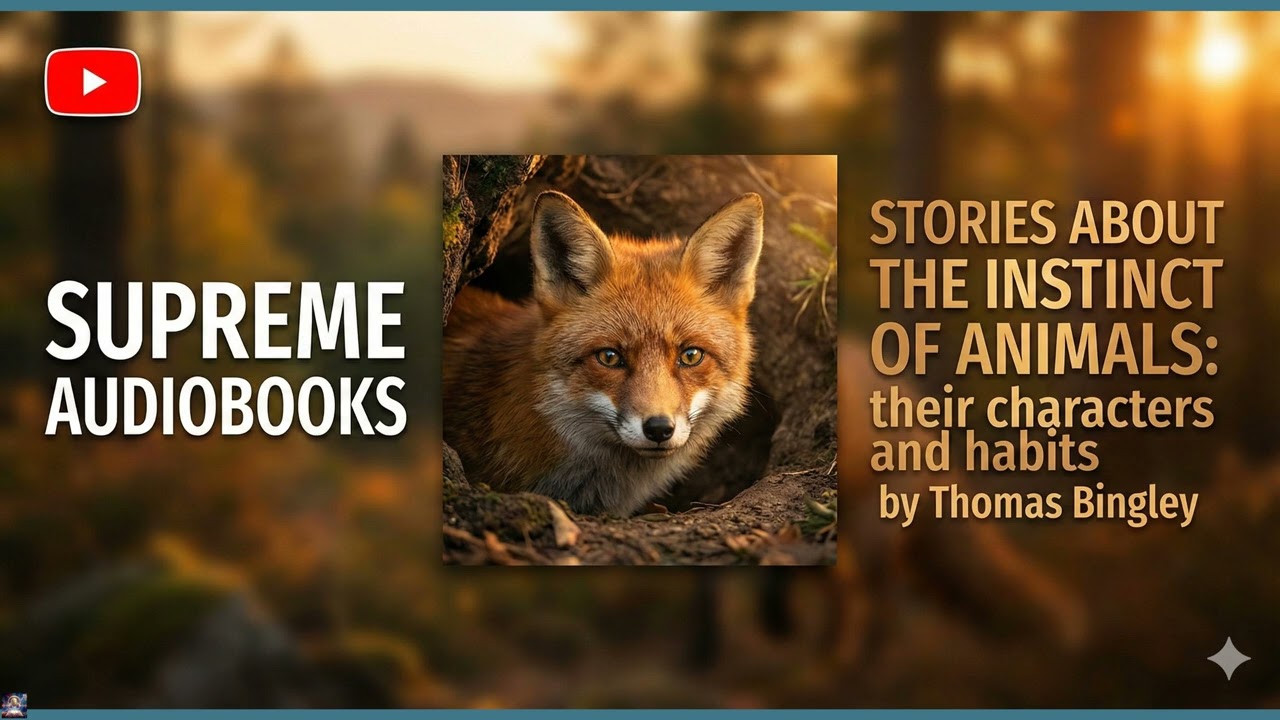
Stories About the Instinct of Animals: their characters and habits
"Stories About the Instinct of Animals: their characters and habits" by Thomas Bingle invites listeners to look closely at the creatures sharing our world, offering a window into the enigmatic forces that shape their existence. In an age where digital distractions often pull us away from the natural environment, Bingle's observations remind us of the profound mysteries unfolding in every forest, field, and even our own backyards. This is not merely a collection of anecdotes; it is a profound inquiry into the very essence of life beyond the human sphere, challenging us to re-evaluate our understanding of intelligence, purpose, and the deeply ingrained behaviors that guide the animal kingdom. The questions Bingle raises about animal instinct—how it manifests, why it persists, and what it tells us about life itself—remain as pertinent and thought-provoking today as they were when these pages were first penned, urging us to consider our own place within the grand design of nature. Rather than following a traditional narrative arc with human protagonists, "Stories About the Instinct of Animals" presents a meticulously compiled collection of natural observations, a series of literary portraits drawn from Bingle's careful study of wildlife. Each "story" serves as a focused case study, introducing listeners to a different creature—from the industrious beaver meticulously constructing its dam, to the migratory bird navigating unseen pathways across continents, to the cunning fox employing sophisticated strategies for survival. Bingle’s "characters" are the animals themselves, brought to life through his vivid descriptions of their routines, their interactions, and the specialized skills that define their species. The central aim of these collective stories is to unravel the complexities of instinct. Bingle methodically details specific behaviors: the intricate dance of a spider weaving its web, the communal spirit of an ant colony, the protective fury of a mother bear. He posits questions about whether these actions are purely pre-programmed, inherited traits, or if there's an element of learning, adaptation, or even primitive reasoning at play. Listeners are guided through a mental laboratory of Bingle’s own devising, where each animal becomes a subject in a quiet, unfolding drama of nature, demonstrating the extraordinary ingenuity and survival mechanisms inherent in the wild. The overarching "arc" of the book is less about a single plot resolution and more about a cumulative revelation. As Bingle moves from one species to another, comparing and contrasting their behaviors, a larger picture of instinct emerges. He builds a comprehensive understanding, piece by piece, of how these innate drives dictate life cycles, social structures, and individual expressions across the animal kingdom. The listener gains not a definitive answer, but a deeper appreciation for the nuanced continuum between reflexive action and adaptable intelligence, always with an eye toward the sheer wonder of animals living out their fundamental truths. Thomas Bingle belongs to a lineage of naturalists and thinkers who, around the turn of the last century, dedicated themselves to observing and interpreting the non-human world. While exact dates and specific biographical minutiae are not widely documented, his writing style and intellectual concerns firmly place him within an era burgeoning with scientific curiosity and a Romantic appreciation for wilderness. Bingle was, by all indications, a keen observer, often spending extended periods in quiet contemplation of the flora and fauna around him, preferring the patient vigil of the field to the confines of a research laboratory. His approach to natural history was distinctively humanistic, blending empirical observation with philosophical reflection. Unlike some of his contemporaries who focused solely on classification or anatomical study, Bingle sought to understand the character and habits of animals—the very things that animate them beyond mere biological function. He was less interested in simply cataloging species and more in deciphering the invisible forces that compel a salmon upstream or guide a wasp in nest construction. This empathetic yet rigorous perspective sets his work apart, making it not just a scientific account but a literary meditation on existence. Beyond "Stories About the Instinct of Animals," Bingle is rumored to have penned several essays and shorter treatises on ecological ethics and the subtle communications within nature, though these are less widely circulated. His contribution lies primarily in popularizing detailed natural observation for a general readership, fostering a sense of connection and respect for wildlife at a time when industrial expansion often overshadowed environmental consciousness. He stands as a quiet but influential voice in the broader movement that sought to bridge the gap between human understanding and the wild, inspiring countless readers to look anew at the world just beyond their doorsteps. One of the central themes that runs through Bingle's collection is the profound question of instinct versus learning. He presents compelling scenarios, such as the elaborate courtship displays of certain birds, which appear utterly pre-programmed and unwavering across generations, contrasting them with the adaptive problem-solving shown by a fox attempting to outwit a trap. Bingle prompts us to consider where the line blurs between an inherited behavioral blueprint and an acquired skill, illustrating how animals navigate their environments using both innate drives and surprising ingenuity. These observations challenge our simplistic categories, revealing a more fluid reality where complex behaviors arise from a dynamic interplay. Another significant theme Bingle addresses is the anthropomorphic impulse—our human tendency to project our own emotions and motivations onto animals. While acknowledging the danger of misinterpretation, he also suggests that empathetic understanding is crucial for true insight. For instance, he describes a mother bird defending her nest with what appears to be fierce maternal love, then thoughtfully questions whether this is a conscious emotion akin to human love or merely an unthinking, powerful instinct for species preservation. Through these thoughtful reflections, Bingle encourages a balanced perspective, allowing us to appreciate animal life on its own terms while still finding resonance with our own experiences. His book ultimately underscores the interconnectedness of all life, demonstrating how seemingly disparate species are bound by common struggles for survival, adaptation, and the perpetuation of life itself. Thomas Bingle’s "Stories About the Instinct of Animals" emerged during a period of intense public fascination with the natural world, a time when the echoes of Darwinian thought were still reverberating through society, prompting new questions about humanity's place in the broader animal kingdom. The late nineteenth and early twentieth centuries saw an an expansion of interest in natural history, driven by increased leisure time for some, advancements in amateur scientific equipment, and a growing concern for landscapes being transformed by industrialization. This era witnessed the rise of popular naturalists and essayists who brought the wonders of wildlife directly into people's homes, often blending scientific observation with accessible, evocative prose. Against this backdrop, Bingle's work resonated deeply. It appeared when natural history was transitioning from purely descriptive classification to more analytical inquiries into behavior and ecology. His focus on "instinct"—a concept central to both evolutionary theory and philosophical debate—positioned his book at the crossroads of science and humanistic understanding. It offered readers a chance to engage with complex biological ideas not through dry academic texts, but through engaging narratives about specific animals, satisfying a widespread desire to comprehend the non-human intelligences around them and to feel more connected to a rapidly changing world. Listening to "Stories About the Instinct of Animals" as an audiobook offers a singular opportunity to fully immerse oneself in Bingle's patient observations and thoughtful prose. The narrator's measured pace allows the listener to absorb each detailed account of animal behavior, picturing the industrious beaver or the soaring hawk as the descriptions unfold. A skilled narration brings Bingle's often reflective tone to the forefront, allowing his questions about instinct and animal character to linger, inviting contemplation. With several hours of content, this audiobook is perfectly suited for extended periods of listening—whether during a quiet walk in nature, a long commute, or simply as a calming presence while working. It transforms Bingle's written word into a spoken dialogue with the listener, fostering a deeper, more immediate connection to the natural world he so diligently observed.
Enjoyed Stories About the Instinct of Animals: their characters and habits? A few ways to support us
Audible & Amazon links are affiliate; we may earn a small commission at no extra cost.
About this production
Human narration by a volunteer reader from LibriVox.org, the public-domain audiobook project. LibriVox volunteers record literary works whose copyright has expired in the United States, releasing the resulting recordings into the public domain.
Stories About the Instinct of Animals: their characters and habits by Thomas Bingle. The underlying text is in the U.S. public domain. We do not republish any modern copyrighted edition, translation, or commentary.
The 4K cinematic visuals accompanying this audiobook are generated by an AI image model from prompts derived from the source text. No copyrighted photos, paintings, or stock footage are used. AI generation is disclosed on every video on our YouTube channel as required by YouTube's altered/synthetic content policy.
English subtitles are transcribed from the LibriVox recording with OpenAI Whisper. Translations into the 11 other supported languages are produced by Meta's NLLB-200 neural translation model. No human translator's copyrighted translation is used.
Questions about sourcing or rights? See our DMCA & Sourcing policy or contact us.
Enjoyed this audiobook?
If you'd like to own a copy of Stories About the Instinct of Animals: their characters and habits or hear a professionally produced edition, the links below help support free audiobook production at no extra cost to you.
As an Amazon Associate we earn from qualifying purchases. Audible / print links are affiliate.