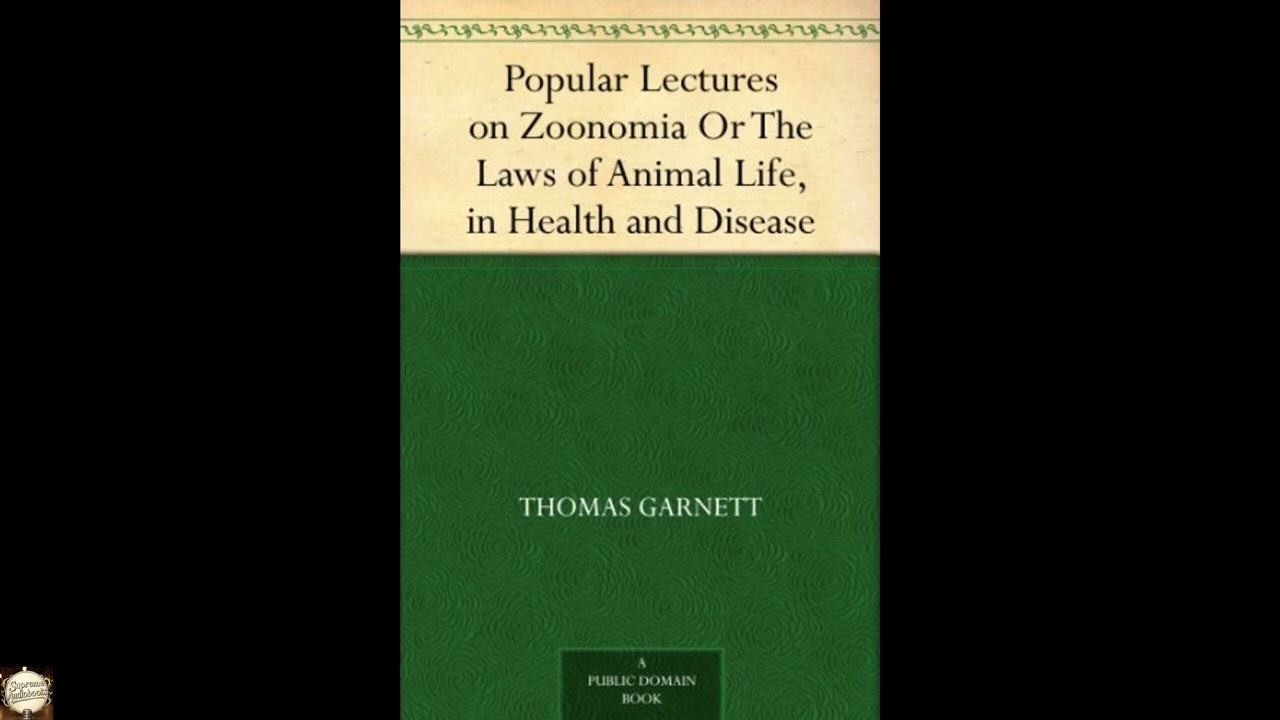
Popular Lectures on Zoonomia Or The Laws of Animal Life, in Health and Disease
Step back into a moment when the very essence of life, health, and disease was being re-examined through a nascent scientific lens. Popular Lectures on Zoonomia Or The Laws of Animal Life, in Health and Disease offers a rare opportunity to hear the thoughts that galvanized a generation, presenting a comprehensive, if historically specific, attempt to systematize our understanding of biological existence. This classic work, originally conceived to make complex physiological concepts accessible to a wider audience, remains a compelling document not just of scientific curiosity, but of the persistent human desire to find order and predictability in the bewildering mechanisms of the body and mind. It invites modern listeners to engage with the foundational ideas that shaped subsequent scientific inquiry, revealing the intellectual roots of disciplines from biology to psychology, and illustrating how early thinkers grappled with questions that continue to resonate today about wellness, malady, and the intricate dance of organic forces. The series of lectures commences by establishing a foundational framework for what the author calls "the laws of animal life." Picture a knowledgeable speaker, addressing an eager public assembly, carefully defining terms like "irritability" and "sensibility" not as mere philosophical concepts, but as fundamental properties inherent to all living matter. These early segments methodically dissect the minute building blocks of organic function, explaining how these basic forces operate in everything from the simplest organism to the complex human body. The central premise advanced is that all life, despite its apparent diversity, operates under a set of unified, observable laws, much like the laws governing the physical universe. As the lectures progress, the scope expands from these micro-level explanations to macroscopic observations, meticulously categorizing and analyzing various diseases and their perceived causes. The speaker guides the audience through examples drawn from common ailments, presenting a unified theory that attempts to link diverse symptoms and conditions back to disturbances in the fundamental laws of animal life. This systematic approach aims to move beyond anecdotal understanding, proposing instead a rational, interconnected system where health is harmony and disease is a disruption of this inherent order. The argument builds steadily, connecting mental states to physical health, the influence of environment, and the fascinating, often perplexing, processes of reproduction and growth, all without divulging the ultimate conclusions of the full scientific argument. While the specific author of these "Popular Lectures" remains unknown, the work is undeniably a direct intellectual descendant of Erasmus Darwin’s groundbreaking philosophical and scientific treatise, Zoonomia; or The Laws of Organic Life. Erasmus Darwin, a prominent English physician, natural philosopher, physiologist, inventor, and poet of the late eighteenth century, was a key figure of the Enlightenment, and notably, the grandfather of Charles Darwin. His original Zoonomia, published in two volumes in the 1790s, was an ambitious attempt to provide a comprehensive system of pathology and to explain the fundamental laws governing all organic life—from sensation and volition to reproduction and disease. He was a radical thinker for his time, proposing ideas about the transmutation of species and the interconnectedness of all living things, presaging later evolutionary theories. These "Popular Lectures" likely served as an accessible distillation or interpretation of Darwin’s complex ideas, designed to bring them to a broader, non-specialist readership. In an era when public lectures and popular science publications were crucial for disseminating knowledge, this work exemplifies a concerted effort to demystify advanced scientific concepts. It stands as a testament to the intellectual climate of the period, where figures like Erasmus Darwin challenged established dogma and sought rational, mechanistic explanations for the natural world. The work thus represents an important branch of scientific popularization, showcasing how intricate philosophical and biological theories were simplified and communicated to cultivate public understanding and engagement with the burgeoning fields of natural history and medicine. The text enacts several significant themes that resonate through its discussions of animal life. One core theme is the unity of organic life, asserting that all living beings, from plants to humans, share fundamental physiological mechanisms. The lectures illustrate this by drawing parallels between, for instance, the involuntary reactions of an irritably plant and the muscle contractions of an animal, suggesting a universal principle underpinning all animation. Another prominent theme is the mechanistic understanding of the body. The author presents the body not as an arena for mysterious forces, but as a complex machine governed by discernible "laws." This is evident in the detailed explanations of how stimulation leads to response, or how environmental factors mechanically alter bodily states, pushing against more mystical or superstitious explanations for illness prevalent at the time. A third major theme present is the interconnection of mind and body, or what was then understood as the "spirit" and "matter." The lectures frequently touch upon how emotions, thoughts, and sensory perceptions directly influence physical health and disease. For example, the text discusses how prolonged mental distress can manifest as physical ailments, or how a cheerful disposition can aid in recovery, demonstrating an early awareness of psychosomatic connections. Finally, a subtle but persistent theme is a proto-evolutionary notion of progressive development. While not articulating Darwin's theory of natural selection, the text hints at the idea that living forms adapt and change over time in response to their environment, and that a grand, underlying order guides the development of species. The speaker’s language often implies a developmental trajectory for life, from simpler to more complex organizations, reflecting a common intellectual current of the age. This seminal work emerged during a transformative period in Western thought: the late eighteenth and early nineteenth centuries. This was the Age of Reason, an era characterized by an intense belief in the power of human intellect to understand and master the natural world through observation, experimentation, and systematic classification. The scientific method was gaining prominence, challenging long-held dogmas and traditions rooted in religion or ancient philosophy. Culturally, there was a widespread public appetite for knowledge and enlightenment, fostering a burgeoning market for popular lectures, scientific societies, and accessible books that could disseminate new ideas beyond university walls. Politically, the era was marked by revolutionary changes, reflecting a broader societal questioning of established orders, mirroring the scientific dismantling of older paradigms. In this fertile intellectual environment, Zoonomia and its popular offshoots represented a significant effort to apply rational inquiry to the most complex of subjects: life itself, at a time when medicine was still grappling with basic understandings of anatomy and physiology, long before the advent of germ theory or modern genetics. Listening to Popular Lectures on Zoonomia Or The Laws of Animal Life, in Health and Disease as an audiobook offers a unique opportunity to immerse oneself directly in the intellectual atmosphere of a bygone era. The measured pace of the narration allows the listener to truly "attend" these historical lectures, absorbing the carefully constructed arguments and the methodical unveiling of biological principles. The speaker’s voice, often formal and didactic, captures the authority and persuasive tone characteristic of public scientific discourse from that time. One can appreciate the clarity and logical progression of the arguments, understanding how the lecturer strove to simplify profound concepts for a general audience without sacrificing intellectual rigor. The considerable run length of several hours provides ample space for a deep engagement with these ideas, inviting listeners to reflect on how our understanding of life and disease has evolved, and to recognize the enduring questions that connect us to these early scientific pioneers.
Enjoyed Popular Lectures on Zoonomia Or The Laws of Animal Life, in Health and Disease? A few ways to support us
Audible & Amazon links are affiliate; we may earn a small commission at no extra cost.
About this production
Human narration by a volunteer reader from LibriVox.org, the public-domain audiobook project. LibriVox volunteers record literary works whose copyright has expired in the United States, releasing the resulting recordings into the public domain.
Popular Lectures on Zoonomia Or The Laws of Animal Life, in Health and Disease by Erasmus Darwin. The underlying text is in the U.S. public domain. We do not republish any modern copyrighted edition, translation, or commentary.
The 4K cinematic visuals accompanying this audiobook are generated by an AI image model from prompts derived from the source text. No copyrighted photos, paintings, or stock footage are used. AI generation is disclosed on every video on our YouTube channel as required by YouTube's altered/synthetic content policy.
English subtitles are transcribed from the LibriVox recording with OpenAI Whisper. Translations into the 11 other supported languages are produced by Meta's NLLB-200 neural translation model. No human translator's copyrighted translation is used.
Questions about sourcing or rights? See our DMCA & Sourcing policy or contact us.
Enjoyed this audiobook?
If you'd like to own a copy of Popular Lectures on Zoonomia Or The Laws of Animal Life, in Health and Disease or hear a professionally produced edition, the links below help support free audiobook production at no extra cost to you.
As an Amazon Associate we earn from qualifying purchases. Audible / print links are affiliate.