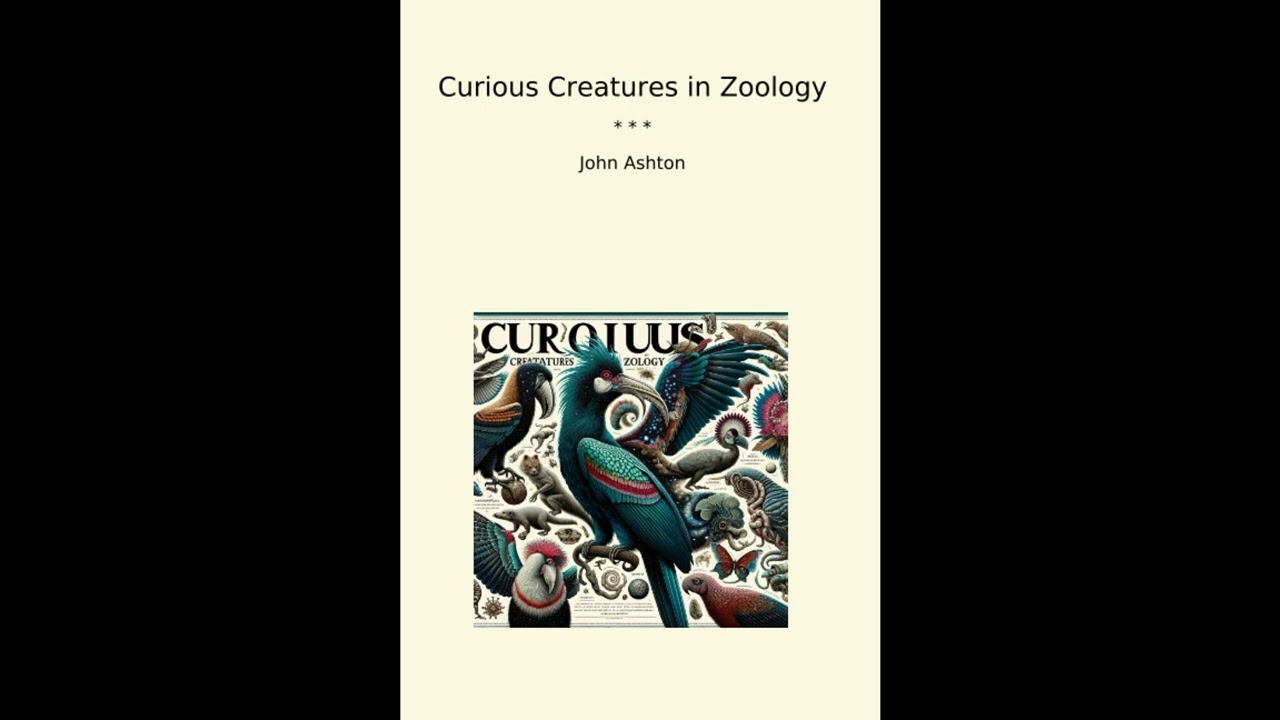
Curious Creatures in Zoology (Classic Books)
Step into a lost world where the boundaries between the real and the imagined blur, where every corner of the earth and sea held the potential for wondrous, terrifying, and utterly baffling life forms. John Ashton's Curious Creatures in Zoology is not merely a catalog of oddities; it is a fascinating glimpse into the human mind's persistent effort to classify, understand, and, often, invent the marvels of the natural world. This classic collection, presented now as an engaging audiobook, invites you to reconsider what our ancestors believed to be true about the animal kingdom and, in doing so, reflect on the enduring power of myth, the slow dawn of scientific inquiry, and the sheer delight of confronting the bizarre. It's a testament to the enduring human fascination with the unknown, a delightful and thought-provoking listen for anyone who has ever wondered what lurks beyond the verifiable. Ashton’s book serves as a remarkable compendium of zoological oddities, both legendary and misidentified, drawing from ancient texts, medieval bestiaries, travelogues, and early scientific observations. Listeners are transported through various cultures and epochs, encountering descriptions of creatures that defy modern classification. From the majestic and often benevolent unicorn, a symbol of purity and strength, whose horn was fabled to hold potent curative powers, to the fearsome dragon, a monstrous serpentine beast capable of flight and fire, Ashton meticulously compiles accounts of their alleged existence, their physical characteristics, and their impact on human lore and belief. The narrative progresses not through a traditional plot, but through a structured unveiling of these beings, moving from the overtly mythical to those creatures that, while strange, hint at misinterpretations of actual animals. The scope of this work is vast, encompassing a menagerie of the monstrous and the marvelous. We encounter the gruesome basilisk, whose gaze alone could bring death; the griffin, a powerful hybrid of lion and eagle guarding ancient treasures; and the seductive mermaid, luring sailors to their doom. But Ashton also addresses animals less obviously supernatural, yet still shrouded in mystery or superstition during earlier eras. He discusses peculiar marine life, land beasts from far-off continents imperfectly described by early explorers, and even mundane animals given exaggerated attributes by folklore. The central focus is the documentation of how people—scholars, commoners, and adventurers alike—perceived, explained, and reacted to the extraordinary, whether it sprang from the depths of the ocean, the wilds of uncharted lands, or the fertile grounds of human imagination. The story, then, is humanity’s relationship with the inexplicable, chronicled through its most fantastic beasts. John Ashton, born in London in 1845 and passing away in 1912, carved out a distinctive niche as a prolific English writer and illustrator, primarily focusing on historical curiosities and social history of Britain. He was a keen antiquarian, with a particular interest in the everyday lives and beliefs of past eras, often drawing directly from original documents, pamphlets, and broadsides. Ashton's work resonated with a Victorian public eager for accessible accounts of history and unusual facts, moving beyond dry academic texts. His other notable contributions include Social Life in the Reign of Queen Anne, The Dawn of the Nineteenth Century in England, and The Devil in Britain and America, all demonstrating his characteristic blend of scholarly rigor and engaging narrative style. Ashton belonged to a generation of popularizers who bridged the gap between academic research and public interest, making historical and cultural details widely available. His meticulous attention to source material, combined with an ability to present often arcane subjects with clarity and wit, earned him a dedicated readership. While not a figure of high literary modernism, his place in the literary landscape is secure as a diligent chronicler of social mores, forgotten customs, and the stranger corners of human belief, embodying the Victorian appetite for both enlightenment and entertainment through historical inquiry. His works continue to provide invaluable insights into the social fabric and intellectual curiosities of the past. Thematically, Curious Creatures in Zoology speaks volumes about the human impulse to comprehend the unknown. One prominent theme is the interplay between observation and imagination: Ashton frequently illustrates how limited scientific knowledge or misidentification could give birth to elaborate myths. For instance, early descriptions of rhinoceroses or narwhals, often based on second-hand accounts, sometimes contributed to the legend of the unicorn, showcasing how a kernel of reality could be transformed by cultural anxieties and desires. This highlights the fluidity of truth and belief in the pre-scientific age. Another key theme is the reflection of cultural values and fears within these fantastical zoologies. Dragons, for example, appear in various forms across the globe, often embodying chaos, greed, or divine power, depending on the cultural context. Ashton demonstrates how these creatures were not merely imaginative constructs but active participants in the moral and spiritual landscapes of their societies. Through detailed historical snippets, he reveals how these beasts provided explanations for natural phenomena, served as allegories for human virtues and vices, or simply stood as symbols of the untamed wilderness existing beyond human control. The late nineteenth century, when Ashton wrote and published, was a period of immense scientific discovery, but also one where popular interest in folklore and history remained strong. Darwin’s theories of evolution had profoundly reshaped biology, challenging old notions of creation and classification. Yet, parallel to this scientific progress, there was a public hunger for accounts of the marvelous and the mysterious, perhaps as a counterpoint to the increasingly rationalized world. Museums of natural history were expanding rapidly, bringing specimens from around the globe to the public eye, alongside exhibitions of "curiosities" that blurred the lines between genuine scientific discovery and outright spectacle. Ashton's work thus emerged at an interesting juncture: a time when the world was shrinking through exploration and scientific classification, yet still held vast pockets of mystery and a deep fascination with what lay beyond proven fact. His book served both as an entertaining diversion and a kind of historical anthropology, documenting how earlier generations made sense of a world far less understood than their own. It offered a window into the pre-scientific mind, at a time when Victorians were both celebrating their own advancements and looking back with nostalgic fascination at the superstitions and wonders of previous eras. Listening to Curious Creatures in Zoology as an audiobook offers a unique opportunity to immerse oneself in Ashton's rich prose. A skilled narrator brings a sense of wonder and gravitas to the descriptions, allowing the listener to truly visualize these legendary beasts and the historical contexts in which they thrived. The several hours of running time make it an ideal companion for long drives, quiet evenings, or moments when you wish to escape into a world of scholarly curiosity and imaginative possibility. Listen for the careful distinction the narrator makes between Ashton's objective reporting and the often hyperbolic claims of the original sources, allowing the author’s dry wit and fascination with his subject to shine through in every anecdote. The pacing will likely be measured, allowing Ashton’s detailed descriptions and historical tangents to unfold naturally, building a rich, atmospheric tableau of a bygone understanding of the animal kingdom.
Enjoyed Curious Creatures in Zoology (Classic Books)? A few ways to support us
Audible & Amazon links are affiliate; we may earn a small commission at no extra cost.
About this production
Human narration by a volunteer reader from LibriVox.org, the public-domain audiobook project. LibriVox volunteers record literary works whose copyright has expired in the United States, releasing the resulting recordings into the public domain.
Curious Creatures in Zoology (Classic Books) by John Ashton. The underlying text is in the U.S. public domain. We do not republish any modern copyrighted edition, translation, or commentary.
The 4K cinematic visuals accompanying this audiobook are generated by an AI image model from prompts derived from the source text. No copyrighted photos, paintings, or stock footage are used. AI generation is disclosed on every video on our YouTube channel as required by YouTube's altered/synthetic content policy.
English subtitles are transcribed from the LibriVox recording with OpenAI Whisper. Translations into the 11 other supported languages are produced by Meta's NLLB-200 neural translation model. No human translator's copyrighted translation is used.
Questions about sourcing or rights? See our DMCA & Sourcing policy or contact us.
Enjoyed this audiobook?
If you'd like to own a copy of Curious Creatures in Zoology (Classic Books) or hear a professionally produced edition, the links below help support free audiobook production at no extra cost to you.
As an Amazon Associate we earn from qualifying purchases. Audible / print links are affiliate.