Sir Francis Drake
The name Sir Francis Drake instantly conjures images of swashbuckling adventure, daring exploits, and the boundless spirit of an age defined by discovery and fierce national ambition. This compelling account, penned by Philip Nichols, offers a unique window into the life and times of one of England's most celebrated, and often controversial, naval heroes. More than a simple biography, this is a primary source document, an eyewitness testimony from the heart of the Elizabethan era, presenting Drake not merely as a historical figure, but as a living, breathing force who shaped the destiny of a nation. For anyone seeking to understand the foundations of English sea power, the dawn of global rivalry, or the sheer audacity of human endeavor, this narrative remains an essential and immediate read. Francis Drake’s remarkable story begins not in the gilded halls of power, but on the rugged coast of Devon, England, where he was born into a relatively humble family in the mid-sixteenth century. From his early days at sea, Drake quickly distinguished himself with a natural aptitude for navigation and an unyielding resolve. His initial voyages took him to the treacherous waters of the West Indies, where he first encountered the formidable might of the Spanish Empire. An infamous ambush at San Juan de Ulua, where Drake’s small fleet suffered heavy losses at the hands of the Spanish, ignited a lifelong vendetta and solidified his commitment to challenging Spain's supremacy on the global stage. These early encounters forged the legendary figure who would soon become a constant thorn in the side of King Philip II of Spain. As his reputation grew, so did the scale of his ambitions. Under the patronage of Queen Elizabeth I, Drake undertook his most famous expedition: a circumnavigation of the globe between 1577 and 1580. Aboard his flagship, the Golden Hind, he sailed through the Strait of Magellan, raided Spanish ports along the Pacific coast of South America, and claimed lands in what is now California for the English crown, naming it "Nova Albion." This audacious feat not only brought immense wealth back to England – gold, silver, and spices – but also cemented Drake's status as a national hero upon his triumphant return, earning him a knighthood from the Queen herself. His bold actions transformed privateering into state-sponsored warfare, blurring the lines between piracy and patriotism. The final chapters of Drake's active career are dominated by the escalating conflict with Spain. His celebrated raid on Cadiz in 1587, where he destroyed a significant portion of the Spanish fleet, was famously dubbed "singeing the King of Spain's beard" and delayed the planned invasion of England. When the Spanish Armada finally set sail in 1588, Drake played a pivotal role in the English defense. As Vice-Admiral, his strategic acumen and fearless leadership were instrumental in harassing and ultimately scattering the supposedly invincible Spanish fleet. This pivotal victory secured England's sovereignty and established its naval dominance for centuries to come, with Drake standing at the very heart of the unfolding drama. Philip Nichols was no distant historian or academic compiling facts from afar. He was, in fact, Sir Francis Drake's chaplain, accompanying him on some of his most significant voyages. This intimate relationship provided Nichols with unparalleled access to Drake's daily life, strategic decisions, and the dramatic events that unfolded before their eyes. His account is therefore not merely a record, but an immediate, firsthand narrative, infused with the perspectives, prejudices, and passions of the era. Nichols’ prose offers a direct connection to the men and moments he describes, making his work an invaluable primary source for understanding Drake’s career and the broader currents of late sixteenth-century Anglo-Spanish rivalry. Nichols’ motivation for writing was clearly to chronicle and celebrate the achievements of his patron. His meticulous attention to detail, combined with a chaplain's moral and spiritual framework, means his biography presents Drake as a righteous Protestant hero, often divinely favored in his battles against Catholic Spain. While reflecting the biases common to contemporary chroniclers, his writing style is direct and evocative, capturing the perils of sea travel, the intensity of naval engagements, and the wonder of new discoveries. It is this immediacy and authenticity that give Nichols' account its enduring power and historical weight, allowing us to perceive Drake as his own contemporaries saw him. As an early example of biographical writing in English, Nichols’ Sir Francis Drake holds a significant place in the literary canon. It predates many forms of modern history writing and serves as a vital document from an age where personal chronicles often formed the backbone of national history. It captures the unique blend of adventure, piety, and practical seafaring knowledge characteristic of Elizabethan prose. For scholars and general readers alike, it offers not only a portrait of Drake but also insight into the narrative conventions and intellectual climate of a period that shaped English national identity and its burgeoning imperial ambitions. Several prominent themes surface throughout Nichols' narrative, offering profound insights into the spirit of the age. One central idea is the powerful assertion of English National Identity and Protestantism. Drake's actions are consistently framed as a defense of Queen and country against the perceived tyranny of Catholic Spain. Nichols highlights moments like Drake’s determined raids on Spanish possessions and his resolve during the Armada crisis, portraying him as an instrument of divine will, safeguarding England’s Protestant faith and sovereignty against a religiously motivated foreign aggressor. These scenes underscore the deep intertwining of national pride and religious conviction that defined the period. Another compelling theme is that of Ambition and Daring. Drake's rise from a relatively humble background to become a knighted national hero epitomizes the opportunities available to individuals of immense talent and courage in a rapidly expanding world. His decision to sail into the largely uncharted Pacific, for instance, a sea previously dominated by Spain, was an act of audacious defiance that risked everything. Nichols conveys the sheer nerve required to undertake such an endeavor, demonstrating how personal drive could align with national interest to achieve seemingly impossible feats against overwhelming odds. The book celebrates a certain boldness that was crucial to England’s ascendance. The historical context surrounding the creation of Nichols’ account is crucial for understanding its impact and purpose. The late sixteenth century was a period of intense geopolitical and religious tension in Europe. Queen Elizabeth I's England, a relatively minor power at the start of her reign, was steadily growing in naval strength and challenging the long-standing dominance of Catholic Spain. The Protestant Reformation had created an ideological divide, turning political conflicts into holy wars. This era saw Spain’s vast colonial empire in the Americas producing immense wealth, which fueled English desires for similar gains and intensified the rivalry at sea. Drake’s actions were thus not isolated incidents, but reflections of this larger struggle for global supremacy and religious freedom. This was also a time when English literature was experiencing a renaissance, marked by a growing interest in documenting overseas ventures and national achievements. Works like Richard Hakluyt's Principall Navigations, Voiages, Traffiques and Discoueries of the English Nation compiled numerous first-hand accounts of English exploration. Nichols’ biography of Drake fits squarely within this tradition, serving as a powerful piece of contemporary history. It was published at a time when England needed heroes to rally around, and Drake, despite his piratical methods from a Spanish perspective, was undeniably presented as a triumphant champion, embodying the nation's burgeoning confidence and maritime prowess. Listening to Sir Francis Drake by Philip Nichols as an audiobook offers a singular experience. A skilled narrator can breathe life into Nichols’ archaic yet compelling prose, making the language accessible while preserving its historical authenticity. The narrative, spanning several hours, unfolds with a natural pace that allows listeners to fully immerse themselves in Drake’s expeditions, feeling the vastness of the oceans and the dramatic tension of naval battles. A strong vocal performance can highlight the urgency of Drake’s commands, the solemnity of shipboard prayers, and the wonder of encountering new lands, transforming a historical document into an immediate, personal encounter with a pivotal moment in global history. It is a chance to hear the story of an era-defining figure directly from someone who stood beside him.
Enjoyed Sir Francis Drake? A few ways to support us
Audible & Amazon links are affiliate; we may earn a small commission at no extra cost.
About this production
Human narration by a volunteer reader from LibriVox.org, the public-domain audiobook project. LibriVox volunteers record literary works whose copyright has expired in the United States, releasing the resulting recordings into the public domain.
Sir Francis Drake by Philip Nichols. The underlying text is in the U.S. public domain. We do not republish any modern copyrighted edition, translation, or commentary.
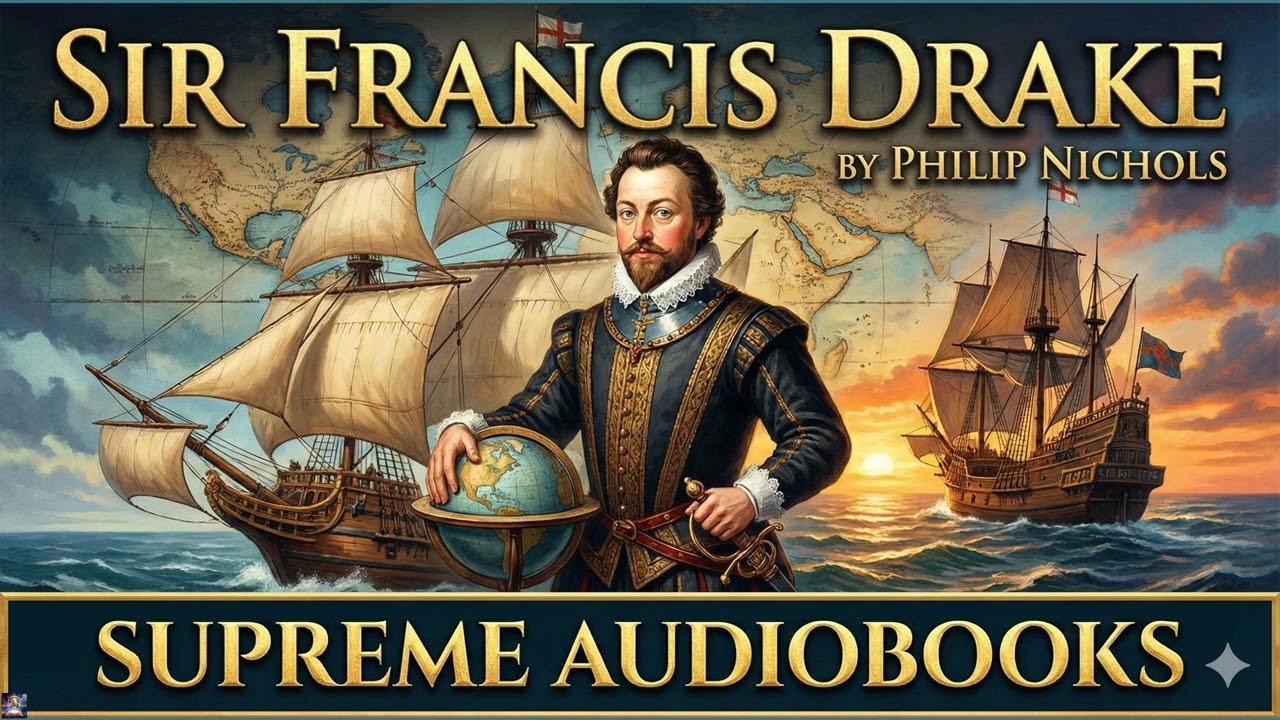
The 4K cinematic visuals accompanying this audiobook are generated by an AI image model from prompts derived from the source text. No copyrighted photos, paintings, or stock footage are used. AI generation is disclosed on every video on our YouTube channel as required by YouTube's altered/synthetic content policy.
English subtitles are transcribed from the LibriVox recording with OpenAI Whisper. Translations into the 11 other supported languages are produced by Meta's NLLB-200 neural translation model. No human translator's copyrighted translation is used.
Questions about sourcing or rights? See our DMCA & Sourcing policy or contact us.
Enjoyed this audiobook?
If you'd like to own a copy of Sir Francis Drake or hear a professionally produced edition, the links below help support free audiobook production at no extra cost to you.
As an Amazon Associate we earn from qualifying purchases. Audible / print links are affiliate.