Shorty McCabe On the Job
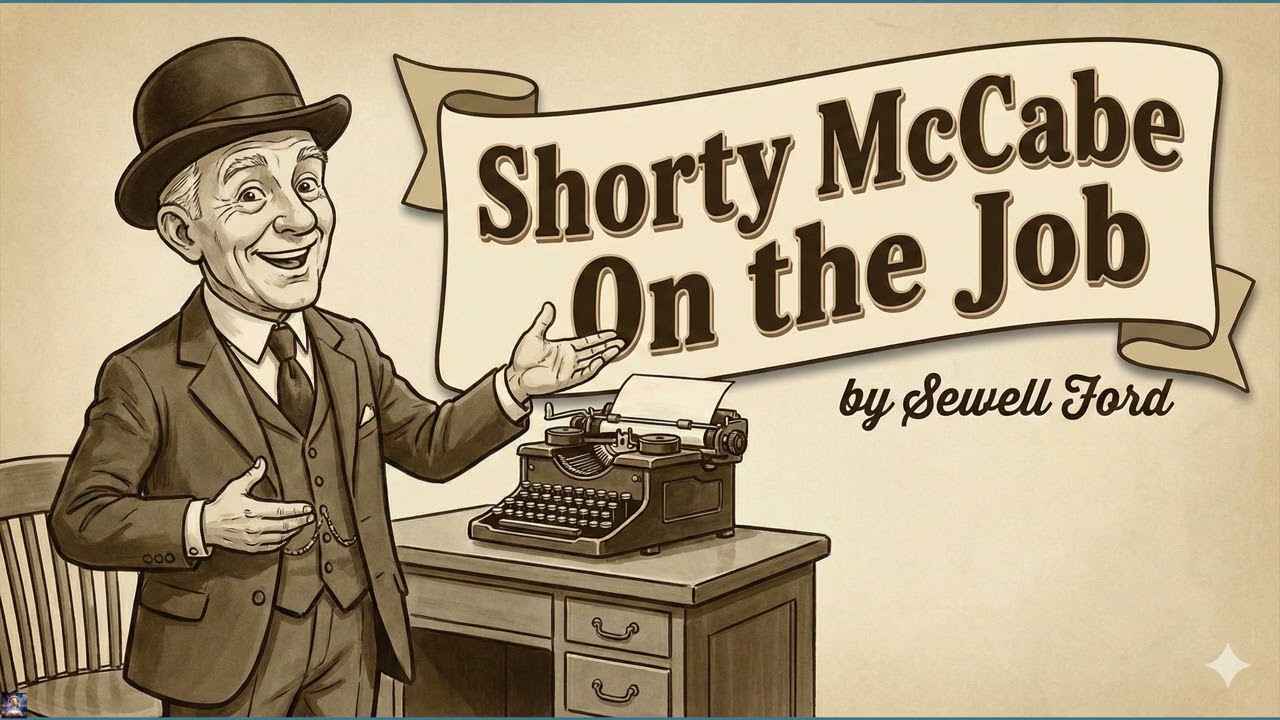
Step into the bustling, boisterous world of early 20th-century New York City, a landscape of horse-drawn cabs and nascent automobiles, where societal shifts were as constant as the clamor of the streets. Here, we meet Shorty McCabe, a character whose particular brand of street smarts and down-to-earth philosophy offers a refreshing counterpoint to the era's formal pretenses. Sewell Ford's "Shorty McCabe On the Job" introduces us to a former pugilist who has transitioned his considerable talents for observation and direct action into a unique career as a problem-solver, a "fixer" for hire. What makes Shorty so compelling, even a century later, is his unwavering belief in common sense and his ability to cut through the convoluted affairs of the well-to-do and the working stiff alike with unvarnished truth and good-natured grit. He represents an enduring American type: the resourceful individual who relies on wits and a strong moral compass when faced with the often absurd complications of modern life. The setting for Shorty McCabe's endeavors is New York City at the turn of the century, a metropolis rapidly expanding and evolving, teeming with a colorful cast of characters from every walk of life. From the smoky back rooms of boxing gyms to the plush drawing-rooms of Fifth Avenue, Shorty navigates a society where old money rubs shoulders with new industry, and the rules of engagement are often unwritten. Our protagonist, Shorty McCabe himself, is a man whose physical stature might belie his formidable intelligence and keen understanding of human nature. He’s a compact figure, always impeccably dressed in a way that suggests respectability without being flashy, a man who carries himself with the quiet confidence of someone who has seen a good deal of life from many angles. His past as a boxer has instilled in him a directness of approach, a refusal to be intimidated, and an innate understanding of strategy, which he now applies to social skirmishes and personal predicaments. Shorty's "job" often involves untangling misunderstandings, retrieving misplaced valuables, mediating disputes, or discreetly assisting those who find themselves in a bind, often without knowing exactly how they got there. He’s not a detective in the classic sense, but rather a human-relations expert with a knack for persuasion and a network of contacts throughout the city's diverse communities. Whether he's dealing with a society lady whose prized pet has gone missing under mysterious circumstances, a young couple whose courtship is being sabotaged by mischievous rivals, or a business deal gone awry, Shorty applies his unique blend of practical logic and good-humored cynicism. The central conflict in each of his cases typically arises from a failure of communication or a lapse in judgment, and Shorty's arc involves systematically peeling back layers of pretense to reveal the simple truth, often with a wry remark or a perfectly timed intervention that sets things right without resorting to elaborate schemes or overt force. His methods are straightforward, his insights sharp, and his ultimate goal is always to restore order and fairness to a world that frequently loses sight of both. Sewell Ford, the creator of Shorty McCabe, was a prominent American author who enjoyed considerable popularity in the early decades of the 20th century. Born in 1868, Ford was a prolific writer whose stories frequently appeared in magazines such as Munsey's Magazine, Everybody's Magazine, and The Saturday Evening Post. These publications were the primary venue for popular fiction of the era, reaching a wide national audience and shaping the literary tastes of millions. Ford made his home in the coastal town of Rye, New York, where he wrote steadily for several decades until his passing in 1946. Beyond the Shorty McCabe stories, Ford was also well-known for his "Torchy" series, which chronicled the adventures of another charismatic, street-smart character, often set against the backdrop of New York's rapidly changing social landscape. Ford's particular genius lay in his ability to craft memorable characters who resonated with the average American reader. His protagonists, like Shorty and Torchy, were not aristocratic heroes or shadowy detectives, but rather men of the people – shrewd, witty, and deeply human. His work captured the vernacular speech and social dynamics of his time, making his stories feel authentic and immediate. While he may not be a figure typically highlighted in academic literary curricula, Ford occupied a crucial place in American popular literature, providing entertainment and a distinct voice that reflected the spirit of an age grappling with urbanization, industrialization, and evolving social mores. He was a master of the short, episodic tale, perfectly suited for the magazine format, and he helped define the character-driven humor that appealed to a broad readership seeking diversion and a dose of plain-spoken wisdom. The stories of Shorty McCabe enact several enduring themes that remain relevant today. One prominent theme is the triumph of practical wisdom over formal knowledge. Shorty, with his boxing background and street education, consistently outmaneuvers individuals who possess academic credentials but lack true understanding of human nature. For example, he might resolve a complex family dispute simply by observing a seemingly insignificant gesture or listening to the unspoken anxieties of those involved, where a lawyer or a scholar might get bogged down in technicalities. This highlights the idea that genuine insight often comes from experience and empathy rather than abstract theory. Another significant theme is the power of observation and common sense in navigating a world often complicated by artifice and pretense. Shorty's greatest asset is his ability to see things as they truly are, stripping away social facades to get to the core of an issue. Furthermore, the book subtly addresses the evolving class dynamics of early 20th-century American society. Shorty, a man who works for a living and understands the struggles of ordinary people, frequently interacts with and advises the city's elite. He acts as a bridge between these disparate worlds, demonstrating that character and integrity are not confined to any particular social stratum. His interactions often expose the sometimes absurd concerns of the privileged, contrasted with the more grounded, relatable problems of those trying to make their way in a booming city. Through his steady demeanor and clear-eyed perspective, Shorty McCabe champions the inherent dignity and capability of the common person, making a quiet argument for egalitarian values in an era of pronounced social stratification. When Sewell Ford wrote the Shorty McCabe stories, America was experiencing a period of immense transformation. The late Gilded Age had given way to the Progressive Era, marked by rapid industrial growth, increasing urbanization, and significant social reform movements. Cities like New York were swelling with new immigrants and internal migrants, creating a diverse and sometimes chaotic social landscape. This was a time when popular culture was taking on new forms, with mass-market magazines becoming incredibly influential in shaping national identity and offering accessible entertainment. The stories emerged from an environment where readers craved relatable heroes who could navigate these changing times with wit and integrity. Ford's characters, like Shorty, offered a comforting familiarity amidst profound change, embodying an adaptable American spirit that found solutions through ingenuity rather than rigid adherence to tradition. The literary world itself was also in flux. While realism and naturalism were gaining academic traction, there remained a huge appetite for popular, character-driven serials that offered a lighter, more humorous perspective on daily life. Sewell Ford's work fit perfectly into this niche, providing entertaining, morally grounded narratives that resonated with a broad audience. He was part of a generation of writers who wrote specifically for the burgeoning magazine market, creating stories that were digestible, engaging, and reflective of contemporary American speech and concerns. His emergence during this period underscores the democratic nature of early 20th-century print culture, where a well-crafted story about a down-to-earth character could capture the public imagination as readily as more formally literary works. Listening to "Shorty McCabe On the Job" as an audiobook offers a singular opportunity to immerse oneself directly in the period and the character's distinctive voice. The narration experience itself is key to unlocking the charm of Ford's writing; a skilled narrator can bring to life Shorty's no-nonsense tone, his precise delivery, and the colorful slang of early 20th-century New York. The several hours of runtime provide ample space to settle into Shorty's rhythm, allowing listeners to appreciate the pacing of his observations and the often-humorous cadences of his dialogue. One can hear the bustling streets, the distinct accents, and the very atmosphere of a bygone era through the spoken word. The subtle humor, often conveyed through Shorty's dry wit and understated reactions, gains additional depth when interpreted by a narrator who understands the timing and nuance of Ford's writing. It becomes a vivid, auditory trip back in time, allowing the listener to truly grasp the spirit of Shorty McCabe and the world he so shrewdly inhabits.
Enjoyed Shorty McCabe On the Job? A few ways to support us
Audible & Amazon links are affiliate; we may earn a small commission at no extra cost.
About this production
Human narration by a volunteer reader from LibriVox.org, the public-domain audiobook project. LibriVox volunteers record literary works whose copyright has expired in the United States, releasing the resulting recordings into the public domain.
Shorty McCabe On the Job by Sewell Ford. The underlying text is in the U.S. public domain. We do not republish any modern copyrighted edition, translation, or commentary.
The 4K cinematic visuals accompanying this audiobook are generated by an AI image model from prompts derived from the source text. No copyrighted photos, paintings, or stock footage are used. AI generation is disclosed on every video on our YouTube channel as required by YouTube's altered/synthetic content policy.
English subtitles are transcribed from the LibriVox recording with OpenAI Whisper. Translations into the 11 other supported languages are produced by Meta's NLLB-200 neural translation model. No human translator's copyrighted translation is used.
Questions about sourcing or rights? See our DMCA & Sourcing policy or contact us.
View 10 famous quotes from this book →
Enjoyed this audiobook?
If you'd like to own a copy of Shorty McCabe On the Job or hear a professionally produced edition, the links below help support free audiobook production at no extra cost to you.
As an Amazon Associate we earn from qualifying purchases. Audible / print links are affiliate.