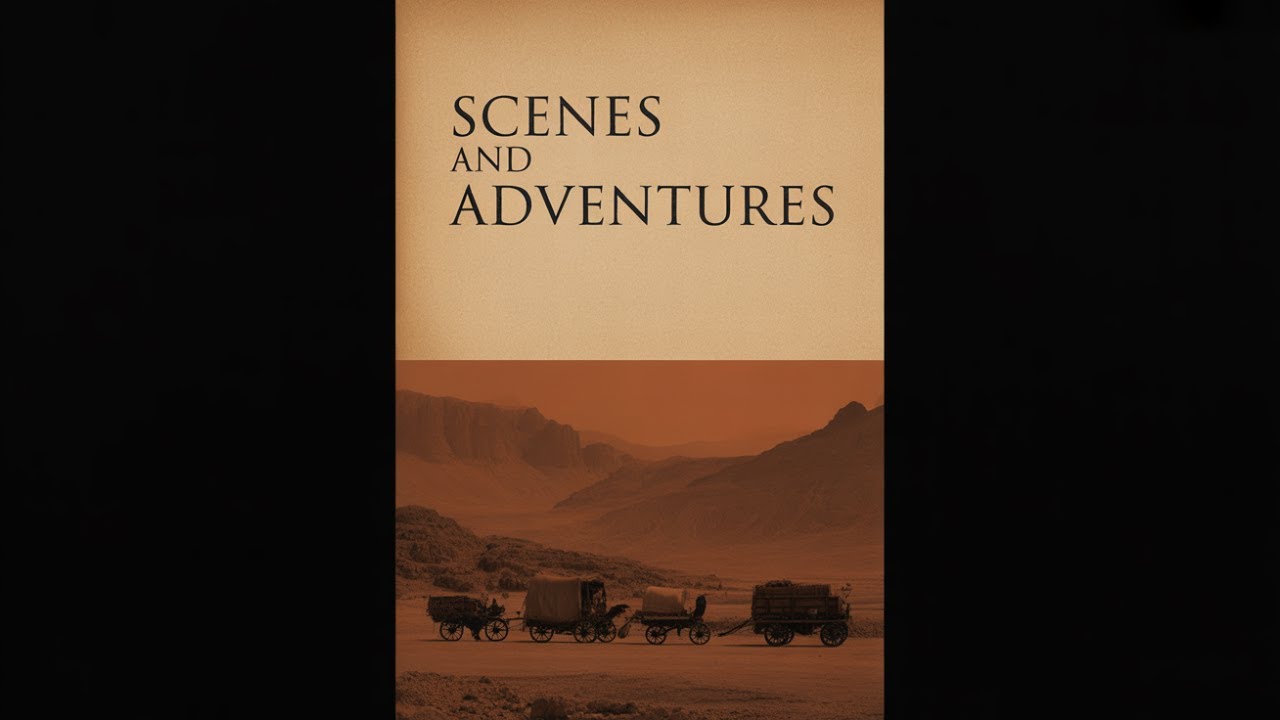
Scenes and Adventures in Affghanistan
"Scenes and Adventures in Affghanistan" stands as a rare artifact from a moment in history often misunderstood, then as now. This is no dry historical treatise, but a vivid recreation of a time and place through the eyes of William Taylor, deeply immersed in the political and physical landscape of nineteenth-century Afghanistan. His narrative provides a unique opportunity to witness the collision of cultures, the unforgiving beauty of a rugged country, and the trials of military and diplomatic life during a period of intense imperial ambition. Taylor's observations offer potent insights into the enduring complexities of a region that continues to shape global affairs, revealing how the echoes of past encounters resonate through the centuries, illuminating the human experience amidst geopolitical struggle. Taylor's account plunges listeners directly into the heart of Afghanistan, a land of stark mountains, windswept plains, and fiercely independent tribal communities. The narrative centers on the author's experiences as he navigates this formidable environment, encountering both the stunning grandeur of the landscape and the intricate, often perilous, political dynamics at play. We meet a diverse cast of characters – fellow British officers, Afghan chieftains, and the ordinary people whose lives are bound to the land and its upheavals. The setting is not merely a backdrop; it is an active participant in the story, dictating the pace of movement, providing both refuge and danger. The central conflict arises from the delicate and often brutal dance between the British imperial presence and the local Afghan populations. Taylor recounts skirmishes in narrow mountain passes, the tense negotiations with tribal leaders who deftly switch allegiances, and the daily struggles of maintaining a foreign presence in a land determined to resist external control. His perspective illuminates the challenges of vast supply lines, unpredictable alliances, and constant threats of ambush or betrayal. The story unfolds as a series of distinct episodes, each "scene" or "adventure" building to paint a comprehensive picture of life on the frontier of empire. While we follow Taylor through periods of intense military action and moments of quiet observation, the overarching arc of the narrative is one of adaptation and survival. He grapples with unfamiliar customs, the harsh realities of campaigning, and the moral ambiguities of his role. His encounters reveal the deep-seated pride of the Afghan people, their resilience, and the complexities that defy simplistic categorization. The narrative avoids neat resolutions, instead leaving the listener with a profound sense of ongoing tension and the human cost of these protracted encounters, ensuring the fate of any particular engagement remains a compelling mystery until the final pages. While specific dates for William Taylor's life and the publication of "Scenes and Adventures in Affghanistan" remain elusive, his writing firmly places him within the Victorian tradition of military memoir and travel literature. Taylor was almost certainly a British gentleman—perhaps an officer, a diplomat, or an administrator—whose duties or personal inclinations led him to the remote and strategic land of Afghanistan during a period of intense imperial activity. His prose suggests a man of education, a keen observer, and someone with a distinct talent for rendering complex situations and landscapes into compelling narrative. Taylor represents a type of writer prevalent in the mid to late nineteenth century: individuals who, through their service or curiosity, found themselves in distant corners of the British Empire and felt compelled to record their experiences. These accounts often served multiple purposes—informing the public back home, providing strategic intelligence, or simply satisfying a personal urge to document extraordinary events. While this work appears to be Taylor's most notable contribution, it stands as an exemplary instance of personal testimony that shaped public perception of imperial ventures and the "Great Game" rivalry. His writing style, characterized by its detailed descriptions, measured tone, and occasional flashes of personal reflection, positions him among figures who provided the British public with their primary understanding of foreign lands. Taylor's observations, though filtered through a nineteenth-century European sensibility, offer invaluable insights into the daily realities of colonial administration, military life, and cross-cultural interaction. He was not merely a chronicler of events, but an interpreter of a world vast and unfamiliar to most of his contemporary readers, securing his place, however quiet, in the broader canon of British travel and adventure writing. "Scenes and Adventures in Affghanistan" enacts several enduring themes that resonate far beyond its original context. One prominent theme is the clash of cultures, vividly depicted in Taylor's interactions with various Afghan tribes and leaders. He frequently notes profound differences in communication styles, social customs, and ethical frameworks. For instance, a scene describes Taylor's frustration during a negotiation where promises made in one context are disregarded in another, revealing the chasm between British contractual understandings and local, fluid loyalties based on family, clan, and immediate advantage. These cultural disparities often escalate into miscommunication, suspicion, and ultimately, conflict. Another significant theme is that of imperial ambition meeting fierce resistance. Taylor's account illustrates the immense logistical challenges and psychological strains of maintaining a foreign occupation in a land whose people consistently push back against external dominion. We see this in the arduous efforts to secure supply routes through treacherous passes, where small, seemingly insignificant local actions can cripple large military movements. His descriptions of guerrilla tactics employed by Afghan fighters against more conventionally equipped British forces underscore the potency of indigenous knowledge of the terrain and an unwavering will for self-determination. The book subtly questions the premise of the imperial endeavor, showcasing the sheer human cost and the futility of imposing an alien order on such a proud and independent populace. William Taylor's "Scenes and Adventures in Affghanistan" emerged during a pivotal era in global politics—the height of the British Empire and the intense rivalry known as the "Great Game." Throughout the mid-nineteenth century, Britain and Russia vied for influence over Central Asia, seeing Afghanistan as a crucial buffer state guarding the routes to India, the jewel in Britain's imperial crown. This geopolitical struggle fueled military expeditions and diplomatic maneuvering, making Afghanistan a strategic hotbed. Culturally, the British public possessed an insatiable appetite for accounts from distant lands, driven by scientific curiosity, imperial pride, and a romanticized view of adventure. Such narratives served to inform, entertain, and often justify the empire's expansionist policies. Works like Taylor's provided a ground-level perspective, contrasting with official dispatches and offering a more humanized—though still colonial—glimpse into the realities of imperial outreach. They allowed readers back home to visualize the landscapes, understand the peoples, and vicariously participate in the dangers and triumphs of imperial life. "Scenes and Adventures in Affghanistan" is thus a product of its time, born from the confluence of strategic necessity, public fascination with the exotic, and the literary tradition of personal narrative as a means of understanding and documenting a rapidly expanding world. Listening to "Scenes and Adventures in Affghanistan" as an audiobook transforms Taylor's historical observations into a living experience. A skilled narrator brings Taylor's distinctive voice to life—a voice that carries the measured tone of a nineteenth-century observer, yet also the urgency and occasional awe of a man witnessing extraordinary events. The several hours of listening time allow for a truly immersive experience, perfect for long drives, thoughtful walks, or quiet evenings, letting the listener absorb the intricate details of Taylor's descriptions. The narrator's pacing subtly shifts from the rapid cadence of a skirmish to the slow, contemplative rhythm of a landscape description, emphasizing the constant oscillation between action and reflection. The nuanced delivery of dialogue, even across cultural barriers, helps to establish the distinct personalities of the various figures Taylor encounters, while the atmospheric sound of the narration itself evokes the vast, challenging terrain and the palpable tension of a volatile frontier, making this more than just a history lesson—it is an entry into a distant world.
Enjoyed Scenes and Adventures in Affghanistan? A few ways to support us
Audible & Amazon links are affiliate; we may earn a small commission at no extra cost.
About this production
Human narration by a volunteer reader from LibriVox.org, the public-domain audiobook project. LibriVox volunteers record literary works whose copyright has expired in the United States, releasing the resulting recordings into the public domain.
Scenes and Adventures in Affghanistan by William Taylor. The underlying text is in the U.S. public domain. We do not republish any modern copyrighted edition, translation, or commentary.
The 4K cinematic visuals accompanying this audiobook are generated by an AI image model from prompts derived from the source text. No copyrighted photos, paintings, or stock footage are used. AI generation is disclosed on every video on our YouTube channel as required by YouTube's altered/synthetic content policy.
English subtitles are transcribed from the LibriVox recording with OpenAI Whisper. Translations into the 11 other supported languages are produced by Meta's NLLB-200 neural translation model. No human translator's copyrighted translation is used.
Questions about sourcing or rights? See our DMCA & Sourcing policy or contact us.
Enjoyed this audiobook?
If you'd like to own a copy of Scenes and Adventures in Affghanistan or hear a professionally produced edition, the links below help support free audiobook production at no extra cost to you.
As an Amazon Associate we earn from qualifying purchases. Audible / print links are affiliate.