Rubaiyat of Doc Sifers
The name James Whitcomb Riley might conjure images of whimsical children’s verses or sentimental depictions of rustic life. While he certainly gifted the world beloved figures like Little Orphant Annie, one of his overlooked narrative poems offers a profound and touching look at the quiet dignity of a country doctor and the community he serves. "Rubaiyat of Doc Sifers" isn't merely a collection of verses; it's a meticulously observed portrait, a narrative mosaic pieced together from the daily rhythms of a small, late-nineteenth-century Indiana town. This is not a book about grand adventures or epic conflicts. Instead, it invites the listener to step into a bygone era, to understand the subtle heroism found in compassion, duty, and unwavering presence. Its gentle wisdom and humane spirit speak across the decades, reminding us of the enduring value in slowing down, connecting with neighbors, and recognizing quiet strength in everyday acts of care. Set against the backdrop of an unassuming Indiana village--a place where the changing seasons dictate much of life's pace and the local general store serves as a vital hub--"Rubaiyat of Doc Sifers" introduces listeners to its central figure, Dr. Sifers himself. He is not a man of great speeches or dramatic pronouncements, but rather one defined by his actions and his deep connection to the people around him. From the earliest hours of a winter morning, through dusty summer afternoons, and into quiet reflective evenings, the doctor navigates the demands of his calling. We see him making his rounds, his buggy often the only sign of movement on deserted country roads, responding to urgent calls of sickness and injury, or simply offering a reassuring word to a worried family. The poem unfolds through a series of vignettes, each stanza acting as a window into the doctor's world and the lives he touches. We see him at the bedside of a child suffering from fever, offering gentle comfort and practical advice. We witness his quiet vigilance as he monitors a slow recovery, and his shared sorrow when a life is lost. His patients range from the boisterous farmer with a broken limb to the frail elderly woman battling a persistent cough. Through these episodes, Riley gradually builds a comprehensive picture of a community where the doctor is not just a medical professional, but a confidant, friend, and indispensable pillar. His "rubaiyat"--a Persian poetic form typically made of quatrains--becomes his life's observations, his philosophy, his quiet chronicle of human experience. James Whitcomb Riley, affectionately known as "The Hoosier Poet," was born in 1849 in Greenfield, Indiana, a place that would forever shape his artistic vision. His early life was marked by a restlessness that eventually led him away from formal education, instead opting for a varied series of jobs--from sign painter and travelling showman to newspaper writer. This unconventional path, however, proved invaluable, immersing him directly in the vernacular speech, customs, and character of rural America. It was this authentic voice, particularly his mastery of local dialect, that would later define his poetry and cement his widespread appeal. Riley began his career by contributing poems to Indiana newspapers, often under pseudonyms, before gaining national recognition. His work, including perennial favorites like "Little Orphant Annie," "The Raggedy Man," and "When the Frost Is on the Punkin'," endeared him to millions, making him one of the most popular American poets of the late 19th and early 20th centuries. Riley's unique ability to blend humor with sentimentality, and to render the everyday lives of ordinary people with warmth and empathy, struck a chord with a public grappling with rapid societal change. He belonged to a generation of "local color" writers who sought to capture the distinct flavor of specific regions, preserving their traditions and dialects amidst encroaching uniformity. Riley's place in the literary canon often sees him as a populist voice, a poet of the people, whose authentic portrayal of Midwestern life created a lasting legacy. He passed away in 1916, leaving behind a body of work that continues to evoke a particular era and sensibility. "Rubaiyat of Doc Sifers" stands as a poignant testament to several core human values, chief among them the nobility of service and compassionate duty. Doc Sifers embodies this theme through his unwavering commitment to his patients, regardless of the hour, the weather, or their ability to pay. We see him leaving his warm bed in the dead of night to attend an urgent case, his personal comfort always secondary to the needs of others. His simple, persistent presence, offering not just medicine but also reassurance and human connection, highlights the profound impact one dedicated individual can have on an entire community. This is the quiet, sustained heroism of daily obligation met with an open heart. Another prominent theme resonating throughout the poem is the essential nature of community and interdependence. Doc Sifers isn't an isolated figure; he is woven into the very fabric of the village. His life is inextricably linked to the lives of his neighbors, whose joys and sorrows he shares. When a child recovers, the relief is palpable not just for the family, but for the doctor and the wider village, underscoring how deeply connected their fates are. Furthermore, Riley's work consistently celebrates the wisdom found in simplicity and rural life. The poem gently contrasts the straightforward virtues of the countryside with the perceived complexities of urban existence, finding profound truths in the rhythms of nature, the directness of human relationships, and the unpretentious dignity of working people. It's a quiet argument for the enduring value of a life lived close to the land. Published in 1897, "Rubaiyat of Doc Sifers" emerged from a fascinating and transformative period in American history. The late nineteenth century was a time of immense change, characterized by rapid industrialization, burgeoning cities, and a significant shift from an agrarian society to one increasingly dominated by factories and commerce. This era saw vast wealth accumulation alongside growing social inequalities and anxieties about the erosion of traditional values. Culturally, there was a widespread yearning for a simpler, more stable past--a nostalgic impulse that found rich expression in literature. Literarily, while movements like realism and naturalism were gaining traction, exploring the realities of modern life, there was also a strong and popular counter-current: regionalism and local color writing. Authors like James Whitcomb Riley provided comfort and familiarity by depicting specific American locales, their unique dialects, and local customs, often with a sentimental glow. "Rubaiyat of Doc Sifers" can be understood as Riley's contribution to this longing for the pastoral, for a vision of America where community bonds were strong and figures like the country doctor represented stability and humane care. The poem speaks to a specific cultural moment, offering solace and a reaffirmation of enduring human values amidst a rapidly modernizing nation. To truly appreciate the warmth and resonance of "Rubaiyat of Doc Sifers," hearing it spoken aloud is an experience unlike any other. James Whitcomb Riley crafted his verses with an ear for rhythm and the nuances of Midwestern American dialect, elements that spring to life through skilled narration. The "several hours" runtime allows ample opportunity to settle into the leisurely pace of village life, to inhabit the world Doc Sifers moves through. A gifted narrator can capture the subtle humor, the underlying pathos, and the quiet dignity embedded in Riley's language, lending specific voices to the various villagers and imbuing Doc Sifers with the gentle authority and compassion that define him. Listen closely for the distinct cadences of Riley's spoken-word style, the way he uses sound to evoke character and setting, and the atmospheric qualities that transport you directly into a bygone Indiana. This listening experience offers a direct connection to the heart of the poem, making its wisdom and sentiment feel immediate and deeply personal.
Enjoyed Rubaiyat of Doc Sifers? A few ways to support us
Audible & Amazon links are affiliate; we may earn a small commission at no extra cost.
About this production
Human narration by a volunteer reader from LibriVox.org, the public-domain audiobook project. LibriVox volunteers record literary works whose copyright has expired in the United States, releasing the resulting recordings into the public domain.
Rubaiyat of Doc Sifers by James Whitcomb Riley. The underlying text is in the U.S. public domain. We do not republish any modern copyrighted edition, translation, or commentary.
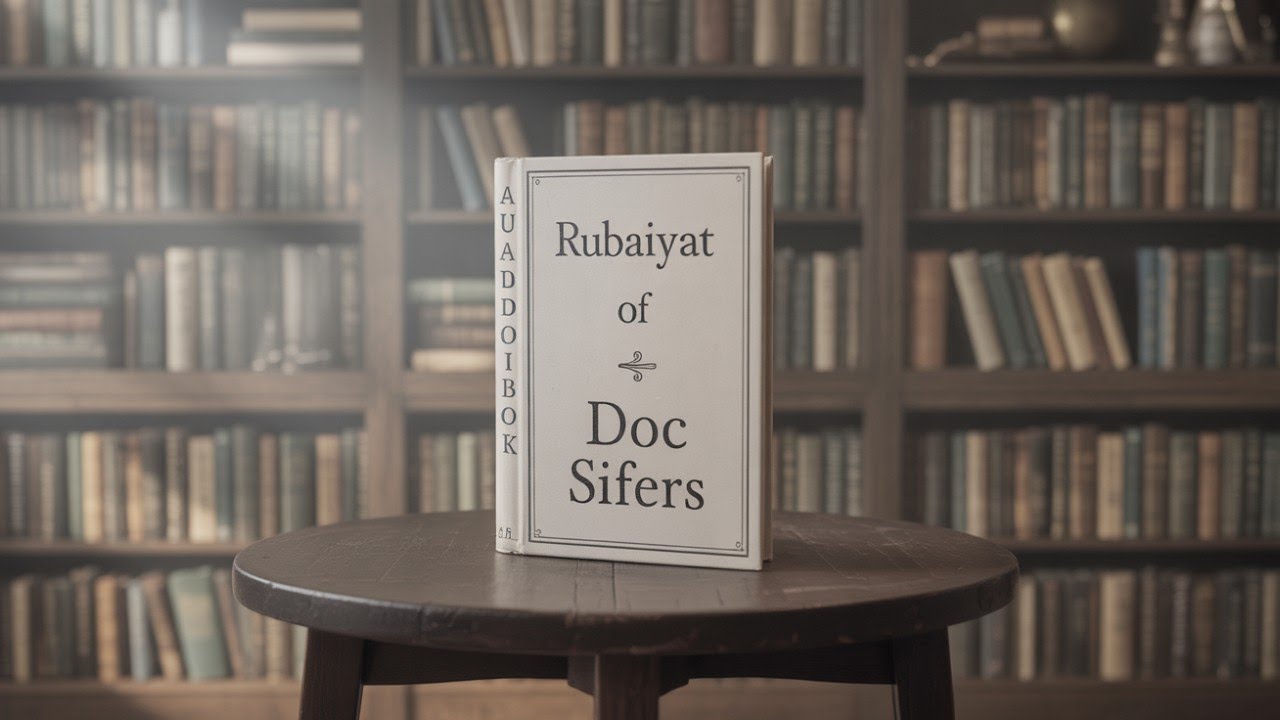
The 4K cinematic visuals accompanying this audiobook are generated by an AI image model from prompts derived from the source text. No copyrighted photos, paintings, or stock footage are used. AI generation is disclosed on every video on our YouTube channel as required by YouTube's altered/synthetic content policy.
English subtitles are transcribed from the LibriVox recording with OpenAI Whisper. Translations into the 11 other supported languages are produced by Meta's NLLB-200 neural translation model. No human translator's copyrighted translation is used.
Questions about sourcing or rights? See our DMCA & Sourcing policy or contact us.
Enjoyed this audiobook?
If you'd like to own a copy of Rubaiyat of Doc Sifers or hear a professionally produced edition, the links below help support free audiobook production at no extra cost to you.
As an Amazon Associate we earn from qualifying purchases. Audible / print links are affiliate.