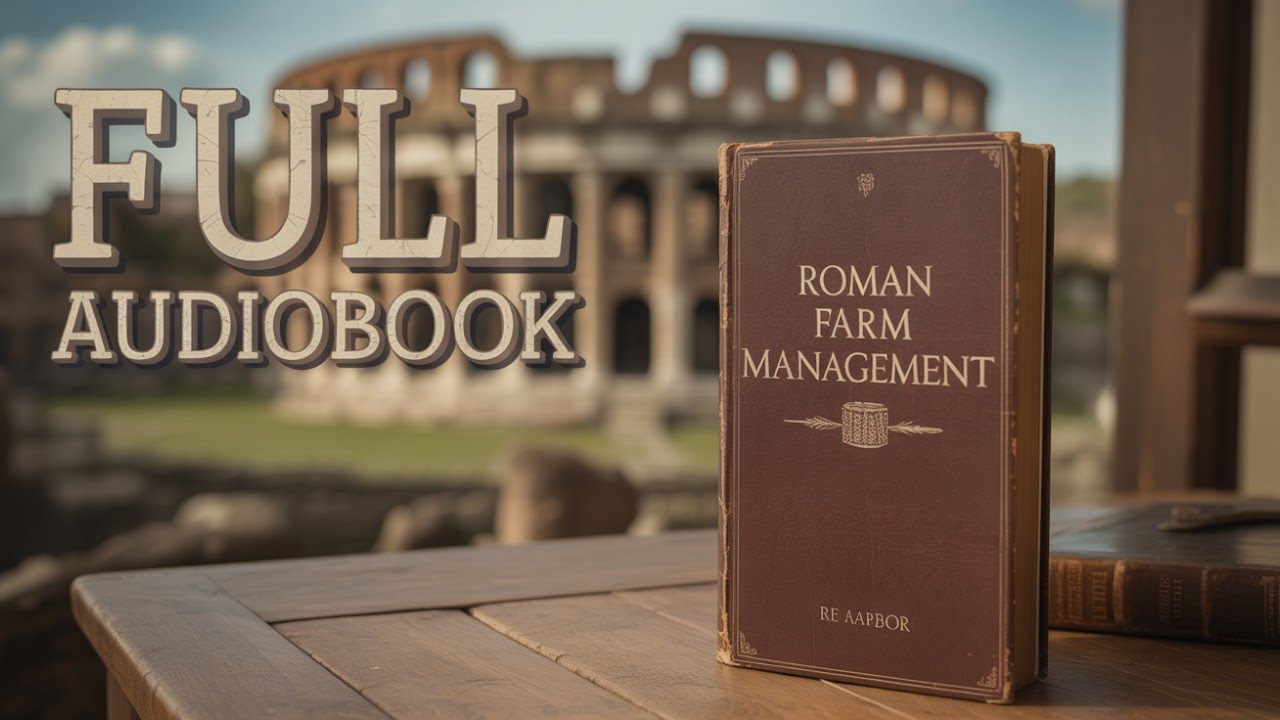
Roman Farm Management The Treatises Of Cato And Varro
Imagine a world built not on algorithms or financial markets, but on the earth itself – on the meticulous planting of olives, the careful tending of vineyards, the unwavering rhythms of the seasons. For ancient Romans, agriculture was more than just a means of subsistence; it was the bedrock of their society, their economy, and their very identity. Roman Farm Management: The Treatises of Cato and Varro invites listeners to step into this foundational world, presenting two of the most significant practical guides to farming from antiquity. These texts, written centuries apart, offer a window into the Roman understanding of efficiency, resourcefulness, and the profound connection between the land and prosperity. Even today, their insights into labor management, sustainability, and profit-driven enterprise hold a surprising relevance for anyone interested in the enduring principles of effective stewardship and the tangible realities of cultivating a livelihood from the soil. The narrative of these combined treatises unfolds as a practical manual, charting the course for a Roman landowner seeking to establish and maintain a profitable farm. Marcus Porcius Cato’s De Agricultura, the earlier of the two, presents a direct, no-nonsense approach, much like a seasoned foreman instructing a new estate manager. The primary setting is a rural Italian estate, typically focused on olives and vines, crops essential to the Roman diet and economy. The main "characters" are the proprietor, the overseer (vilicus), and the enslaved workforce, each with specific roles and responsibilities. Cato’s guidance covers everything from purchasing land and selecting the best tools to managing slaves, making wine, and selling surplus produce. The central conflict, if one can call it that in a didactic text, is the constant battle against waste, inefficiency, and the natural challenges of farming – pests, weather, and market fluctuations. The implied arc of the "story" is the transformation of raw land and labor into a thriving, self-sufficient, and profitable enterprise, all under the watchful eye of a diligent and pragmatic owner. Varro’s Rerum Rusticarum Libri Tres, or Three Books on Agriculture, broadens this scope considerably. Written as a series of dialogues between learned friends, it paints a more expansive picture of Roman agricultural life, addressing not only the cultivation of fields but also animal husbandry, poultry, fishponds, and even beekeeping. The setting shifts between a luxurious suburban villa and a bustling farm, with the conversational tone allowing for a wider array of perspectives and more theoretical discussion alongside practical advice. The "characters" are more defined – Varro himself, along with various named interlocutors who bring different specializations to the conversation. Their collective effort is to compile a comprehensive guide to agriculture, demonstrating the Romans' sophisticated understanding of ecology, economics, and human management. The central "conflict" remains the optimization of agricultural output and the preservation of the agrarian ideal, but with an added intellectual dimension, as the speakers debate the best methods and the rationale behind them. The arc moves from Cato’s austere practicality to a more scholarly and encompassing vision of farming as both an art and a science, a pursuit worthy of intellectual engagement. The primary authors behind these remarkable treatises are two titans of Roman thought and action. Marcus Porcius Cato (234–149 BCE), often referred to as Cato the Elder, was a formidable statesman, soldier, and orator during the Roman Republic. Renowned for his strict adherence to traditional Roman values, his public life was marked by his opposition to luxury and Hellenistic influences. He served as consul and censor, fiercely advocating for frugality and public morality. His De Agricultura is not merely a farming manual; it reflects his deep-seated conviction that agriculture was the foundation of Roman virtue and strength, a practical guide born from his own extensive experience as a landowner. It stands as the oldest complete prose work in Latin, a stark, unadorned testament to his practical mind and conservative principles. Marcus Terentius Varro (116–27 BCE) was a man of an entirely different intellectual caliber, a polymath celebrated as Rome's most learned scholar. He was a contemporary of Cicero and Caesar, a prolific writer who reputedly penned hundreds of books on subjects ranging from linguistics and philosophy to history and rhetoric. Only a fraction of his vast output survives, but his Rerum Rusticarum Libri Tres remains a testament to his encyclopedic knowledge. Varro held various political and military offices but dedicated much of his life to scholarship, assembling one of Rome’s great libraries. His work on agriculture, written in his old age, draws upon a wide range of Greek and Latin sources, synthesizing practical knowledge with theoretical considerations and presenting it in an elegant, dialogic format that showcases his erudition and refined style. Several significant themes resonate throughout Roman Farm Management. One prominent theme is pragmatism and profitability. Cato, in particular, consistently advises on the most cost-effective and productive methods, often with a ruthless efficiency. He famously suggests selling off old or sick slaves, prioritizing the financial health of the estate above sentiment. For instance, he details precisely which tools to purchase, the timing of planting and harvesting for maximum yield, and even the optimal market days for selling produce. Another key theme is self-sufficiency and independence. The ideal Roman farm was designed to provide for most of its needs, reducing reliance on external markets and fostering the autonomy of the paterfamilias, the head of the household. Cato provides recipes for preserving food and instructions for making wine and oil, demonstrating how the farm served as a closed economic unit. The texts also highlight the theme of virtue and tradition (Romanitas). For both Cato and Varro, agriculture was not just an economic activity but a moral one, intrinsically linked to the upright character and enduring strength of Rome. Cato’s warnings against extravagance and his praise for the simple life of the farmer underscore this connection. Varro, while more scholarly, also emphasizes the wisdom of ancestral practices and the natural order inherent in agrarian life. Finally, order and management stand out as crucial themes. Both authors provide detailed instructions for organizing labor, scheduling tasks, and maintaining careful records. Varro, through his dialogue format, meticulously categorizes different types of animals, crops, and farm structures, showcasing a highly structured approach to managing complex agricultural operations, vital for minimizing waste and maximizing output on large estates. These treatises emerged from distinct but equally critical periods in Roman history. Cato’s De Agricultura was written in the mid-Republic, following the Punic Wars, a time of significant expansion and increasing wealth for Rome. This era also saw the growth of large estates (latifundia) worked by enslaved labor, and a burgeoning urban population demanding reliable food supplies. Cato’s work can be seen as a conservative response to perceived moral decay and the influence of Greek culture, advocating for a return to the perceived virtues of the traditional, land-owning Roman citizen. It reflects anxieties about the changing social structure and the importance of maintaining an agrarian base for Roman power. Varro’s Rerum Rusticarum Libri Tres, penned during the turbulent late Republic and early Principate, around the time of Caesar’s civil wars, offers a different perspective. This was a period of intense political upheaval, social transformation, and intellectual ferment. While agriculture remained fundamental, the landscape of farming was shifting, with economic pressures, soldier resettlements, and debates over land reform. Varro’s work, in its comprehensive and scholarly nature, perhaps represents both a practical guide for landowners navigating these changes and a nostalgic celebration of an idealized Roman agricultural past, aiming to preserve ancient knowledge and advocate for sound agricultural practices amid uncertainty. Listening to Roman Farm Management: The Treatises of Cato and Varro as an audiobook offers a unique connection to these ancient voices. The narration can bring a sense of immediate presence to the pragmatic instructions of Cato, allowing his blunt, authoritative tone to land with direct impact. When Varro's more conversational sections unfold, the listener hears the exchange of ideas, the thoughtful discussions among learned Romans about everything from the proper care of oxen to the selection of a healthy slave. The length of several hours provides ample time to absorb the incredible detail and the wealth of ancient wisdom without feeling rushed. One can listen for the distinct personalities of the authors – Cato’s unadorned practicality versus Varro’s scholarly breadth – reflected in the pacing and vocal characterization. It’s an opportunity to immerse oneself in the daily sounds and rhythms of a Roman farm, imagining the creak of the olive press, the rustle of grain, and the distant bleating of sheep, all while understanding the foundational principles that underpinned one of history's greatest empires.
Enjoyed Roman Farm Management The Treatises Of Cato And Varro? A few ways to support us
Audible & Amazon links are affiliate; we may earn a small commission at no extra cost.
About this production
Human narration by a volunteer reader from LibriVox.org, the public-domain audiobook project. LibriVox volunteers record literary works whose copyright has expired in the United States, releasing the resulting recordings into the public domain.
Roman Farm Management The Treatises Of Cato And Varro by Various. The underlying text is in the U.S. public domain. We do not republish any modern copyrighted edition, translation, or commentary.
The 4K cinematic visuals accompanying this audiobook are generated by an AI image model from prompts derived from the source text. No copyrighted photos, paintings, or stock footage are used. AI generation is disclosed on every video on our YouTube channel as required by YouTube's altered/synthetic content policy.
English subtitles are transcribed from the LibriVox recording with OpenAI Whisper. Translations into the 11 other supported languages are produced by Meta's NLLB-200 neural translation model. No human translator's copyrighted translation is used.
Questions about sourcing or rights? See our DMCA & Sourcing policy or contact us.
View 10 famous quotes from this book →
Enjoyed this audiobook?
If you'd like to own a copy of Roman Farm Management The Treatises Of Cato And Varro or hear a professionally produced edition, the links below help support free audiobook production at no extra cost to you.
As an Amazon Associate we earn from qualifying purchases. Audible / print links are affiliate.
More by Various

More Audiobooks
Characters and Events of Roman History, from Caesar to Nero (Dodo Press)- Full Audiobook
Home vegetable gardening; a complete and practical guide to the planting and care o
Life in the Roman World of Nero and St. Paul
Ancient Rome: From The Earliest Times Down To 476 A.D.