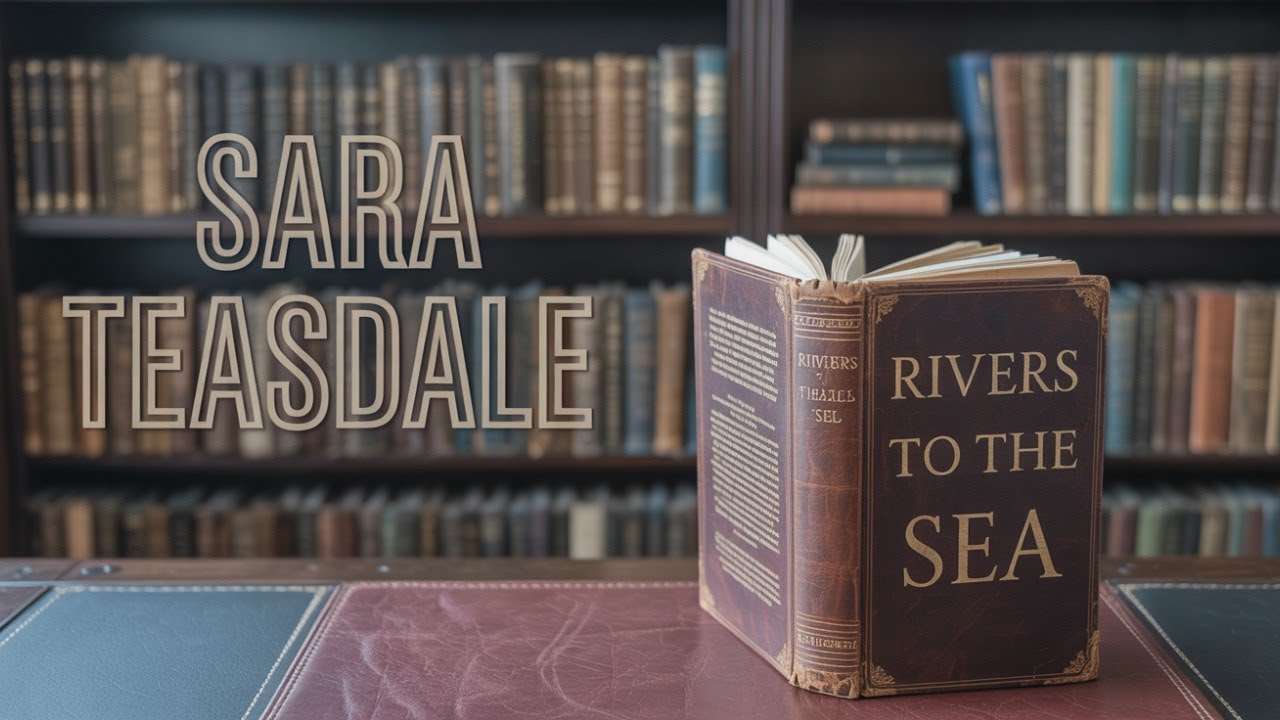
Rivers to the Sea
Step into the lyrical heart of early twentieth-century American poetry with Sara Teasdale’s Rivers to the Sea, a collection that, even a century after its initial appearance, continues to speak with profound intimacy and resonant truth. This isn't merely a book of verse; it is a sensitive and openhearted communion with the deepest currents of human experience – love in all its forms, the solace and mystery of the natural world, and the quiet ache of introspection. Listeners today will discover in Teasdale a voice both delicate and strong, one that articulates universal feelings of longing, wonder, and the often-fragile beauty of existence, inviting reflection on their own inner landscapes and emotional tides. This collection, rather than following a traditional narrative, guides the listener through a series of emotional and sensory experiences, akin to tracing a river from its nascent springs to its eventual merging with the vast ocean. Each poem acts as a distinct moment, a snapshot of feeling or observation. The initial poems often present a youthful, almost breathless anticipation of love, a yearning for connection against a backdrop of natural beauty—the moon, the stars, the changing seasons. The speaker's sensibility is frequently attuned to the fleetingness of happiness, the transient nature of human attachment, even as she savors the intensity of present joy. As the collection progresses, the emotional landscape subtly shifts. While the celebration of love remains a central motif, there emerges a growing awareness of solitude, the inevitable partings, and the quiet strength found within one's own spirit. The settings vary from the intimate confines of a room to expansive natural vistas, always filtered through the speaker's contemplative gaze. The central tension often arises from the heart's desire for permanence in a world defined by change, the search for an enduring solace amidst the ebb and flow of emotions and relationships. It is a progression from openhearted giving to a more mature, sometimes wistful, understanding of the self in relation to the world's beauty and its sorrows. Sara Teasdale, born in 1884 in St. Louis, Missouri, was a significant voice in American poetry during the early twentieth century. Her early life was marked by a somewhat sheltered upbringing due to delicate health, fostering an intense inner world that would later inform her poetry. Moving to New York City in 1914 proved a pivotal moment, connecting her with a wider literary community and fueling her creative output. She was briefly married to Ernst Filsinger, though this union dissolved, and her personal life, often marked by deep friendships and sometimes unrequited affections, frequently found expression in her verses. She became a central figure in the flourishing American "Poetry Renaissance" of the period, known for her directness and emotional clarity. Teasdale's reputation soared with her Pulitzer Prize for Poetry in 1918 for Love Songs, a testament to her widespread appeal and the critical recognition of her distinct lyrical style. Her other notable collections include Helen of Troy and Other Poems (1911), Flame and Shadow (1920), and Dark of the Moon (1926). While her poetic forms remained largely traditional—often employing meter and rhyme with elegant simplicity—her thematic focus on individual emotion and personal experience resonated deeply with readers. She held a unique place, bridging the late Romantic sensibilities of the nineteenth century with the emerging modernism, consistently prioritizing feeling and direct expression over experimentalism. Teasdale died by suicide in 1933 in New York City, leaving behind a body of work that continues to resonate with its honesty and beauty. The collection enacts several powerful themes, perhaps none more central than the paradox of love's intense presence and its inherent ephemerality. Many poems capture the incandescent joy of a moment of connection, such as the lines that speak of a heart "like a flower that opens to the sun." Yet, even in these rapturous expressions, there often lurks the subtle acknowledgment that such bliss is fleeting, a delicate blossom easily lost to the turning season or a passing shadow. This creates a poignant tension, where beauty is cherished precisely because it is impermanent. Another significant theme is the deep resonance between the human soul and the natural world. Rivers, the sea, the moon, and stars are not mere backdrops; they become metaphors for internal states. The "rivers" of the title can be seen as the flow of emotion, experience, and time, eventually leading to the vast, perhaps infinite, "sea" of ultimate understanding or dissolution. Teasdale also consistently portrays a profound sense of solitude and introspection. While her poems often address a beloved or contemplate relationships, the lens is almost always the individual speaker's interiority. This is not a lonely solitude, but often a chosen one, a space for deep thought and feeling, where the self can commune with its own nature and the larger cosmos. A poem might describe a quiet evening walk, where the external world fades and the inner voice becomes paramount, revealing thoughts that are both personal and universally recognizable. Furthermore, the search for beauty and meaning in ordinary or heightened moments threads through the collection. Teasdale finds transcendence not in grand philosophical statements, but in the glint of moonlight on water, the quiet song of a bird, or the pure, unadorned expression of affection. When Rivers to the Sea was published in 1915, the world was on the precipice of profound change. World War I had begun, though America’s full involvement was still two years away. This period saw a ferment of social and political movements, including the continued fight for women's suffrage and evolving ideas about gender roles. In the literary sphere, it was a dynamic time; while Modernism, with its experimental forms and challenging themes, was gaining momentum through figures like T.S. Eliot and Ezra Pound, there remained a strong appetite for more accessible, emotionally direct poetry. Teasdale's work emerged from this confluence, offering a voice that was deeply personal and aesthetically pleasing, a counterpoint to the growing intellectualism and fragmentation of nascent modern literature. Her clear, musical verse provided comfort and beauty in an increasingly complex and tumultuous era, articulating private feelings with a public resonance that appealed to a wide readership. Listening to Rivers to the Sea as an audiobook offers a unique and enriching experience that amplifies the inherent musicality and emotional depth of Teasdale's verse. The human voice, with its subtle inflections and pacing, becomes an instrument that breathes life into each line, allowing the listener to absorb the rhythm, rhyme, and precise word choices in a way that silent reading might not immediately convey. Over several hours, a narrator can guide you through the collection's emotional arc, highlighting the subtle shifts in tone from youthful optimism to mature reflection. Pay attention to how the voice creates atmosphere, whether evoking the stillness of a starlit night or the surge of passionate feeling. The pauses, the emphasis on certain words, and the overall cadence work together to unlock the profound sincerity and enduring beauty embedded within these timeless poems.
Enjoyed Rivers to the Sea? A few ways to support us
Audible & Amazon links are affiliate; we may earn a small commission at no extra cost.
About this production
Human narration by a volunteer reader from LibriVox.org, the public-domain audiobook project. LibriVox volunteers record literary works whose copyright has expired in the United States, releasing the resulting recordings into the public domain.
Rivers to the Sea by Sara Teasdale. The underlying text is in the U.S. public domain. We do not republish any modern copyrighted edition, translation, or commentary.
The 4K cinematic visuals accompanying this audiobook are generated by an AI image model from prompts derived from the source text. No copyrighted photos, paintings, or stock footage are used. AI generation is disclosed on every video on our YouTube channel as required by YouTube's altered/synthetic content policy.
English subtitles are transcribed from the LibriVox recording with OpenAI Whisper. Translations into the 11 other supported languages are produced by Meta's NLLB-200 neural translation model. No human translator's copyrighted translation is used.
Questions about sourcing or rights? See our DMCA & Sourcing policy or contact us.
Enjoyed this audiobook?
If you'd like to own a copy of Rivers to the Sea or hear a professionally produced edition, the links below help support free audiobook production at no extra cost to you.
As an Amazon Associate we earn from qualifying purchases. Audible / print links are affiliate.