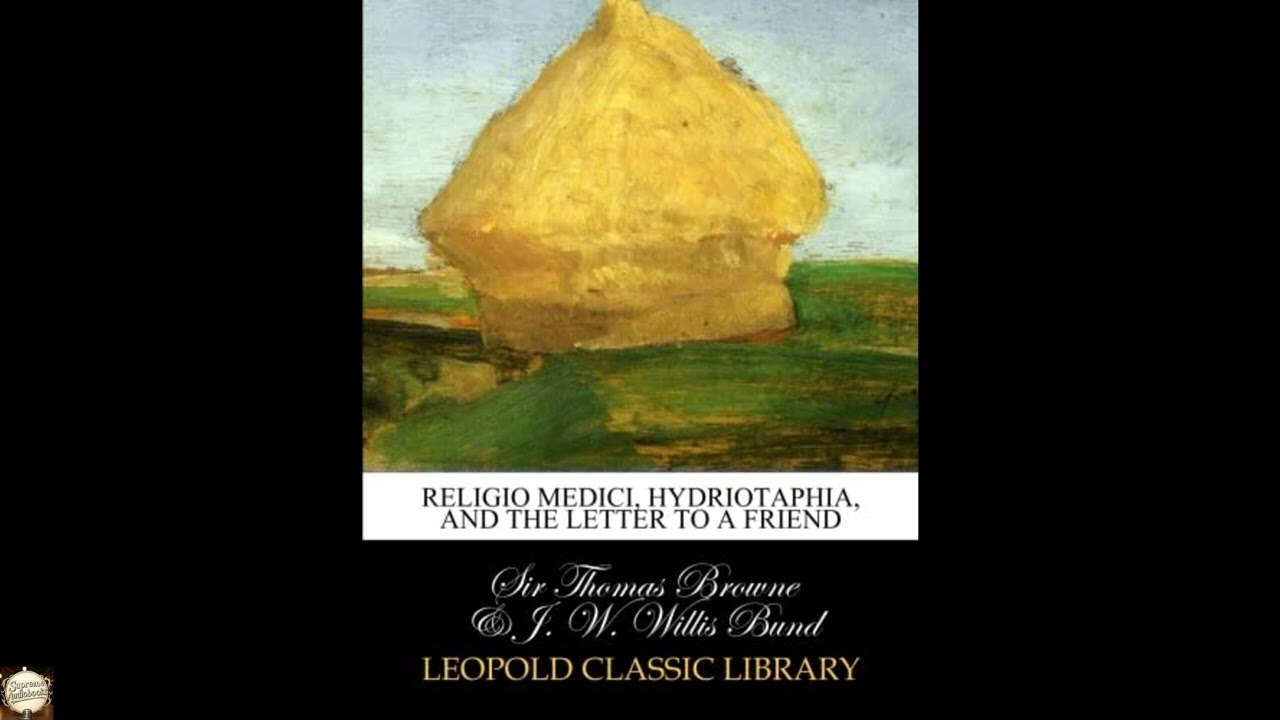
Religio medici, Hydriotaphia, and the Letter to a friend
Step into the mind of a true polymath, a physician who found God in anatomy and a philosopher who contemplated eternity in ancient dust. Sir Thomas Browne's collected works — Religio medici, Hydriotaphia, and A Letter to a Friend — present an unparalleled fusion of scientific observation, profound introspection, and poetic prose that continues to resonate with searching minds centuries after their composition. This collection offers not merely a glimpse into a bygone era, but a direct engagement with universal questions concerning faith, reason, mortality, and the enduring mysteries of human existence. It is a testament to an intellect that bridged the scientific revolution and deep spiritual tradition, offering comfort and challenge in equal measure to any who grapple with the ultimate questions of life and death. Religio medici, or "The Religion of a Doctor," forms the initial and most personal offering within this collection. Here, Browne lays bare his own unique brand of Christianity, addressing the supposed conflict between his empirical, scientific training and his fervent, if unorthodox, faith. He crafts a confessional document, not intended for public consumption initially, wherein he navigates theological tenets, the nature of miracles, and the vastness of divine design, often through the lens of a physician's understanding of the human body and the natural world. He expresses a belief system that embraces paradox, finding greater truth in the inexplicable than in dogma alone, and reveling in the mysteries that elude purely rational comprehension. The argument progresses as a series of reflections, a private dialogue with himself and a potential, unseen confidant, as he endeavors to reconcile the macrocosm of the universe with the microcosm of his own soul. Following this intimate spiritual declaration comes Hydriotaphia, or "Urn Burial," a work prompted by the discovery of ancient burial urns in Norfolk. This meditation takes a more outward, yet equally profound, turn, beginning with archaeological curiosity and expanding into an eloquent contemplation of mortality, the impermanence of human memory, and the diverse ways cultures have confronted death. Browne meticulously details ancient burial customs, the fading of monuments, and the ultimate futility of human attempts to defy oblivion. He considers the fleeting nature of fame and earthly recognition, observing how the most elaborate tombs and rituals ultimately yield to dust and forgetfulness. The text moves from specific historical details to sweeping philosophical pronouncements, inviting the reader to ponder the universal fate that awaits all flesh and all achievements, finding a somber beauty in this ultimate surrender to time. Finally, A Letter to a Friend, upon the occasion of the death of his intimate friend presents a poignant, deeply personal reflection on the process of dying. While ostensibly a letter of condolence, it quickly transcends mere comfort to become a profound discourse on the preparations one makes for the final moments of life. Browne, ever the physician, touches upon the physical aspects of a declining body, yet swiftly elevates his thoughts to the spiritual and psychological dimensions of death. He offers counsel on how to face the inevitable, how to find peace in resignation, and how to view the transition not merely as an end, but as a passage. It is a short, but remarkably concentrated piece, distilling his wisdom on life's most inevitable conclusion into a tender yet unflinching consideration. Sir Thomas Browne, born in London in 1605, was a towering intellectual figure of the 17th century. Educated at Winchester College and Broadgates Hall (now Pembroke College), Oxford, he pursued a medical degree with studies in Montpellier, Padua, and Leiden, qualifying as a physician in 1633. He later settled in Norwich, where he practiced medicine for the remainder of his life, becoming a respected citizen and a prolific writer. Knighted by King Charles II in 1671, Browne was a true Renaissance man, keenly interested in natural history, anatomy, classical literature, and the nascent fields of scientific inquiry, all while maintaining a deep, if unconventional, spiritual devotion. Beyond the texts presented here, Browne is also widely known for Pseudodoxia Epidemica, often called Vulgar Errors, a monumental work that systematically debunked numerous common misconceptions and superstitions of his day through empirical observation and logical argument. His distinctive literary style, characterized by its elaborate Latinate vocabulary, complex sentence structures, and profound intellectual reach, places him in a unique position within the English literary canon. He stands as a prose stylist without direct parallel, often considered a bridge between the grand rhetoric of earlier periods and the more direct style that would follow. His writings are not merely historical curiosities, but enduring monuments to profound thought and linguistic artistry. Several central themes emerge consistently across Browne's works. Foremost among them is the compatibility of faith and reason. In Religio medici, Browne, a man of science, openly confesses to a belief in miracles and mysteries that transcend mere logical explanation, arguing that faith provides a deeper understanding than reason alone. He observes the intricate design of the human body as a testament to divine creation, yet does not shy away from questioning dogma, seeking a personal truth that integrates scientific observation with spiritual intuition. Another recurring theme is mortality and the brevity of human existence. This is most powerfully demonstrated in Hydriotaphia, where the contemplation of ancient burial urns prompts Browne to reflect on the transient nature of all earthly endeavors. The urns themselves are relics of forgotten lives, symbols of the universal fate that renders even the grandest achievements vulnerable to the erosion of time and the indifference of oblivion. Furthermore, the mystery and wonder of the natural world holds a constant fascination for Browne. As a physician and naturalist, he finds endless fascination in the minutiae of creation, from the structure of an insect to the vastness of the cosmos, seeing in each a reflection of divine power. His prose often elevates scientific observation to poetic revelation. Coupled with this is the intense focus on introspection and the inner life. Browne's works are fundamentally personal confessions and meditations. A Letter to a Friend, for instance, is a profound expression of empathy and philosophical understanding of the dying process, reflecting not just on medical facts, but on the emotional and spiritual journey towards death, showcasing Browne's sensitive observation of the human spirit in its ultimate vulnerability. Browne's writings emerged during a period of immense intellectual and political ferment in 17th-century England. The mid-decades of the century saw the upheaval of the English Civil War, a conflict that deeply divided society along political and religious lines. This era was also a crucial time for the advancement of scientific thought, with figures like Francis Bacon advocating for empirical methods and laying the groundwork for the Royal Society. Browne’s work, particularly Religio medici, reflects the intellectual tension of his age—the struggle to reconcile emerging scientific empiricism with deeply entrenched religious belief systems. He offered a uniquely personal solution to this dilemma, forging a syncretic worldview that embraced both the microscope and the mystery. His contemplative style and rich, Latinate vocabulary were characteristic of the Baroque prose then prevalent, yet his engagement with nascent scientific ideas also positioned him at the forefront of a new intellectual landscape. His works arose from a deeply introspective engagement with the tumultuous world around him, offering solace and profound questions in an era of uncertainty. Listening to Sir Thomas Browne's works as an audiobook provides an exceptional experience, unlocking the full sonic grandeur of his prose. Browne's sentences are not merely conveyors of information; they are meticulously constructed musical compositions, rich with alliteration, assonance, and complex rhythms. A skilled narrator brings out the sonorous quality of his language, allowing the listener to truly savor the intricate architecture of his thought. The run length of several hours is ideal for absorbing the density of his ideas, making it a perfect companion for thoughtful walks, contemplative evenings, or extended periods of focused listening. Pay attention to the narrator's pacing, which should allow time for the weight of each word and phrase to settle, and notice how the voice shifts subtly to convey Browne's shifts from scientific observation to poetic reflection, from philosophical argument to deeply personal confession. The atmosphere created by the narration transforms these dense texts into an immersive, almost meditative, encounter with one of English literature's most distinctive voices.
Enjoyed Religio medici, Hydriotaphia, and the Letter to a friend? A few ways to support us
Audible & Amazon links are affiliate; we may earn a small commission at no extra cost.
About this production
Human narration by a volunteer reader from LibriVox.org, the public-domain audiobook project. LibriVox volunteers record literary works whose copyright has expired in the United States, releasing the resulting recordings into the public domain.
Religio medici, Hydriotaphia, and the Letter to a friend by Sir Thomas Browne. The underlying text is in the U.S. public domain. We do not republish any modern copyrighted edition, translation, or commentary.
The 4K cinematic visuals accompanying this audiobook are generated by an AI image model from prompts derived from the source text. No copyrighted photos, paintings, or stock footage are used. AI generation is disclosed on every video on our YouTube channel as required by YouTube's altered/synthetic content policy.
English subtitles are transcribed from the LibriVox recording with OpenAI Whisper. Translations into the 11 other supported languages are produced by Meta's NLLB-200 neural translation model. No human translator's copyrighted translation is used.
Questions about sourcing or rights? See our DMCA & Sourcing policy or contact us.
View 10 famous quotes from this book →
Enjoyed this audiobook?
If you'd like to own a copy of Religio medici, Hydriotaphia, and the Letter to a friend or hear a professionally produced edition, the links below help support free audiobook production at no extra cost to you.
As an Amazon Associate we earn from qualifying purchases. Audible / print links are affiliate.