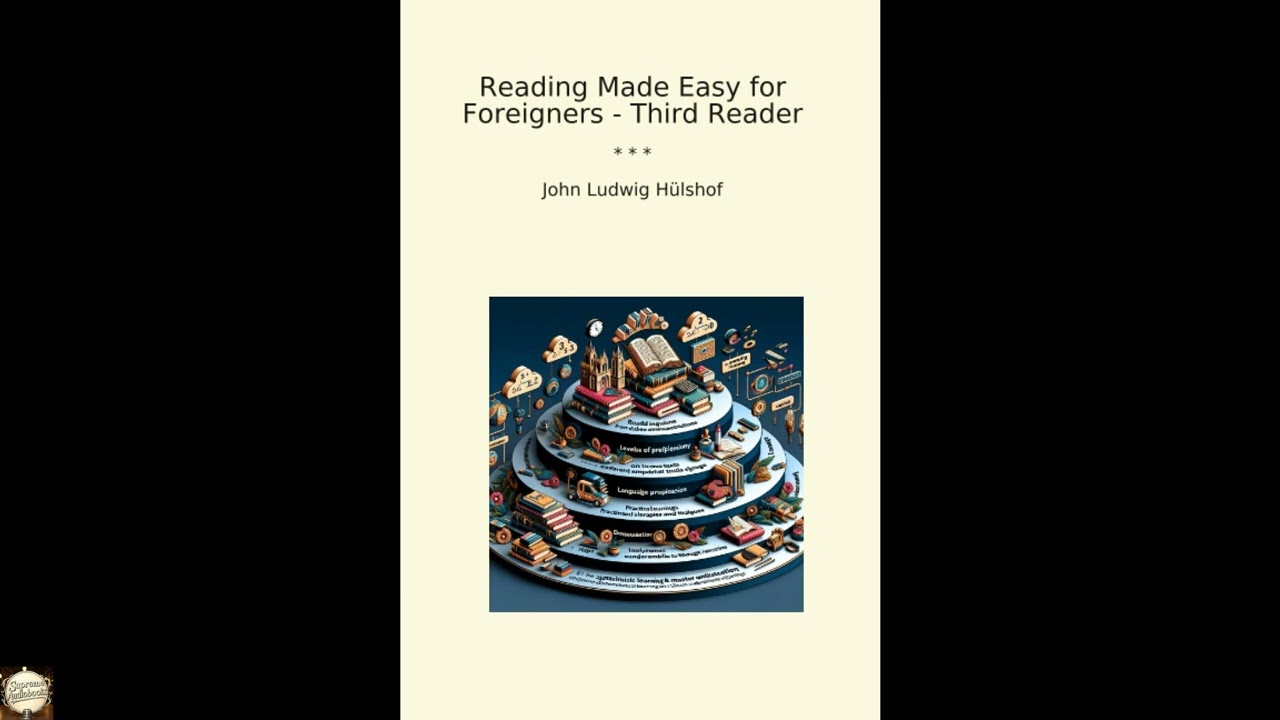
Reading Made Easy for Foreigners - Third Reader
For anyone seeking to understand the very foundations of American identity and education at the turn of the twentieth century, John Ludwig Hülshof’s Reading Made Easy for Foreigners – Third Reader offers far more than its unassuming title suggests. It stands not merely as a pedagogical tool, but as a cultural artifact – a window into the hopes, struggles, and aspirations of countless immigrants arriving on American shores. This work, designed to guide new arrivals through the complexities of a new language and a new way of life, functions as a collection of distilled narratives, moral lessons, and historical vignettes that collectively paint a compelling portrait of an era and its educational philosophy. Listening to this "Reader" today is to connect directly with the past, understanding the concerted effort to integrate disparate cultures into a shared national experience, and to grasp the bedrock values deemed essential for success in a new land. The "plot," if one can call it that in a traditional sense, unfolds not through a single protagonist's dramatic arc, but through the cumulative experience of the diligent student – the "foreigner" for whom the book was intended. Each lesson, each brief story, each dialogue serves as a progressive step on this intellectual and cultural ascent. The setting oscillates between the intimate domestic sphere where families learn and discuss, the bustling urban environment where new challenges arise, and the historical landscape of American foundation and achievement. Main "characters" emerge as archetypes rather than individuals: the wise teacher, the earnest student, the hardworking family, the civic-minded citizen, and figures from American history whose tales exemplify national virtues. The central conflict is the universal struggle for comprehension and integration – overcoming the barrier of an unknown tongue, grasping unfamiliar social customs, and internalizing the civic responsibilities of a new citizenry. The narrative arc moves from simpler linguistic structures and basic vocabulary to more complex concepts, idiomatic expressions, and nuanced moral dilemmas. It is a journey from initial bewilderment to growing fluency, from cultural detachment to active participation, and ultimately, from a state of being "foreign" to a sense of belonging and understanding. Through a series of carefully selected fables, historical anecdotes, and practical conversations, the Third Reader charts a course not just in language acquisition, but in identity formation, guiding its listeners toward an informed and ethical engagement with their adopted country. John Ludwig Hülshof, the dedicated educator behind this seminal work, was a figure ideally suited to bridge cultural divides. Born in Westphalia, Germany, in 1870, Hülshof immigrated to the United States, bringing with him a deep understanding of the immigrant experience firsthand. He eventually pursued higher education and established a distinguished career in language instruction, notably serving on the faculty of Teachers College, Columbia University, in New York City. His personal journey from European roots to American scholarship imbued his pedagogical works with an authentic empathy for those navigating similar transitions. Hülshof dedicated his professional life to developing accessible and effective methods for teaching English and American civics to new immigrants. His output included several graded readers and language manuals, all characterized by a clear, progressive structure and a keen awareness of the learner's needs. His work positioned him at the forefront of early twentieth-century Americanization movements, though his approach was always rooted in practical linguistic acquisition rather than purely ideological imposition. Hülshof passed away in 1944, leaving behind a legacy of educational materials that profoundly impacted generations of new Americans, helping them to find their voice and place in a new society. The Third Reader effectively enacts several key themes, chief among them diligence and perseverance. Many of the short narratives present scenarios where characters face challenges – learning a new trade, understanding a complex legal concept, or simply mastering a difficult English idiom – and succeed through sustained effort. For instance, a passage might describe a young man struggling with a new job, making mistakes, but steadily improving through his refusal to give up, thereby illustrating the rewards of hard work. Another prominent theme is cultural understanding and assimilation. The book consistently introduces aspects of American life – from historical figures like George Washington and Abraham Lincoln to descriptions of electoral processes and common social courtesies. A scene might depict a family discussing the meaning of Thanksgiving, or a newly naturalized citizen explaining the importance of voting, thereby familiarizing the learner with essential American values and traditions. A third pervasive theme is moral education and civic responsibility. Hülshof intersperses his linguistic lessons with fables and stories that carry clear ethical implications. Tales of honesty rewarded, industry leading to prosperity, and generosity fostering community spirit are commonplace. One anecdote might feature children resolving a playground dispute fairly, teaching principles of justice and compromise. Finally, the overarching theme of the power of language itself permeates every page. The entire purpose of the book is to demonstrate how mastering English unlocks opportunities, facilitates communication, and integrates the individual into the broader society. Each successful reading, each new word understood, reinforces the idea that language is the indispensable key to self-empowerment and true belonging. This foundational work emerged during a period of immense social and demographic change in the United States. The late nineteenth and early twentieth centuries witnessed unprecedented waves of immigration, primarily from Southern and Eastern Europe, profoundly reshaping American cities and society. Millions of new arrivals, speaking dozens of different languages, sought new lives and opportunities, but often faced significant barriers of language and culture. Public schools and various social organizations increasingly recognized the urgent need for structured programs to teach English and American civics to these newcomers. The drive for "Americanization" was a powerful force, often a mix of altruistic educational goals and a desire for social cohesion and order. Hülshof’s Reading Made Easy for Foreigners – Third Reader was a direct response to this critical need. It reflected the pedagogical wisdom of its time, emphasizing repetition, contextual learning, and a gradual progression in difficulty, all within a framework that subtly inculcated the perceived virtues and historical narratives of American life. The book provided a vital service, offering a structured pathway for integration at a time when resources for adult education were still developing and standardized curricula were essential. Listening to Reading Made Easy for Foreigners – Third Reader as an audiobook offers a particularly immersive and revealing experience. The narrator's clear, measured pacing allows listeners to absorb the instructional content and narrative fragments at a comfortable rate, mirroring the deliberate progression intended by Hülshof for his original students. The precise enunciation and careful articulation of words serve to highlight the very mechanisms of language acquisition that the text itself teaches. Distinct voices for dialogue passages bring the simple conversations and anecdotal scenes to life, creating an atmosphere that is both educational and engaging. It provides a unique opportunity to not only understand the content and purpose of this historical artifact, but also to appreciate the sonic quality of the English language as it was taught and learned by a generation of new Americans over a century ago. The entire experience transports you back to a classroom of the past, offering a direct connection to a vital piece of educational history and a profound testament to the enduring human desire for understanding.
Enjoyed Reading Made Easy for Foreigners - Third Reader? A few ways to support us
Audible & Amazon links are affiliate; we may earn a small commission at no extra cost.
About this production
Human narration by a volunteer reader from LibriVox.org, the public-domain audiobook project. LibriVox volunteers record literary works whose copyright has expired in the United States, releasing the resulting recordings into the public domain.
Reading Made Easy for Foreigners - Third Reader by John Ludwig Hülshof. The underlying text is in the U.S. public domain. We do not republish any modern copyrighted edition, translation, or commentary.
The 4K cinematic visuals accompanying this audiobook are generated by an AI image model from prompts derived from the source text. No copyrighted photos, paintings, or stock footage are used. AI generation is disclosed on every video on our YouTube channel as required by YouTube's altered/synthetic content policy.
English subtitles are transcribed from the LibriVox recording with OpenAI Whisper. Translations into the 11 other supported languages are produced by Meta's NLLB-200 neural translation model. No human translator's copyrighted translation is used.
Questions about sourcing or rights? See our DMCA & Sourcing policy or contact us.
Enjoyed this audiobook?
If you'd like to own a copy of Reading Made Easy for Foreigners - Third Reader or hear a professionally produced edition, the links below help support free audiobook production at no extra cost to you.
As an Amazon Associate we earn from qualifying purchases. Audible / print links are affiliate.