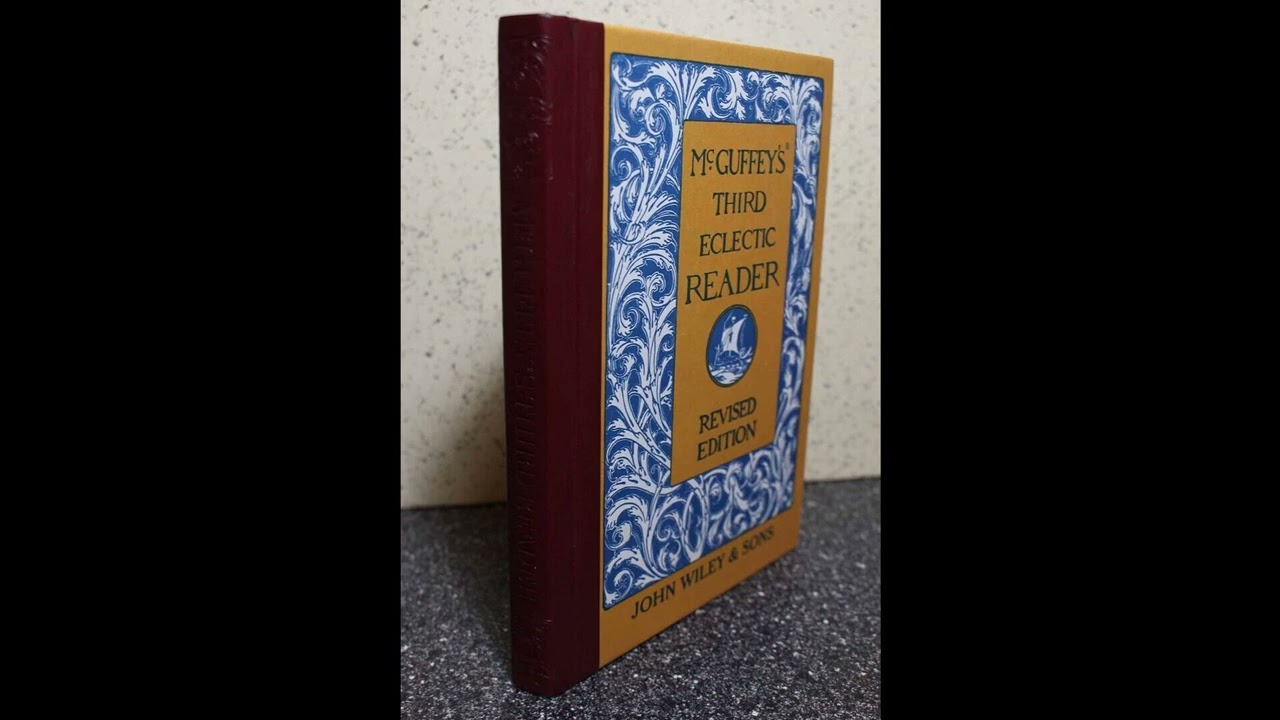
McGuffey's Third Eclectic Reader
Step into a classroom from a bygone era, one where the foundations of American literacy and morality were painstakingly laid, and you find yourself face-to-face with a book unlike any other on your shelf: McGuffey's Third Eclectic Reader. This isn't just a collection of stories; it's an educational artifact, a cultural touchstone, and a profound window into the values that shaped generations of Americans. For over a century, the McGuffey Readers were the primary textbooks in countless schools across the nation, teaching children not only how to read but also how to live. To engage with this book today is to connect with a foundational text, to understand the bedrock of a nation's educational philosophy, and to witness the compelling power of stories used to instill virtue, cultivate character, and foster a common language for an expanding country. While McGuffey's Third Eclectic Reader does not present a continuous narrative in the traditional sense of a novel, it constructs a compelling educational arc for its young audience. The setting for these lessons is largely rural and domestic, often depicting scenes of family life, interactions with nature, and simple community activities, all rendered with a moralizing tone. The main "characters" are the myriad individuals, both human and animal, who populate the short stories, poems, and fables – diligent children, honest tradesmen, helpful siblings, and even anthropomorphized creatures who demonstrate virtues or consequences. The central "conflict" is the ongoing struggle between right and wrong, idleness and industry, ignorance and wisdom, as each selection presents a situation demanding a moral choice or illustrating a valuable lesson. The progression within the Reader guides students through increasingly complex vocabulary and more nuanced moral quandaries. Early stories might focus on straightforward lessons about politeness or honesty, perhaps through a simple anecdote about a child returning a lost coin. As the reader progresses, the narratives introduce more elaborate scenarios, demanding a deeper understanding of cause and effect, empathy, and social responsibility. The "arc of the story," therefore, is the intellectual and ethical development of the student themselves, moving from foundational literacy to a sophisticated grasp of ethical reasoning, all cultivated through engaging and memorable prose. There isn't a final twist or a dramatic resolution, but rather a gradual unfolding of understanding, leaving the student prepared for the challenges of both future reading and responsible citizenship. William Holmes McGuffey, the author whose name became synonymous with American education, was born in 1800 in West Finley, Pennsylvania, to a family of Scottish descent who had migrated to the American frontier. A prodigious learner from a young age, McGuffey was largely self-taught, devouring books by candlelight and demonstrating an exceptional aptitude for language and teaching. He graduated from Washington College (now Washington & Jefferson College) in 1826 and quickly distinguished himself as an educator. He held professorships at Miami University in Ohio and Cincinnati College, before eventually joining the faculty at the University of Virginia in 1845, where he taught moral philosophy until his death in 1873. McGuffey was also an ordained Presbyterian minister, a role that heavily influenced the moral and ethical framework of his educational texts. His most enduring legacy began in 1834 when he was commissioned by the Cincinnati College of Teachers to create a series of graded readers for the rapidly expanding common school system. The first two McGuffey Readers were published in 1836, with the Third and Fourth following in 1837. Though his name is on the covers, McGuffey relied on the assistance of his brother Alexander Hamilton McGuffey and other collaborators to compile the vast amount of material. McGuffey's works were not part of a specific literary movement in the artistic sense, but rather defined a fundamental educational movement, bringing a much-needed standardization and moral backbone to American pedagogy during a critical period of national growth and social change. His readers truly occupied a unique and unassailable place in the American literary canon of instruction. At its core, McGuffey's Third Eclectic Reader enacts several crucial themes, chief among them being moral rectitude and virtue. The stories consistently champion traits like honesty, diligence, obedience, kindness, and temperance. For instance, a common type of story describes a child who, through hard work and perseverance (diligence), overcomes a challenge, or a tale where a character's good deed (kindness) is ultimately rewarded. Another pervasive theme is the importance of education and self-improvement. Many selections implicitly or explicitly praise the pursuit of knowledge, the value of literacy, and the benefits of applying oneself to studies. A story might portray a boy who regularly attends school and learns valuable skills, contrasting him with another who prefers idleness and consequently struggles. Furthermore, the Reader consistently highlights the beauty and lessons of the natural world and reinforces traditional community and family values. Many poems and prose pieces describe animals, plants, and natural phenomena, often imbuing them with allegorical significance for human behavior or using them as springboards for scientific observation. A tale about an industrious ant preparing for winter, for example, serves as a direct analogy for human foresight and labor. Simultaneously, the narratives emphasize respect for elders, the duties of children to their parents, the benefits of harmonious family relations, and the importance of contributing positively to one's community – all foundational elements for a cohesive and moral society. These recurring elements form a robust ethical framework for the developing mind. The mid-19th century in America was a period of immense change and expansion. From the 1830s onward, the nation was grappling with the challenges of westward migration, industrialization, and a burgeoning population. There was a desperate need for accessible, affordable, and standardized educational materials to serve the growing number of common schools across states and territories. Before McGuffey, textbooks were often scarce, expensive, and varied wildly in quality and content. This chaotic landscape of education meant that children from different regions often learned different material and were exposed to conflicting moral messages. In this context, McGuffey's Third Eclectic Reader and the series it belonged to emerged as a unifying force. It provided a coherent curriculum that taught not just reading, but also a common set of American values, a shared understanding of civics, and a consistent moral code rooted in Protestant ethics. The readers reflected the era's emphasis on self-reliance, hard work, patriotism, and piety, preparing children to become productive and moral citizens in a rapidly evolving republic. They became a cultural glue, imparting a standardized lexicon and a shared moral imagination to millions of young minds. To experience McGuffey's Third Eclectic Reader as an audiobook is to gain an entirely new appreciation for its original purpose and profound impact. The gentle, measured cadence of the narrator conjures the very atmosphere of a 19th-century classroom, evoking a sense of attentive learning and quiet discovery. Listening allows the carefully chosen words, the rhythmic poetry, and the instructive prose to sink in with a clarity that recalls a simpler time. With a run length of several hours, this audio production is ideal for focused listening, perhaps during a quiet evening, or for dipping in and out as a respite from modern complexities. The deliberate pacing, the distinct voices often employed for different characters in the stories, and the overall calm, instructional atmosphere make it more than just a recitation; it becomes a direct channel to an essential piece of American educational and cultural history, a gentle lesson in itself.
Enjoyed McGuffey's Third Eclectic Reader? A few ways to support us
Audible & Amazon links are affiliate; we may earn a small commission at no extra cost.
About this production
Human narration by a volunteer reader from LibriVox.org, the public-domain audiobook project. LibriVox volunteers record literary works whose copyright has expired in the United States, releasing the resulting recordings into the public domain.
McGuffey's Third Eclectic Reader by McGuffey. The underlying text is in the U.S. public domain. We do not republish any modern copyrighted edition, translation, or commentary.
The 4K cinematic visuals accompanying this audiobook are generated by an AI image model from prompts derived from the source text. No copyrighted photos, paintings, or stock footage are used. AI generation is disclosed on every video on our YouTube channel as required by YouTube's altered/synthetic content policy.
English subtitles are transcribed from the LibriVox recording with OpenAI Whisper. Translations into the 11 other supported languages are produced by Meta's NLLB-200 neural translation model. No human translator's copyrighted translation is used.
Questions about sourcing or rights? See our DMCA & Sourcing policy or contact us.
Enjoyed this audiobook?
If you'd like to own a copy of McGuffey's Third Eclectic Reader or hear a professionally produced edition, the links below help support free audiobook production at no extra cost to you.
As an Amazon Associate we earn from qualifying purchases. Audible / print links are affiliate.