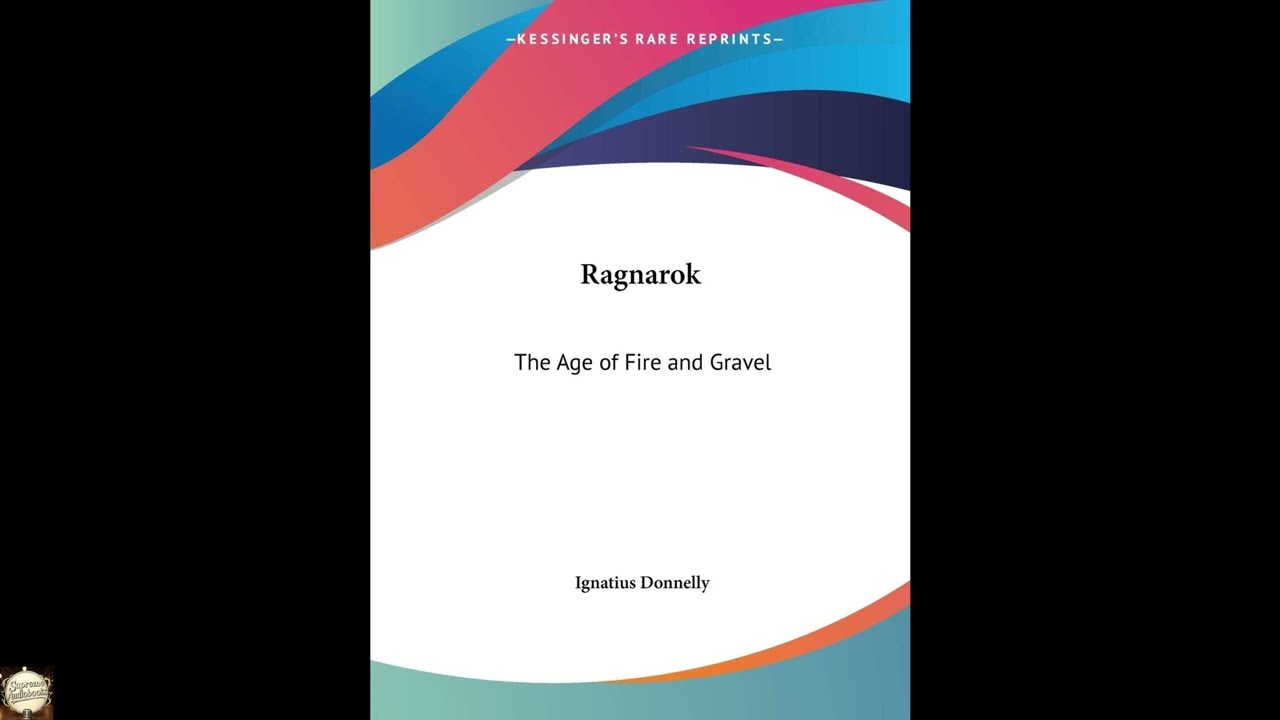
Ragnarok: The Age of Fire and Gravel
Ragnarok: The Age of Fire and Gravel by Ignatius Donnelly asks us to reconsider the very foundations of Earth's history. This provocative argument posits that our world has been repeatedly shaped by cosmic catastrophe, not merely gradual processes. In an era where established narratives are constantly re-examined, Donnelly’s bold challenge to prevailing geological and historical understanding remains strikingly relevant. He urges us to question what we think we know, to imagine a past far more dramatic and violent than commonly portrayed—a past that, if true, profoundly alters our perception of human civilization's origins and resilience. This book appeals to anyone fascinated by antiquity's grand mysteries, the power of myth, and an individual's audacity to challenge scientific consensus with a colossal vision of Earth’s past. Donnelly frames his argument across the entire planet and immense geological time. His "characters" are titanic natural forces: layers of rock, vast gravel deposits, and the enduring myths of diverse cultures. The book posits a worldwide cataclysm—a near-collision with a comet—that scorched the Earth, laid down immense debris, and dramatically reshaped continents. He builds his case examining seemingly disparate phenomena: mysterious "drift" across continents, uniform loess layers, widespread glacial evidence in unexpected places, and the universal prevalence of flood myths and fiery destruction tales, from Norse Ragnarok to Hindu Pralaya. The central conflict arises between Donnelly’s catastrophic vision and the then-dominant principle of uniformitarianism—the idea that gradual geological processes sufficiently explain past changes. Donnelly argues this view is insufficient. He posits a swift, overwhelming event that scoured the Earth, deposited vast debris, and left an indelible mark on both the physical landscape and humanity's collective memory. His argument unfolds chapter by chapter, accumulating evidence from geology, paleontology, and comparative mythology. He reinterprets all available data through the lens of this singular, grand catastrophe. Ignatius Donnelly, born in Philadelphia in 1831, was a formidable intellect and restless energy, embodying the ambitious spirit of the American late nineteenth century. While known today for his controversial theories about ancient civilizations and Earth's history, Donnelly also led a dynamic public life. A lawyer, he became deeply involved in politics, serving as Lieutenant Governor of Minnesota and a U.S. Congressman. His political career championed populist causes like farmers' rights, often putting him at odds with established powers. He was a gifted orator and prolific writer, known for persuasive arguments and a willingness to challenge conventional wisdom. Donnelly's literary output matched his varied political career. Before "Ragnarok," he gained fame with "Atlantis: The Antediluvian World" (1882), which popularized the idea of Atlantis as a real, advanced civilization. He also wrote "The Great Cryptogram" (1888), asserting via cipher that Francis Bacon authored Shakespeare's plays. These works, with "Ragnarok," cemented his status as a leading voice in alternative history and scientific speculation. His place in the literary canon is as a pioneering figure in popular pseudo-history, whose bold ideas, though largely discredited by mainstream science, captured public imagination and inspired generations. He passed away in 1901. A compelling theme in "Ragnarok" is catastrophism and the reinterpretation of evidence. Donnelly directly confronts uniformitarian geology, arguing for a past punctuated by sudden, immense global disasters rather than slow processes. He highlights widespread deep gravel deposits and erratic boulders across continents, arguing they defy explanation by gradual erosion or localized glaciation. Instead, he posits a sudden, violent deluge of water and debris from a comet's near-pass. This project involves re-examining accepted scientific data—geological formations, fossil records, astronomical observations—and offering an entirely new framework. He challenges listeners to see familiar facts in a different light, questioning mainstream conclusions; for instance, proposing that immense gravel and drift, attributed to ice ages, were formed by rapid material redistribution during his proposed cosmic encounter. A second significant theme is the power of myth and folklore as historical records. Donnelly repeatedly draws parallels between the Norse myth of Ragnarok—the twilight of gods, marked by fire, flood, and winter—and similar narratives found globally. He points to Hindu traditions of cosmic flood and renewal (Pralaya), and Native American tales of world-destroying fires and deluges. His argument: these disparate myths are not flights of fancy, but fragmented memories of a shared, terrifying global event that imprinted itself on early humanity. These common threads across cultures become powerful evidence for a real cataclysm, transforming myth into historical testimony. "Ragnarok" emerged from the intellectual ferment of the late nineteenth century, a period of profound shifts in scientific understanding and public engagement with grand theories. Darwin's ideas on evolution had already challenged biblical chronologies and spurred rethinking of natural history. While evolution gained acceptance, geological change mechanisms remained debated. Donnelly's work reflects a cultural moment that embraced scientific inquiry while seeking dramatic, comprehensive explanations for the world's mysteries. Politically and socially, this was also an era of burgeoning populism in America, a movement Donnelly championed. Distrust of established institutions fueled a hunger for alternative viewpoints. Donnelly, a politician and accessible writer, tapped into this public appetite for sweeping narratives, offering fresh perspectives on ancient puzzles and challenging academic orthodoxy. His books resonated with an audience eager for big ideas beyond specialized scientific language, appealing to fascination with lost civilizations, cosmic events, and hidden history. Listening to "Ragnarok: The Age of Fire and Gravel" as an audiobook offers a unique gateway into Donnelly's ambitious vision. His writing possesses an oratorical quality, as if he speaks directly to the listener, building his case with a speaker's persuasive rhythm. The several hours of listening time allow for complete immersion in his comprehensive argument, letting theories unfold at a comfortable pace. A skilled narrator can amplify the dramatic scope of Donnelly's prose, bringing to life descriptions of ancient cataclysms and the weight of his evidence. Pay attention to how the voice brings out his relentless detail and passionate appeals to reason, revealing the intellectual daring of a mind determined to rewrite Earth's primal story.
Enjoyed Ragnarok: The Age of Fire and Gravel? A few ways to support us
Audible & Amazon links are affiliate; we may earn a small commission at no extra cost.
About this production
Human narration by a volunteer reader from LibriVox.org, the public-domain audiobook project. LibriVox volunteers record literary works whose copyright has expired in the United States, releasing the resulting recordings into the public domain.
Ragnarok: The Age of Fire and Gravel by Ignatius Donnelly. The underlying text is in the U.S. public domain. We do not republish any modern copyrighted edition, translation, or commentary.
The 4K cinematic visuals accompanying this audiobook are generated by an AI image model from prompts derived from the source text. No copyrighted photos, paintings, or stock footage are used. AI generation is disclosed on every video on our YouTube channel as required by YouTube's altered/synthetic content policy.
English subtitles are transcribed from the LibriVox recording with OpenAI Whisper. Translations into the 11 other supported languages are produced by Meta's NLLB-200 neural translation model. No human translator's copyrighted translation is used.
Questions about sourcing or rights? See our DMCA & Sourcing policy or contact us.
Enjoyed this audiobook?
If you'd like to own a copy of Ragnarok: The Age of Fire and Gravel or hear a professionally produced edition, the links below help support free audiobook production at no extra cost to you.
As an Amazon Associate we earn from qualifying purchases. Audible / print links are affiliate.