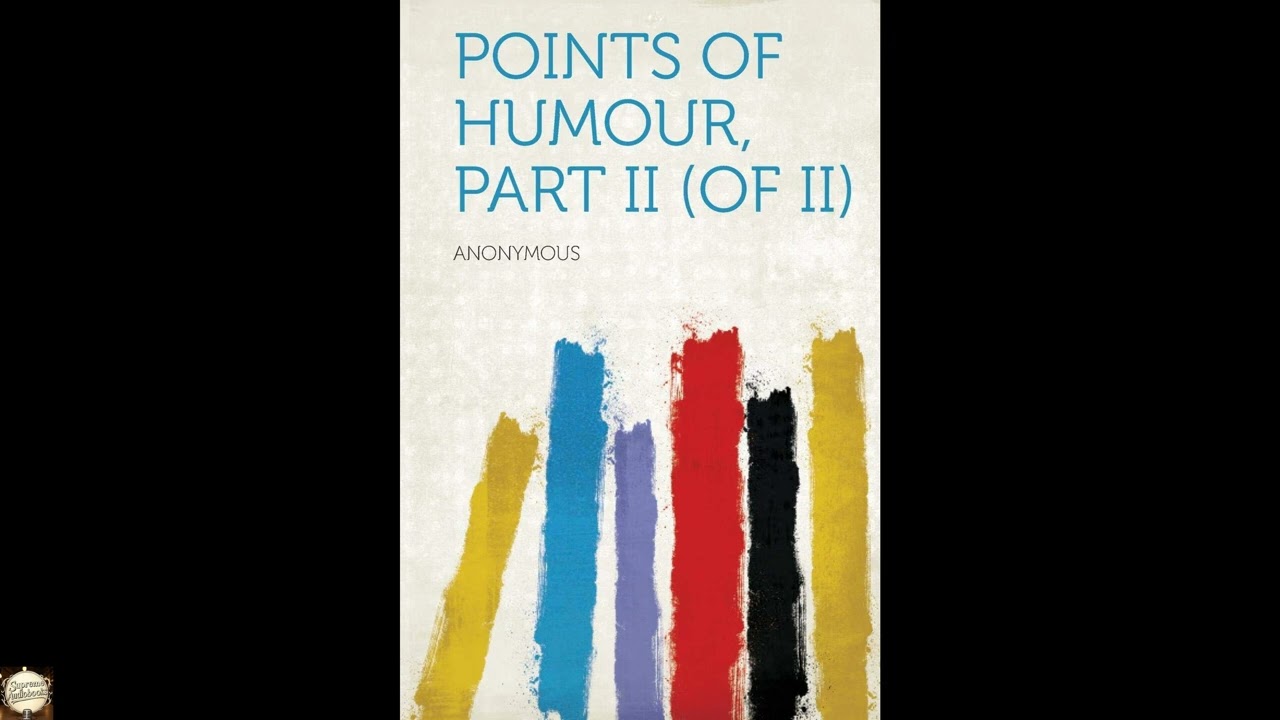
Points of Humour, Part II
In an age often preoccupied with the profound and the serious, a return to the sheer delight of well-crafted humor can be a refreshing antidote. Points of Humour, Part II offers precisely this—a collection not merely of jokes, but of astute observations and finely tuned comedic scenarios that remind us of the enduring nature of human folly and the timeless power of laughter. This isn't just a relic from a bygone era; it's a mirror held up to our own tendencies toward pomposity, self-deception, and the everyday absurdities that define our existence. To listen to these pieces is to reconnect with a tradition of wit that sees through pretense and finds genuine amusement in the quirks and eccentricities that make us fundamentally human. It promises not just entertainment, but a gentle reminder that sometimes, the best way to understand the world is to laugh at it, and at ourselves. This fascinating collection, presented as Points of Humour, Part II, does not unfold as a single, continuous narrative with a singular protagonist facing a defining struggle. Instead, it invites the listener into a kaleidoscopic world of vignettes, anecdotes, and character sketches, each a self-contained comedic gem. The setting is less a geographical location and more a social landscape – we are transported to bustling street corners, hushed drawing rooms, contentious marketplaces, and quiet domestic scenes, all rendered with an eye for the amusing detail. The main "characters," if one can call them that, are the archetypes of human society: the oblivious social climber, the verbose pundit, the star-crossed lover beset by minor mishaps, the pedant undone by their own knowledge, or the common person navigating an increasingly complex world with a mix of earnestness and bewilderment. The central conflict, consistent across these varied scenarios, is often the clash between appearance and reality, between what one says and what one does, or between an individual's inflated self-image and their actual capabilities. We see characters striving for dignity only to tumble into pratfalls, attempting eloquent speeches that devolve into stuttering nonsense, or concocting elaborate schemes that unravel with farcical precision. The arc of the story, then, is not one of a hero's quest, but rather the cumulative effect of witnessing humanity’s endless capacity for comical blunders and misjudgments. Each piece presents a miniature dramatic structure, building tension through escalating misunderstandings or increasingly outlandish circumstances, culminating in a moment of humorous resolution, revelation, or often, further absurdity. The collection acts as a tour through the many comedic facets of social interaction, inviting us to recognize echoes of our own lives and acquaintances within its pages. The authorship of Points of Humour, Part II remains veiled in the mists of time, listed simply as "Unknown." This absence of a named individual, however, tells its own story about the nature of humor and classic literature. Many foundational comedic texts and popular witticisms from antiquity and medieval periods were not attributed to a single genius but rather grew organically from oral traditions, public performances, or were simply published without specific credit in an era where individual authorship was less emphasized than the content itself. Such collections often served as a compendium of popular jests, satirical observations, and clever wordplay circulating among a literate public, reflecting a collective wit rather than a singular authorial voice. It is likely that this work emerged from a cultural milieu that highly valued sharp observation and the ability to articulate the absurdities of human behavior for public amusement and edification. The anonymity could also suggest that some of the pieces within it were critical or satirical enough to warrant discretion, allowing the humor to speak for itself without the baggage of an individual’s reputation. Whether compiled by a dedicated scribe, an anonymous editor, or gradually assembled through various contributions, Points of Humour, Part II stands as a testament to the enduring power of comedic writing to transcend individual creators and become a shared cultural artifact. It joins a long tradition of "books of jests" or "facetiae," demonstrating that the appetite for laughter and social commentary has been a constant throughout literary history. Among the specific themes that Points of Humour, Part II enacts with particular skill, one finds the perennial theme of social satire and the unmasking of hypocrisy. Consider, for instance, a sequence where a self-important dignitary, utterly convinced of their own intellectual superiority, expounds at length on a subject they clearly misunderstand, all while the surrounding company struggles to maintain polite expressions. The humor here does not rely on slapstick but on the carefully constructed dialogue and the implicit contrast between the character's self-perception and their actual intellect, gently skewering the widespread human tendency to feign knowledge or importance. Another recurring motif is the absurdity of everyday life and human error. Imagine a scene depicting a meticulously planned social event dissolving into comical chaos due to a series of minor mishaps – a misplaced hat, a misunderstood invitation, a well-meaning servant’s blunder. These moments, while seemingly trivial, lay bare the fragile order of our lives and how easily our best intentions can be derailed by simple, often hilarious, mistakes. Furthermore, the collection frequently touches upon human vanity and self-deception, often through characters who are blissfully unaware of their own flaws or the impression they make on others. A particularly memorable instance might involve a character who believes themselves to be a master of disguise, yet whose "disguises" are so transparently feeble they only draw more attention. This highlights the inherent humor in our inability to see ourselves as others see us, and our often-futile attempts to project an image that contradicts reality. Finally, there's a strong undercurrent of the power and pitfalls of language, with many pieces demonstrating how misunderstandings, puns, and rhetorical flourishes can both entertain and lead to farcical predicaments. We might encounter a dialogue where two characters are utterly at cross-purposes, each interpreting the other's words through their own biased lens, creating a cascade of comedic miscommunication that speaks to the inherent ambiguities of language itself. To consider the historical context of Points of Humour, Part II is to place it within a broad tradition of literary and oral humor that has existed as long as human society itself. While the specific year of its origin is not known, the very concept of "points of humour" suggests a period that prized wit, cleverness, and the ability to articulate social observations in an entertaining fashion. Such collections often flourished in eras where literacy was expanding, leading to a greater demand for printed materials that could both amuse and subtly critique. It could have emerged during a time of increased social mobility, where the foibles of different classes and the clash of new and old customs provided ample fodder for comedic scrutiny. Humor has always served as a vital social safety valve, a way to discuss uncomfortable truths, challenge authority, or simply provide relief from the rigors of daily life. This work, like other classic compilations of jests and satires, likely emerged from a cultural environment where public discourse, whether in salons, coffee houses, or through popular pamphlets, allowed for the free exchange of amusing observations and witty critiques. It reflects a society that was perhaps keenly aware of its own imperfections, finding solace and understanding not in solemn pronouncements, but in the shared experience of laughter at the human condition. Its existence speaks to a continuous thread of comedic appreciation woven throughout various periods of human history, demonstrating that the need for a good laugh, and the insight it can bring, transcends specific epochs. Listening to Points of Humour, Part II as an audiobook offers a unique and highly recommended gateway into its world of wit and observation. With several hours of content, it provides a substantial and sustained experience, perfect for long commutes, relaxed afternoons, or simply as a delightful accompaniment to daily tasks. The true genius of these pieces often lies in their timing and the precise delivery of their comedic beats—qualities that a skilled narrator can bring to life in ways that print cannot fully capture. Listen for the subtle shifts in voice that distinguish a pompous pronouncement from a whispered aside, or the nuanced pacing that builds anticipation for a punchline. The narrator's interpretation of dialogue, intonation, and even moments of silence can significantly enhance the atmosphere, allowing the listener to fully grasp the irony, the absurdity, and the sheer joy embedded within the text. The spoken word allows the humor to land with immediate impact, creating an intimate connection between the classic wit of the unknown author and the discerning ear of the present-day listener.
Enjoyed Points of Humour, Part II? A few ways to support us
Audible & Amazon links are affiliate; we may earn a small commission at no extra cost.
About this production
Human narration by a volunteer reader from LibriVox.org, the public-domain audiobook project. LibriVox volunteers record literary works whose copyright has expired in the United States, releasing the resulting recordings into the public domain.
Points of Humour, Part II by William Henry Westmacott. The underlying text is in the U.S. public domain. We do not republish any modern copyrighted edition, translation, or commentary.
The 4K cinematic visuals accompanying this audiobook are generated by an AI image model from prompts derived from the source text. No copyrighted photos, paintings, or stock footage are used. AI generation is disclosed on every video on our YouTube channel as required by YouTube's altered/synthetic content policy.
English subtitles are transcribed from the LibriVox recording with OpenAI Whisper. Translations into the 11 other supported languages are produced by Meta's NLLB-200 neural translation model. No human translator's copyrighted translation is used.
Questions about sourcing or rights? See our DMCA & Sourcing policy or contact us.
Enjoyed this audiobook?
If you'd like to own a copy of Points of Humour, Part II or hear a professionally produced edition, the links below help support free audiobook production at no extra cost to you.
As an Amazon Associate we earn from qualifying purchases. Audible / print links are affiliate.