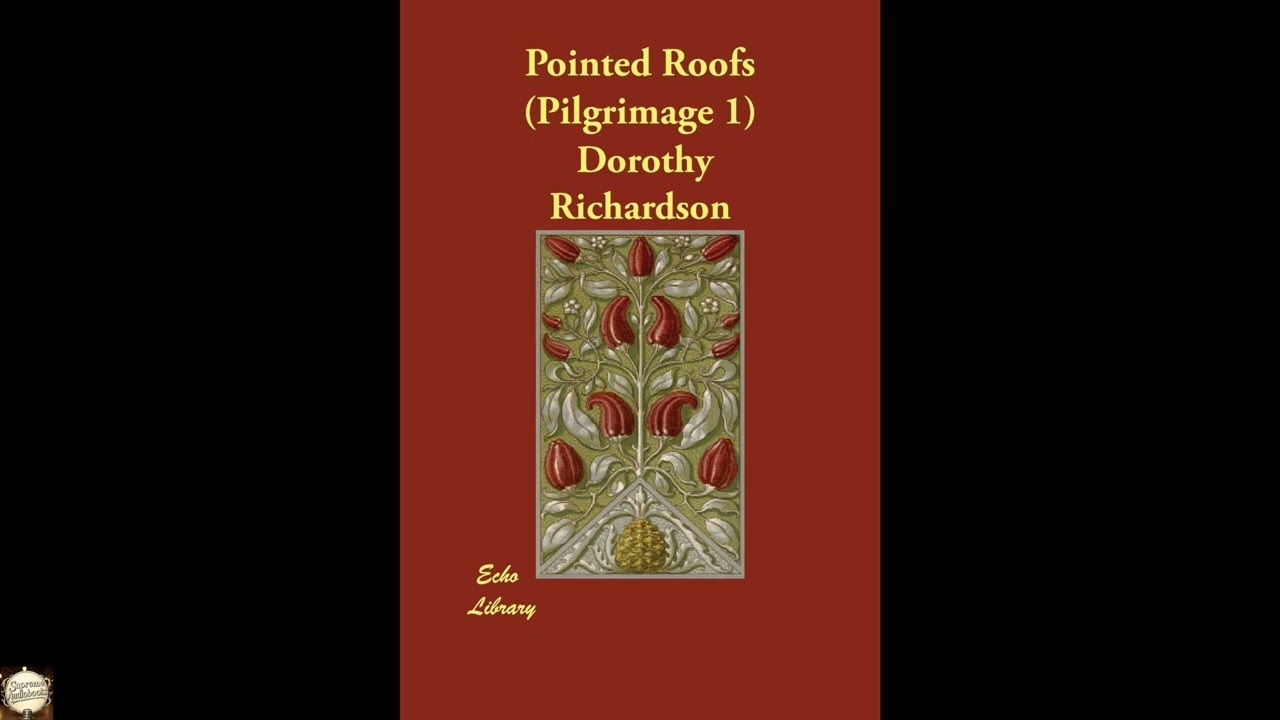
Pointed Roofs (Pilgrimage 1)
Pointed Roofs, the inaugural volume of Dorothy Richardson's monumental Pilgrimage sequence, stands as a foundational text in the development of modern English literature. It invites listeners into the mind of Miriam Henderson, a young woman at the dawn of the twentieth century, whose internal life is rendered with unprecedented intimacy and detail. This book is not merely a story; it is an experience of consciousness itself, a quiet revolution that continues to resonate today by offering an unflinching look at a woman striving to define herself in a world that often seeks to define her for her. For anyone curious about the origins of modern thought in fiction, or those seeking a profound connection with a keenly observing spirit, Miriam's story remains as fresh and compelling as it was at its first appearance. The year is 1902, and nineteen-year-old Miriam Henderson, seeking independence and a measure of purpose, leaves her family home in England for Germany. Her destination is a finishing school for girls in Hanover, where she has secured a position as an English governess. From the moment she steps off the train, Miriam's keen, sometimes anxious, observations begin to paint a vivid picture of her new surroundings. The "pointed roofs" of the German architecture, the unfamiliar sounds of the language, the strict routines of the school, and the personalities of its headmistress, Fräulein Pfaff, and her charges—all are filtered through Miriam's highly individual perception. She is an outsider, constantly processing, questioning, and categorizing the world around her, even as she struggles with the practicalities of her new role. Miriam's life at the school unfolds with a focus on her internal reactions rather than external events. We witness her attempts to connect with the various girls, some eager for her attention, others indifferent. Her relationships with the other governesses, particularly the kind but somewhat conventional Miss Stack, highlight her own burgeoning intellectual curiosity and her subtle defiance of expectations. She observes the nuances of German culture, the particularities of family life among her pupils, and the often-unspoken rules that govern society. While the plot moves gently, its true drama lies within Miriam's mind—her moments of intense sensory awareness, her solitary walks through the town, her quiet resistance to conformity, and her growing understanding of her own desires and limitations. The central conflict is her struggle to find authentic expression and self-knowledge in a world that offers few models for an independent woman. Dorothy Richardson, born in 1873, was an English novelist and essayist whose singular literary vision earned her a place among the pioneers of modernism. Her early life was marked by both intellectual promise and practical necessity. Following her mother's death and her family's financial difficulties, Richardson took on various roles, including that of a governess in Germany, an experience that directly informed Pointed Roofs. Later, she worked as a dental secretary in London, a profession she held for many years, while also pursuing writing and journalism. This period saw her engaging with bohemian circles and intellectual currents of the time, including Fabian socialism and early feminist thought. Richardson's output was largely devoted to Pilgrimage, a sprawling, thirteen-volume novel sequence published between 1915 and 1967. Pointed Roofs was the first installment, establishing her unique narrative approach. She is widely credited as one of the earliest writers to fully employ the stream-of-consciousness technique in English fiction, influencing subsequent modernists such as Virginia Woolf and James Joyce. While her work often received critical acclaim from her peers, it remained somewhat niche during her lifetime compared to her more famous contemporaries. Nonetheless, her commitment to depicting inner life, particularly the female psyche, secured her status as a crucial figure in the twentieth-century literary canon. She passed away in 1957. Pointed Roofs enacts several significant themes. Perhaps most prominent is the assertion of female consciousness and subjectivity. Miriam's mind is the primary lens through which the entire story is told, offering a direct, unfiltered experience of her thoughts, feelings, and perceptions. For instance, her internal monologues often reveal her keen observational skills and her subversive critiques of societal norms, even as she outwardly conforms to her role. She notices the subtle power dynamics between teachers and students, the unspoken expectations placed upon women, and the different ways individuals navigate their emotional lives. Another central theme is the search for identity and autonomy. Miriam, despite her youth and inexperience, consistently grapples with who she is and who she wishes to become, separate from the roles society dictates. She yearns for intellectual stimulation and a life of meaning beyond the confines of a traditional woman's existence. This is evident in her quiet moments of reflection, her resistance to gossip, and her desire to understand German philosophy, contrasting sharply with the more superficial concerns of some of her peers. The book also subtly questions the nature of reality itself, positing that individual perception creates its own truth, a groundbreaking idea for its time. The period in which Pointed Roofs was conceived and published—the early twentieth century, with its setting predating World War I—was a time of profound societal and cultural upheaval. Women were increasingly questioning traditional roles, with the suffrage movement gaining momentum and new opportunities, however limited, emerging in education and the workplace. Richardson's own experiences as a working woman in London and as a governess abroad provided her with firsthand insight into these shifts. Literarily, this was the crucible of modernism. Novelists were moving away from the omniscient narrator and linear plots characteristic of Victorian literature. The emerging field of psychology, particularly the work of Freud and Jung, was fostering new ideas about the subconscious mind and individual subjectivity. Pointed Roofs directly responded to this intellectual ferment, offering a radical departure from conventional narrative by attempting to replicate the continuous flow of thought, sensation, and memory, rather than simply recounting external events. It was a conscious effort to break new ground in how fiction could represent human experience. Listening to Pointed Roofs as an audiobook offers a uniquely immersive pathway into Miriam Henderson's interior world. The very nature of stream-of-consciousness prose—its rhythms, its associative leaps, its delicate balance of observation and introspection—lends itself beautifully to the spoken word. A skilled narrator can guide you through the nuanced ebb and flow of Miriam's thoughts, making her often-solitary reflections feel like an intimate conversation. The careful pacing of the narration can highlight the moments of intense sensory detail—the distinct smells of the German kitchen, the particular lilt of a student's voice, the play of light on a tiled roof—allowing you to fully absorb the atmosphere and Miriam's subtle reactions. This is a story where the voice itself becomes the conduit for the character's consciousness, enhancing the sense of being present inside her mind as she observes, questions, and begins to understand herself.
Enjoyed Pointed Roofs (Pilgrimage 1)? A few ways to support us
Audible & Amazon links are affiliate; we may earn a small commission at no extra cost.
About this production
Human narration by a volunteer reader from LibriVox.org, the public-domain audiobook project. LibriVox volunteers record literary works whose copyright has expired in the United States, releasing the resulting recordings into the public domain.
Pointed Roofs (Pilgrimage 1) by Dorothy Richardson. The underlying text is in the U.S. public domain. We do not republish any modern copyrighted edition, translation, or commentary.
The 4K cinematic visuals accompanying this audiobook are generated by an AI image model from prompts derived from the source text. No copyrighted photos, paintings, or stock footage are used. AI generation is disclosed on every video on our YouTube channel as required by YouTube's altered/synthetic content policy.
English subtitles are transcribed from the LibriVox recording with OpenAI Whisper. Translations into the 11 other supported languages are produced by Meta's NLLB-200 neural translation model. No human translator's copyrighted translation is used.
Questions about sourcing or rights? See our DMCA & Sourcing policy or contact us.
Enjoyed this audiobook?
If you'd like to own a copy of Pointed Roofs (Pilgrimage 1) or hear a professionally produced edition, the links below help support free audiobook production at no extra cost to you.
As an Amazon Associate we earn from qualifying purchases. Audible / print links are affiliate.