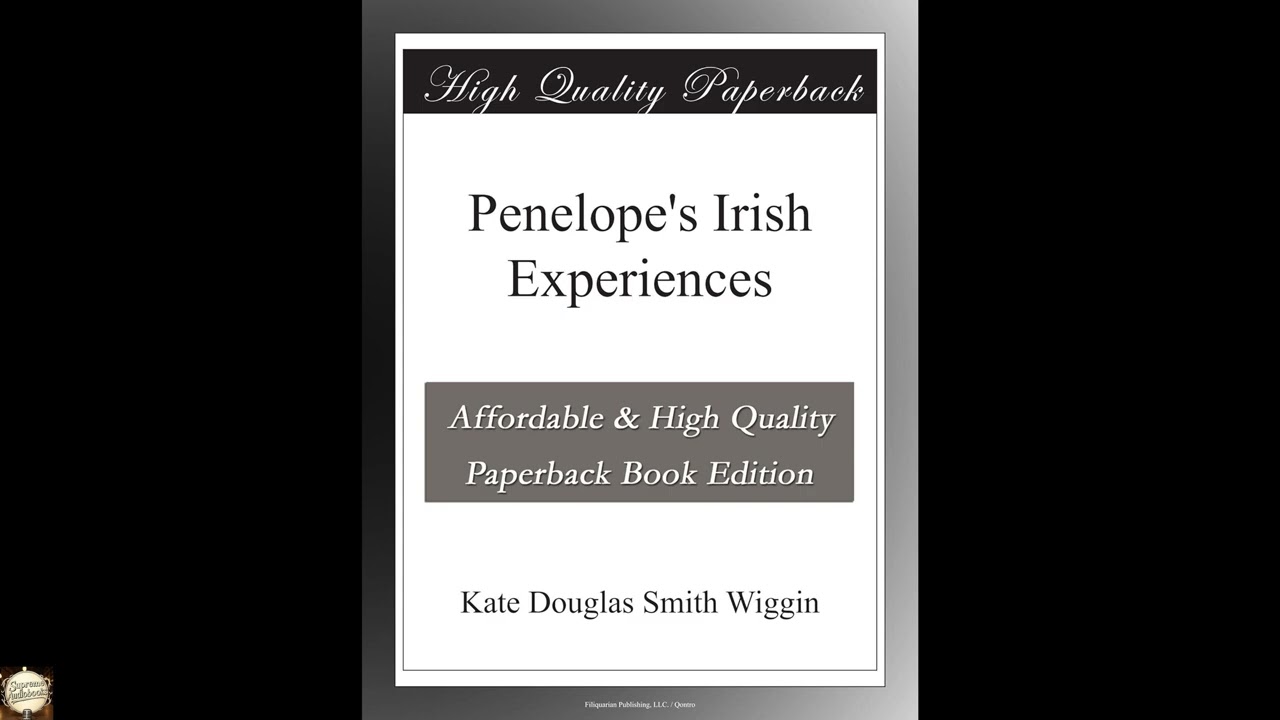
Penelope's Irish Experiences
Step into a world where the emerald isle unfolds with a gentle wit and a keen eye for human nature, a place where three American ladies, spirited and utterly charming, navigate the quirks and wonders of a foreign land. Kate Douglas Smith Wiggin's Penelope's Irish Experiences is more than a simple travelogue; it is a delightful expedition into the heart of early twentieth-century Ireland, observed through the humorous and often affectionate lens of its protagonist, Penelope Hamilton. This book, first published in 1901, invites modern listeners to rediscover the enduring appeal of thoughtful observation and the subtle comedy of cultural encounters, offering a refreshing perspective on a historical moment and a testament to the joys of independent travel long before it became commonplace. It stands as a testament to the power of shared laughter and genuine curiosity, reminding us that true understanding often begins with an open heart and a willingness to be surprised. Our story begins as Penelope Hamilton, an American woman of wit and good humor, arrives on the shores of Ireland accompanied by her two equally engaging companions, the sensible Frances and the quietly observant Salemina. Having already charmed their way through Scotland and England in previous adventures, these three friends are prepared for a new set of discoveries, armed with their American sensibilities and a genuine desire to experience the true essence of Irish life. Their aim is not merely to sightsee, but to immerse themselves, engaging with the local people, exploring the often-remote countryside, and uncovering the authentic spirit of a nation famed for its storytelling and hospitality. The narrative unfolds as a series of connected vignettes, each detailing a fresh encounter or a new destination. From bustling Dublin streets to the serene lakes of Killarney, and from the rugged beauty of the Giant's Causeway to the quiet charm of rural cottages, Penelope and her friends meet an array of characters who embody the diverse fabric of Irish society. They encounter kind-hearted farmers, loquacious innkeepers, curious children, and even members of the local gentry, each interaction contributing to their evolving understanding of the country. The central thread of the story lies in Penelope's constant, good-natured attempts to reconcile her preconceptions with the realities she observes, often finding humor in the cultural differences and occasional misunderstandings that arise. The arc of their adventures traces a path from initial impressions to a deep and abiding affection for the land and its people, an appreciation built on shared moments of laughter, unexpected kindness, and the simple beauty of everyday life. The author, Kate Douglas Smith Wiggin, was born in Philadelphia in 1856 and passed away in Santa Barbara, California, in 1923. Her life was as varied and inspiring as the characters she created. After spending her childhood in Hollis, Maine, she moved to California where, remarkably, she established the first free kindergarten on the West Coast in San Francisco. Her passion for education and her keen understanding of human nature became the bedrock of her literary career, which began with stories written for children to raise funds for her schools. While Penelope's Irish Experiences is a beloved work, Wiggin is perhaps best remembered for her enduring contributions to American children's literature, most notably Rebecca of Sunnybrook Farm (1903) and the heartwarming The Birds' Christmas Carol (1887). She was a prolific writer, known for her ability to blend humor with genuine sentiment, crafting narratives that resonated with readers of all ages. Her place in the literary canon is that of a significant voice in American regionalism and a pioneering figure in the development of children's literature at the turn of the twentieth century, celebrated for her optimistic outlook and her ability to capture the innocent charm of childhood and the gentle wisdom found in ordinary lives. At its core, Penelope's Irish Experiences enacts several powerful themes. One prominent idea is the beauty of cultural exchange and understanding. Through Penelope's encounters, the text gently highlights the humor and occasional friction that arises when different customs meet. For instance, Penelope often finds herself amused by the distinctive turns of phrase in Irish speech, or the unique blend of hospitality and directness she encounters, such as when a local tells a colorful, perhaps embellished, story about their village history. This constant interplay fosters a deeper appreciation for the nuances of identity. Another theme is the power of travel to broaden one's perspective. The three women, far from home, are transformed by their discoveries, shedding superficial observations for genuine insight. This is evident in Penelope's detailed descriptions of the landscapes, from the wild coasts to the tranquil glens, which become more than just scenery; they become characters in themselves, imbued with history and spirit through her appreciative gaze. The book also vividly illustrates the theme of female friendship and independence. Penelope, Frances, and Salemina are not seeking husbands or chaperones; they are intellectual companions, delighting in each other's observations and supporting each other through every new adventure. Their collective joy in discovering Ireland together, whether it is navigating a winding country road or sharing a simple meal, underscores the strength and warmth of their bond. Finally, the novel touches on the enduring charm of simplicity and genuine human connection. Amidst the picturesque descriptions, Wiggin consistently brings the narrative back to the people, celebrating their warmth, their resilience, and their rich oral traditions. A scene where Penelope shares tea with a family in a modest cottage, exchanging stories and laughter, exemplifies how the text values heartfelt interaction over grand experiences, suggesting that the most meaningful souvenirs of travel are often the human connections made along the way. When Penelope's Irish Experiences was published in 1901, the world was on the cusp of a new century, but echoes of the Victorian era still resonated strongly. Culturally, there was a growing interest in international travel, with Americans particularly fascinated by the perceived antiquity and romanticism of Europe. Ireland, though still under British rule and grappling with complex political realities and economic hardship, was also experiencing a cultural resurgence, known as the Celtic Revival, which saw a renewed interest in Irish language, folklore, and arts. Wiggin’s portrayal offers a somewhat idealized, "picturesque" view of Ireland, catering to the aesthetic and romantic notions of her largely American readership who sought charm and quaintness. Her work emerged in a period when women writers were increasingly prominent, and the idea of independent female travelers, though still somewhat novel, was gaining traction, reflecting a broader societal shift towards greater autonomy for women. Listening to Penelope's Irish Experiences as an audiobook transforms this literary excursion into an even more immediate and delightful sensory experience. The narration breathes life into Wiggin’s distinctive prose, allowing the listener to truly savor the witty dialogue and the rich descriptions of early twentieth-century Ireland. An accomplished narrator can masterfully differentiate between Penelope's keen American observations and the charming, often lyrical speech of the Irish characters, allowing their unique personalities to shine through. The gentle, unhurried pacing of the reading perfectly matches the observational nature of the narrative, inviting you to relax and soak in the atmosphere. With a runtime spanning several hours, this allows for extended periods of immersive listening, making it an ideal companion for long drives, peaceful afternoons, or simply as a comforting presence while engaged in quiet tasks. The cadence and rhythm of the spoken word enhance the humor, the warmth, and the vivid imagery, transporting you directly into the quaint inns and windswept landscapes, making Penelope’s delightful adventures your very own.
Enjoyed Penelope's Irish Experiences? A few ways to support us
Audible & Amazon links are affiliate; we may earn a small commission at no extra cost.
About this production
Human narration by a volunteer reader from LibriVox.org, the public-domain audiobook project. LibriVox volunteers record literary works whose copyright has expired in the United States, releasing the resulting recordings into the public domain.
Penelope's Irish Experiences by Kate Douglas Smith Wiggin. The underlying text is in the U.S. public domain. We do not republish any modern copyrighted edition, translation, or commentary.
The 4K cinematic visuals accompanying this audiobook are generated by an AI image model from prompts derived from the source text. No copyrighted photos, paintings, or stock footage are used. AI generation is disclosed on every video on our YouTube channel as required by YouTube's altered/synthetic content policy.
English subtitles are transcribed from the LibriVox recording with OpenAI Whisper. Translations into the 11 other supported languages are produced by Meta's NLLB-200 neural translation model. No human translator's copyrighted translation is used.
Questions about sourcing or rights? See our DMCA & Sourcing policy or contact us.
Enjoyed this audiobook?
If you'd like to own a copy of Penelope's Irish Experiences or hear a professionally produced edition, the links below help support free audiobook production at no extra cost to you.
As an Amazon Associate we earn from qualifying purchases. Audible / print links are affiliate.