Pax Vobiscum
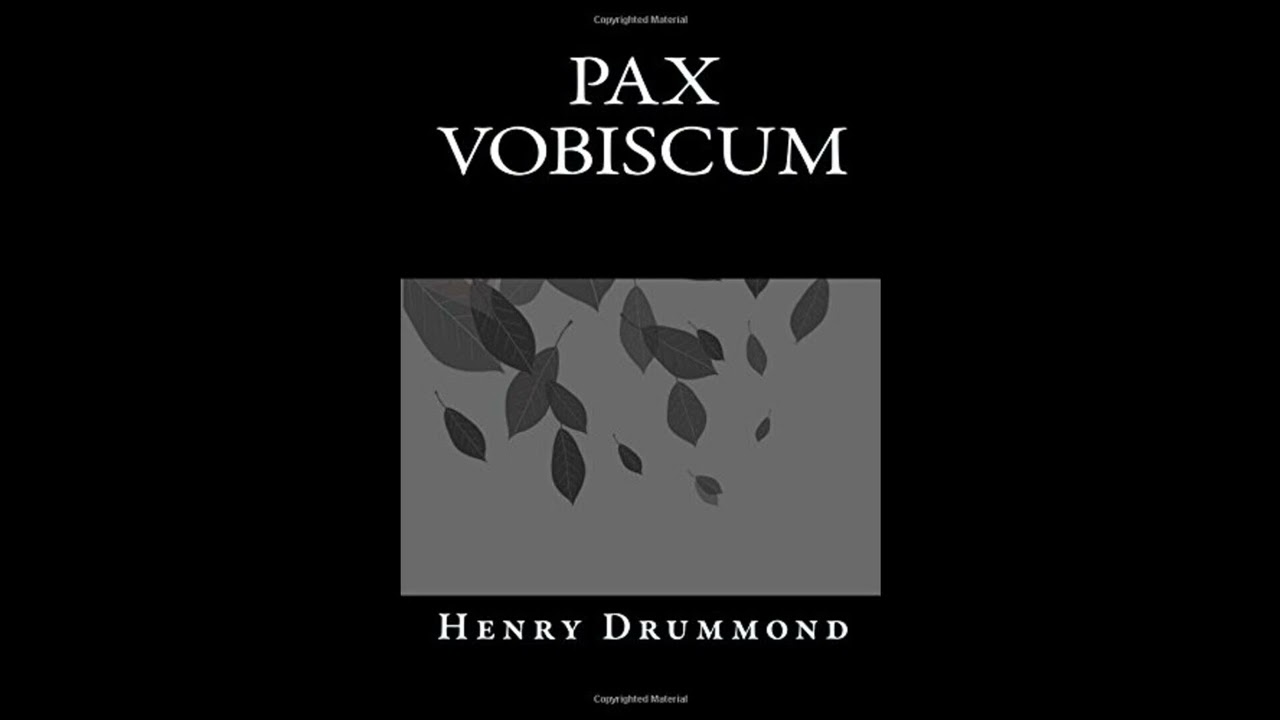
In an age defined by its relentless pace, by constant digital chatter and an ever-present hum of anxiety, the yearning for inner quietude often feels like an unattainable dream. Henry Drummond’s profound essay, Pax Vobiscum – meaning "Peace Be With You" – speaks directly to this very human longing. Far from offering a superficial calm, Drummond presents a radical and practical path to a peace that resides not in the absence of external trouble, but in the cultivated stillness of the heart itself. This enduring work, first published in the late nineteenth century, continues to resonate today, offering a beacon of hope and a clear blueprint for cultivating tranquility within a turbulent world. This isn't a narrative with characters in the conventional sense, but rather a profound spiritual argument, structured as a gentle yet insistent guide for the seeker of true peace. Drummond sets the scene not in a specific geographical location, but within the inner landscape of the human spirit, a place where restlessness often overshadows contentment. The central challenge addressed is the universal struggle against worry, impatience, and self-centeredness—the very forces that steal our quietude. Drummond begins by subtly dismantling common misconceptions about peace, arguing that it is not merely a reprieve from external strife, but an active, internal state of being. He systematically leads the reader through the conditions necessary for cultivating this inner harmony. The essay charts a course from understanding what peace is not, to discerning what it truly is: a spiritual disposition rooted in specific virtues. Drummond lays bare the subtle ways we obstruct our own peace, contrasting these self-imposed barriers with the promise of a quiet mind and spirit. His "story" is one of self-discovery and transformation, where the reader, as the implicit protagonist, learns to recognize the true sources of serenity and how to welcome them into everyday life, rather than waiting for ideal circumstances. The essay unfolds as a logical progression, building its case with clarity and persuasive insight. Henry Drummond, born in Stirling, Scotland, in 1851, was a figure of considerable intellectual and spiritual influence in his era. He initially pursued natural sciences at Edinburgh University before turning to theology, a dual training that shaped his unique perspective. Drummond became a highly sought-after lecturer and evangelist, renowned for his ability to bridge the seemingly disparate worlds of scientific inquiry and Christian faith. He held the prestigious Chair of Natural Science at the Free Church College, Glasgow, a position from which he profoundly impacted generations of students and thinkers. His travels took him to America, Australia, and Africa, broadening his understanding of humanity and faith across diverse cultures. Drummond’s most celebrated work, The Greatest Thing in the World, often published alongside Pax Vobiscum, focuses on the supreme importance of love. Other notable works include Natural Law in the Spiritual World, where he sought to demonstrate the continuity between scientific laws and spiritual principles, and Tropical Africa, a record of his observations during his travels. He carved out a distinct place in Victorian literature as a leading voice in Christian apologetics and inspirational writing. His straightforward, accessible prose, devoid of academic jargon, made profound spiritual truths palatable and practical for a wide audience. He was not a novelist or a poet, but an essayist and speaker whose clear, empathetic voice made him a beloved guide for those seeking meaning and moral direction. One of the core themes running through Pax Vobiscum is the idea of inner peace as a state independent of external circumstances. Drummond argues that true peace isn't found by escaping trouble, but by changing one's internal response to it. He might illustrate this, for instance, by suggesting that a boat navigating a stormy sea can remain steady if its internal ballast is correctly distributed, just as a person can maintain inner calm amidst life’s tumult if their spiritual foundation is secure. Another significant theme is the role of character in cultivating peace. Drummond posits that peace is not merely a feeling but a byproduct of specific virtues. He emphasizes that impatience, anxiety, and self-preoccupation are fundamentally incompatible with inner quietude, and that qualities like patience, humility, and unselfishness are prerequisites for true serenity. The essay also embodies practical spirituality, offering actionable steps rather than abstract theological concepts. Drummond avoids abstruse doctrines, instead providing concrete examples of how small, everyday acts of self-control or kindness contribute to a peaceful inner life, demonstrating that peace is a habit to be cultivated, not a sudden, unearned gift. This leads naturally to a fourth theme: the essential continuity of love and peace. Drawing implicitly from his other major essay, Drummond shows that peace is a natural outgrowth of love—love for God and neighbor dispels the worries and egoism that disrupt our inner calm, creating a fertile ground for tranquility to flourish. When Henry Drummond wrote Pax Vobiscum in the late 1880s, the world was undergoing immense transformation. The Victorian era was characterized by rapid scientific advancements, notably Darwin's theory of evolution, which created significant anxieties about the perceived conflict between science and traditional religious belief. Industrially, the world was modernizing at an unprecedented rate, bringing with it both progress and new social complexities. Culturally, there was a widespread thirst for spiritual meaning and guidance, often expressed through revival movements led by figures like D.L. Moody, with whom Drummond himself had a close association. Drummond’s work emerged precisely to address these prevailing intellectual and spiritual challenges. Many people felt caught between the certainties of traditional faith and the compelling discoveries of science. Pax Vobiscum offered solace and a pragmatic blueprint for personal well-being in an age wrestling with profound questions. His ability to articulate spiritual truths in a clear, reasoned manner, often using scientific analogies, made his message particularly accessible and reassuring to a generation seeking anchors amidst shifting sands. The essay provided a path to personal peace that felt both deeply spiritual and intellectually coherent, a powerful combination for his time. Listening to Pax Vobiscum as an audiobook offers a unique and intimate encounter with Drummond's gentle wisdom. The narrative experience, free from visual distractions, allows the listener to fully absorb the measured rhythm of his prose. A thoughtful narrator, with a calm and clear voice, can bring out the essay’s meditative quality, allowing Drummond’s arguments to unfold with unhurried grace. The run length, several hours, makes it an ideal companion for reflective periods—perhaps during a quiet evening, a long drive, or dedicated moments of personal contemplation. Listen for the deliberate pacing, which invites pauses for reflection, and for the way the narrator's voice can emphasize the inherent logic and spiritual power behind Drummond's words. The lack of traditional dialogue means the focus rests entirely on the author's direct address, creating an atmosphere of profound yet accessible guidance, a quiet conversation with a wise friend.
Enjoyed Pax Vobiscum? A few ways to support us
Audible & Amazon links are affiliate; we may earn a small commission at no extra cost.
About this production
Human narration by a volunteer reader from LibriVox.org, the public-domain audiobook project. LibriVox volunteers record literary works whose copyright has expired in the United States, releasing the resulting recordings into the public domain.
Pax Vobiscum by Henry Drummond. The underlying text is in the U.S. public domain. We do not republish any modern copyrighted edition, translation, or commentary.
The 4K cinematic visuals accompanying this audiobook are generated by an AI image model from prompts derived from the source text. No copyrighted photos, paintings, or stock footage are used. AI generation is disclosed on every video on our YouTube channel as required by YouTube's altered/synthetic content policy.
English subtitles are transcribed from the LibriVox recording with OpenAI Whisper. Translations into the 11 other supported languages are produced by Meta's NLLB-200 neural translation model. No human translator's copyrighted translation is used.
Questions about sourcing or rights? See our DMCA & Sourcing policy or contact us.
Enjoyed this audiobook?
If you'd like to own a copy of Pax Vobiscum or hear a professionally produced edition, the links below help support free audiobook production at no extra cost to you.
As an Amazon Associate we earn from qualifying purchases. Audible / print links are affiliate.