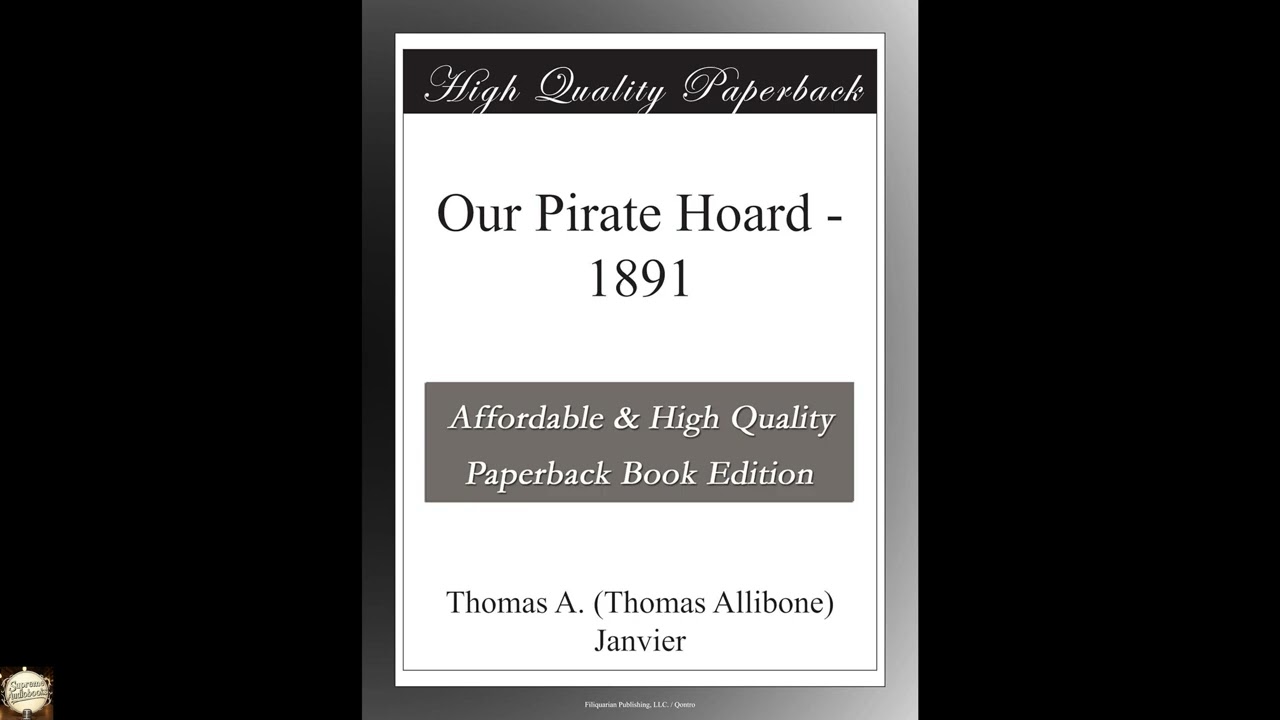
Our Pirate Hoard - 1891
Deep in the annals of classic adventure lies Our Pirate Hoard, a stirring tale penned by Thomas Atherton in 1891, a novel that captures the very essence of an era obsessed with discovery and the untamed corners of the world. Far more than a simple swashbuckling narrative, this book stands as a testament to the enduring human fascination with hidden riches and the profound transformation that the pursuit of them can ignite within the soul. It asks enduring questions about morality, loyalty, and the true cost of ambition, making it a compelling listen not just for those who cherish historical fiction, but for anyone who has ever dreamed of a life beyond the ordinary, a life forged in the crucible of extraordinary circumstances. The story begins in the seemingly unremarkable English coastal town of Blackwater, where young Arthur Pimm, a restless apprentice to a dry goods merchant, chafes under the mundane routines of his existence. His life takes an abrupt turn with the arrival of the enigmatic Captain Barnaby, a grizzled old sea dog with a weather-beaten face and eyes that hint at a thousand untold stories. Captain Barnaby, a frequent patron of the local tavern, carries a secret that gradually reveals itself: a tattered, ancient map detailing the location of a legendary pirate hoard on a remote, uncharted island in the Caribbean. Arthur, spurred by a longing for adventure and a desire to escape his predetermined fate, finds himself drawn into the Captain's orbit, listening raptly to fragmented tales of Blackbeard's rumored treasures and the perilous journey required to claim them. Soon, the lure of untold gold proves too strong to resist for a motley crew of local sailors, ne'er-do-wells, and desperate men, all dreaming of a new life bought with ill-gotten gains. Arthur, against the cautious advice of his few friends, signs on as a cabin boy, plunging headfirst into a world of creaking timbers, salty spray, and the rough camaraderie of men bound by a common, perilous goal. Their voyage across the vast ocean is fraught with both natural dangers – violent storms and becalmed waters – and the growing internal tensions among the crew. As the ship nears the fabled island, the promise of the hoard begins to expose the darker facets of human nature, transforming hopeful companions into wary rivals. Suspicion festers, loyalties are tested, and Arthur must quickly learn to navigate not only the physical dangers of the high seas but also the treacherous currents of human greed and betrayal, all while keeping the secret of the map's most crucial details close to his chest. Thomas Atherton, born in the bustling port city of Bristol in 1855, was a writer whose life was as imbued with the spirit of the sea as many of his characters. The son of a shipwright, Atherton spent his formative years amidst the sights and sounds of the docks, an environment that instilled in him a profound respect for maritime life and its inherent dramas. Though initially destined to follow in his father's footsteps, a childhood accident left him with a lingering physical impairment that steered him toward the quieter pursuits of reading and writing. He devoured tales of exploration and adventure, from Defoe's castaways to the burgeoning travelogues of his own era. After a brief, unfulfilling stint as a clerk in a shipping company, Atherton dedicated himself fully to literature. His early works, serialized in popular periodicals, often focused on realistic depictions of working-class life, but it was with The Crimson Tide (1885), a gripping novella of a shipwreck and survival, that he found his true calling in adventure fiction. Our Pirate Hoard, published six years later, solidified his reputation as a master storyteller, capable of blending thrilling escapades with keen psychological insight. Atherton continued to write prolifically throughout his life, producing other notable works such as The Lost Ivory Coast (1898) and the collection of short stories, Sailor's Yarn and Other Maritime Tales (1905), cementing his place as a foundational figure in late Victorian popular literature before his passing in 1920. Our Pirate Hoard masterfully explores several profound themes. The most apparent is the age-old conflict between greed and morality. As the promise of the treasure grows closer, Atherton paints a vivid picture of how material desire can corrupt even the most seemingly upright individuals. Characters who began with a sense of adventure find themselves driven by an insatiable hunger for gold, leading to treachery and even violence. For instance, the slow but undeniable moral decay of Mr. Finch, the ship's seemingly respectable first mate, who begins as a voice of reason but succumbs to avarice, serves as a stark warning. The novel also powerfully portrays the coming-of-age of its young protagonist, Arthur Pimm. Initially naive and idealistic, Arthur is forced to confront the harsh realities of the world and the complexities of human nature. He transforms from a sheltered boy dreaming of glory into a resourceful and resilient young man, learning painful lessons about trust and survival, often through the crucible of direct confrontation with danger and betrayal. Another key theme is the potent allure of the unknown and the spirit of exploration that defined the late 19th century. The uncharted island, the whispered legends of the pirate hoard, and the vast expanse of the ocean all represent a world beyond the confines of civilization, a place where rules are fluid and destiny is forged by courage and wit. Finally, Atherton deftly touches upon the theme of loyalty and betrayal. The bonds formed on the ship are tested time and again, revealing the fragile nature of alliances built on shared ambition rather than genuine affection. Scenes of tense standoffs and whispered conspiracies highlight the constant threat of disloyalty that permeates the entire quest, questioning the very notion of honor among thieves. Published in 1891, Our Pirate Hoard emerged during a fascinating nexus of cultural and literary trends. The British Empire was at its zenith, and public imagination was captivated by tales of exotic lands, colonial expansion, and the romanticized dangers of distant frontiers. Advances in printing and distribution meant that popular literature, often serialized in magazines before book publication, reached an unprecedented audience. Authors like Robert Louis Stevenson, H. Rider Haggard, and Jules Verne had already established a voracious appetite for adventure stories, offering an escape from the increasingly industrialized and urbanized realities of Victorian life. Atherton’s work resonated deeply with this public hunger for escapism, but also offered a more nuanced perspective than some of his contemporaries. While providing the thrills of a treasure hunt, Our Pirate Hoard also served as a subtle commentary on the moral compromises inherent in such quests and, by extension, perhaps even in imperial expansion. It reflected a society grappling with the consequences of its reach, presenting both the grandeur and the darker side of human ambition when unleashed in untamed territories. The novel solidified its author’s place as a significant voice within this flourishing genre, contributing to a body of work that continues to influence adventure narratives today. Listening to Our Pirate Hoard as an audiobook transforms the experience into something truly immersive, bringing the salt spray and the whisper of distant adventure directly to your ears. A skilled narrator breathes life into Captain Barnaby's gravelly pronouncements, Arthur Pimm's youthful earnestness, and the diverse accents of the crew, making each character distinct and memorable. The several hours of run time unfold at a deliberate yet engaging pace, perfect for long walks, commutes, or an evening curled up in your favorite chair. Pay attention to the subtle shifts in the narrator's voice as tension builds during a storm at sea or a clandestine meeting on the island, enhancing the atmosphere of suspense and discovery. The dialogue, rich with the vernacular of the late 19th century, gains an authentic cadence when spoken aloud, transporting you directly aboard the ship and into the heart of the perilous quest for the legendary pirate hoard.
Enjoyed Our Pirate Hoard - 1891? A few ways to support us
Audible & Amazon links are affiliate; we may earn a small commission at no extra cost.
About this production
Human narration by a volunteer reader from LibriVox.org, the public-domain audiobook project. LibriVox volunteers record literary works whose copyright has expired in the United States, releasing the resulting recordings into the public domain.
Our Pirate Hoard - 1891 by Thomas A. The underlying text is in the U.S. public domain. We do not republish any modern copyrighted edition, translation, or commentary.
The 4K cinematic visuals accompanying this audiobook are generated by an AI image model from prompts derived from the source text. No copyrighted photos, paintings, or stock footage are used. AI generation is disclosed on every video on our YouTube channel as required by YouTube's altered/synthetic content policy.
English subtitles are transcribed from the LibriVox recording with OpenAI Whisper. Translations into the 11 other supported languages are produced by Meta's NLLB-200 neural translation model. No human translator's copyrighted translation is used.
Questions about sourcing or rights? See our DMCA & Sourcing policy or contact us.
Enjoyed this audiobook?
If you'd like to own a copy of Our Pirate Hoard - 1891 or hear a professionally produced edition, the links below help support free audiobook production at no extra cost to you.
As an Amazon Associate we earn from qualifying purchases. Audible / print links are affiliate.