Mysticism in English Literature
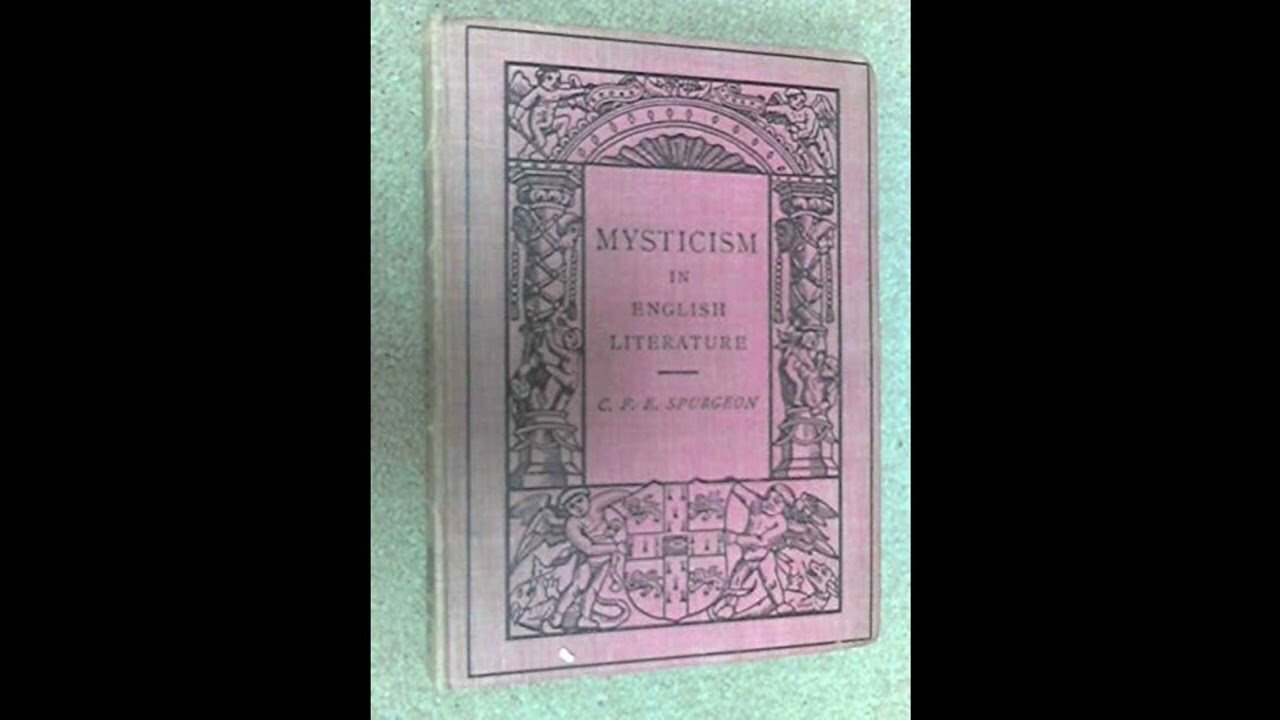
What happens when the profound, often ineffable stirrings of the human spirit find expression in the structured beauty of words? Caroline F. E. Spurgeon's Mysticism in English Literature addresses this very question, not as a theological treatise, but as a sweeping survey of how mystical experience—the direct apprehension of spiritual truth—has shaped and informed the English literary tradition. Listeners will discover that the impulse for transcendent connection isn't confined to hallowed texts or cloistered lives; it pulses beneath the surface of seemingly secular works, informing the visions of poets, dramatists, and prose writers across centuries. This groundbreaking study invites us to reread the literary canon with new eyes, revealing a continuous thread of spiritual yearning that makes sense of our shared human desire for meaning beyond the mundane, a relevance that echoes powerfully even today. Spurgeon's remarkable study begins its exposition not with abstract definitions, but with the concrete evidence found in early English verse and prose. She establishes a foundational understanding of what she means by "mysticism" – not necessarily confined to specific religious doctrines, but rather a direct, intuitive awareness of God or ultimate reality, characterized by personal experience and inner light. Her argument moves chronologically, starting with the earliest Christian writings in Anglo-Saxon England, where glimpses of a contemplative spirit can be discerned in devotional works and even nature poetry. She then proceeds through the high Middle Ages, shining a spotlight on figures like Richard Rolle and Julian of Norwich, whose intense personal revelations and articulate prose provide clear instances of English mystical writing, demonstrating how their experiences shaped their literary output. The narrative arc of the book continues through the Renaissance, the tumultuous Reformation, and into the periods of the Metaphysical poets and the Romantics. Spurgeon is less concerned with the orthodoxy of belief and more with the character of the mystical expression – how it manifests in metaphor, symbol, and narrative. She differentiates between various types of mystical temperament, showing how some authors experience a serene union, while others grapple with ecstatic visions or dark nights of the soul. The central thread is how these deeply personal experiences find a voice, often stretching the limits of language itself. She analyzes how authors adapt and transform the vocabulary of spiritual experience, whether drawing from established religious traditions or forging new forms of expression to convey the inexpressible, thereby demonstrating the dynamic interplay between spirit and literary form throughout English history. Caroline Frances Eleanor Spurgeon was a truly pioneering figure in early 20th-century English literary scholarship. Born in London in 1869, she defied the educational norms for women of her era, pursuing higher education at King's College London and Westfield College, and later completing her doctorate at the Sorbonne in Paris. Her dedication and intellectual rigor led her to become the first woman Professor of English Literature in England, holding the Hildred Carlile Chair at Bedford College, University of London, from 1913 until her retirement. This was a monumental achievement in a profession largely dominated by men, marking her as a trailblazer not only academically but also for women's rights in education. Beyond her ground-breaking role, Spurgeon was a prolific and influential scholar whose work helped shape modern literary criticism. While Mysticism in English Literature, published in 1913, was an early triumph, her most celebrated work remains Shakespeare's Imagery, and What It Tells Us (1935). In this seminal study, she employed a then-revolutionary empirical method, systematically categorizing and analyzing Shakespeare's recurring images to gain insight into his mind, themes, and characteristic ways of thinking. She also published significant studies on Keats, demonstrating her breadth of scholarly interest. Spurgeon's meticulous attention to textual detail and her willingness to apply innovative analytical techniques cemented her place as a major figure in the development of systematic literary study, moving criticism beyond impressionistic readings towards more evidence-based interpretation. A primary concern of Spurgeon's text is the profound elusiveness of mystical experience itself. She illustrates how English writers, from the anonymous authors of medieval lyrics to the soaring verse of Romantic poets, constantly wrestle with the inadequacy of language to describe direct encounters with the divine or ultimate reality. For example, she might point to the simple yet profound language of Julian of Norwich, who uses domestic imagery like a "little thing, the size of a hazelnut" to describe God's creation, attempting to ground a vast spiritual truth in tangible terms. This effort highlights the inherent tension between the boundless nature of spiritual insight and the finite tools of human communication. Another core idea is the continuity of spiritual seeking across historical epochs. Despite the seismic shifts in religious practice and intellectual thought—from medieval Catholicism to the Protestant Reformation, and then to the scientific rationalism of later centuries—Spurgeon shows how the human impulse for transcendent connection endures. She might demonstrate this by juxtaposing the overtly devotional poetry of a 17th-century Metaphysical poet like George Herbert, whose work is saturated with Christian doctrine, with the more Pantheistic leanings of a 19th-century figure such as William Wordsworth, who found profound spiritual resonance in the natural world. This underlines that while the forms and objects of spiritual focus may change, the underlying human desire to connect with something larger than oneself remains a constant, finding new literary manifestations. When Mysticism in English Literature appeared in 1913, the world was on the cusp of profound change. The early 20th century was a period marked by burgeoning scientific advancements, a questioning of traditional religious authority, and the rise of secular thought. However, alongside this rationalist tide, there was also a renewed interest in spiritualism, esoteric traditions, and non-dogmatic forms of spirituality, often as a response to the perceived emptiness of a purely materialistic worldview. In the literary sphere, Modernism was beginning to take root, challenging Victorian conventions, yet many scholars were still grappling with the legacies of Romanticism and the Victorian era's complex relationship with faith. Spurgeon's work, therefore, emerged into a fascinating intellectual milieu. It offered a scholarly bridge between the historical study of literature and a deeper understanding of its spiritual undercurrents, at a time when academic discourse might have otherwise leaned towards more purely historical or aesthetic analyses. Her project was innovative in its specific focus on mysticism as a persistent, shaping force within English literature, providing a counter-narrative to purely materialist interpretations and demonstrating that the spiritual dimension remained a vital, if sometimes hidden, aspect of literary creation during an era of increasing secularization. It was a timely reminder that even as the world modernized, the human soul continued its age-old quest for ultimate meaning, finding its echoes in the written word. To hear Mysticism in English Literature presented as an audiobook is to receive a scholarly text not as a dry academic exercise, but as a living conversation with centuries of literary genius. The comprehensive run length, stretching over several hours, encourages attentive, unhurried listening, allowing Spurgeon's carefully constructed arguments to unfold at their own pace. A skilled narrator brings clarity and nuance to her precise language, ensuring that the listener can absorb the intricate historical and textual connections she draws. The voice of the narrator becomes a guide through the varied landscape of English literature, highlighting the subtle shifts in tone and perspective as Spurgeon moves from medieval devotional texts to later philosophical poetry. This format allows the listener to fully appreciate the continuity of thought and feeling that Spurgeon so eloquently traces, making the complex interplay of spirituality and literary expression accessible and engaging.
Enjoyed Mysticism in English Literature? A few ways to support us
Audible & Amazon links are affiliate; we may earn a small commission at no extra cost.
About this production
Human narration by a volunteer reader from LibriVox.org, the public-domain audiobook project. LibriVox volunteers record literary works whose copyright has expired in the United States, releasing the resulting recordings into the public domain.
Mysticism in English Literature by Caroline F. E. Spurgeon. The underlying text is in the U.S. public domain. We do not republish any modern copyrighted edition, translation, or commentary.
The 4K cinematic visuals accompanying this audiobook are generated by an AI image model from prompts derived from the source text. No copyrighted photos, paintings, or stock footage are used. AI generation is disclosed on every video on our YouTube channel as required by YouTube's altered/synthetic content policy.
English subtitles are transcribed from the LibriVox recording with OpenAI Whisper. Translations into the 11 other supported languages are produced by Meta's NLLB-200 neural translation model. No human translator's copyrighted translation is used.
Questions about sourcing or rights? See our DMCA & Sourcing policy or contact us.
Enjoyed this audiobook?
If you'd like to own a copy of Mysticism in English Literature or hear a professionally produced edition, the links below help support free audiobook production at no extra cost to you.
As an Amazon Associate we earn from qualifying purchases. Audible / print links are affiliate.