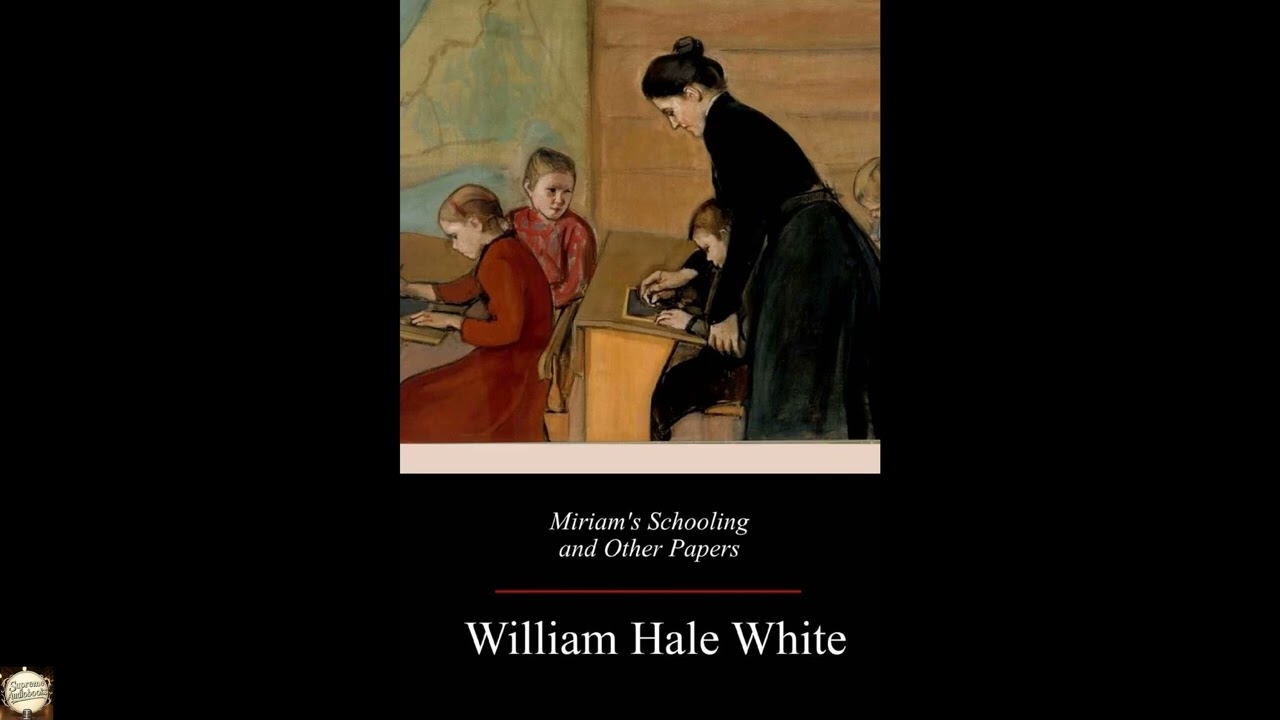
Miriam's Schooling and Other Papers
In an age of constant noise and fleeting trends, the quiet, profound voice of William Hale White, writing as Mark Rutherford, offers a much-needed sanctuary for reflection. His collection, Miriam's Schooling and Other Papers, stands as a testament to the enduring human quest for truth, meaning, and an authentic inner life. Far from a dusty relic, this volume directly addresses the anxieties and aspirations that still resonate deeply today—the struggle to reconcile inherited beliefs with personal experience, the search for a meaningful education, and the courage to forge one's own spiritual path. It is a work for anyone who has ever questioned the status quo, who seeks intellectual honesty above easy answers, and who understands that true growth often happens in the quiet spaces of the soul. The central narrative, "Miriam's Schooling," introduces us to Miriam, a sensitive and intellectually curious young woman navigating the often-confining world of late Victorian provincial England. Her early life is steeped in the rigid moral and religious doctrines of her dissenting family and community. From a young age, Miriam exhibits a profound capacity for observation and an unsettling honesty that sets her apart. Her schooling, intended to instill conventional piety and knowledge, instead becomes a crucible for her burgeoning intellect. She grapples with the limitations of rote learning and the hypocrisy she sometimes perceives in her teachers and elders. As she matures, Miriam's questions grow more pointed, challenging the very foundations of the faith she is expected to embrace without doubt. Miriam's journey is less about grand external events and more about an intense internal struggle. She encounters various mentors and intellectual influences, some offering comfort and others further stirring her doubts. She tries to conform, to find peace within the prescribed boundaries of her upbringing, but her innate honesty continually pulls her towards a more personal and often solitary understanding of the world. Her conflict lies in the tension between her sincere desire for belief and her inability to accept doctrines that contradict her reason or her deeply felt moral sense. The story follows her slow, deliberate path of disillusionment and re-evaluation, as she quietly sheds the strictures of her youth, not in rebellion, but in a profound, almost reluctant search for a faith that is truly her own, grounded in experience rather than dogma. William Hale White (1831-1913), the man behind the pseudonym Mark Rutherford, was himself a product of the very world he so acutely observed. Born into a Congregationalist family in Bedford, England, White initially pursued a career in the nonconformist ministry, training at New College, London, and later at the more liberal Unitarian Manchester New College. However, his profound intellectual honesty and growing theological doubts made a conventional ministry impossible. He left the pulpit after only a few years, unable to preach what he no longer fully believed. This pivotal personal crisis, a "deliverance" from what he considered intellectual bondage, became the wellspring for much of his subsequent literary output. After leaving the ministry, White spent the greater part of his working life in the civil service, a steady but undramatic career that allowed him the space for private reflection and writing. He began his literary career relatively late in life, publishing his first novel, The Autobiography of Mark Rutherford, in 1881, when he was fifty years old. His subsequent works, including The Deliverance of Mark Rutherford and The Revolution in Tanner's Lane, further established his unique voice. Although never a widely popular author in his lifetime, White was deeply admired by a discerning readership, including literary figures like André Gide, D.H. Lawrence, and Virginia Woolf, who valued his austere moral vision, his psychological acuity, and his unflinching intellectual sincerity. He stands as a significant figure in the realist tradition, offering a penetrating look into the spiritual and intellectual ferment of his era. Miriam's Schooling resonates with several potent themes that transcend its specific historical setting. One central theme is the power and limitations of education. Miriam’s experiences highlight the distinction between rote learning and genuine intellectual awakening. Her "schooling" is less about accumulating facts and more about the painful, exhilarating process of learning to think for herself, to question authority, and to forge an independent understanding of truth. A scene depicting her struggle with a dogmatic theology lesson, where she finds herself unable to feign conviction, perfectly illustrates this clash between prescribed knowledge and personal integrity. Another significant theme is the nature of spiritual crisis and doubt in an era of profound religious upheaval. White's narrative portrays doubt not as a failure of faith, but as a necessary and often purifying stage in the development of a mature spiritual life. Miriam’s quiet questioning of orthodox doctrines, her inability to accept conventional platitudes, reflects a broader Victorian crisis of faith in the face of scientific advancements and biblical criticism. Her journey demonstrates that true belief, if it is to be meaningful, must be hard-won through personal conviction and experience. The "Other Papers" accompanying Miriam's story often expand upon these philosophical and theological ponderings, offering further insights into White's own wrestling with similar questions. The late nineteenth century, when White's works emerged, was a period of immense social and intellectual transformation in Britain. The foundations of traditional belief were being shaken by Darwin's theories of evolution and the rise of biblical criticism, leading to widespread spiritual anxiety and questioning among the educated classes. Politically, the era was marked by the expansion of the franchise and debates over social reform, while culturally, there was a growing interest in psychological realism in literature, moving away from purely romantic or sensational narratives. White's work reflects these currents, particularly the religious ferment and the nuanced interior lives of individuals grappling with a changing world. His focus on the dissenting tradition and the struggles of conscience speaks directly to the social and intellectual pressures faced by those outside the Anglican establishment, providing a vital counter-narrative to more conventional Victorian stories of faith. Listening to Miriam's Schooling and Other Papers as an audiobook offers an immersive and particularly intimate experience of White’s distinctive prose. The narration allows ample time to absorb the profound intellectual and emotional weight of Miriam’s story and the accompanying essays. A skilled reader can bring to life the measured pacing of White's writing, emphasizing the quiet intensity of Miriam’s inner life and the thoughtful cadences of her reflections. Pay close attention to the nuances in dialogue, which often conveys more through implication and unspoken emotion than through direct statement. The atmospheric qualities of the narration can perfectly evoke the earnest, often melancholy mood of the English provincial setting, and the profound, almost spiritual solitude of a mind grappling with the deepest questions of existence. The auditory experience enhances the meditative quality of the text, inviting listeners to engage directly with the timeless struggle for sincerity and self-knowledge.
Enjoyed Miriam's Schooling and Other Papers? A few ways to support us
Audible & Amazon links are affiliate; we may earn a small commission at no extra cost.
About this production
Human narration by a volunteer reader from LibriVox.org, the public-domain audiobook project. LibriVox volunteers record literary works whose copyright has expired in the United States, releasing the resulting recordings into the public domain.
Miriam's Schooling and Other Papers by William Hale White. The underlying text is in the U.S. public domain. We do not republish any modern copyrighted edition, translation, or commentary.
The 4K cinematic visuals accompanying this audiobook are generated by an AI image model from prompts derived from the source text. No copyrighted photos, paintings, or stock footage are used. AI generation is disclosed on every video on our YouTube channel as required by YouTube's altered/synthetic content policy.
English subtitles are transcribed from the LibriVox recording with OpenAI Whisper. Translations into the 11 other supported languages are produced by Meta's NLLB-200 neural translation model. No human translator's copyrighted translation is used.
Questions about sourcing or rights? See our DMCA & Sourcing policy or contact us.
Enjoyed this audiobook?
If you'd like to own a copy of Miriam's Schooling and Other Papers or hear a professionally produced edition, the links below help support free audiobook production at no extra cost to you.
As an Amazon Associate we earn from qualifying purchases. Audible / print links are affiliate.