Madame Chrysantheme
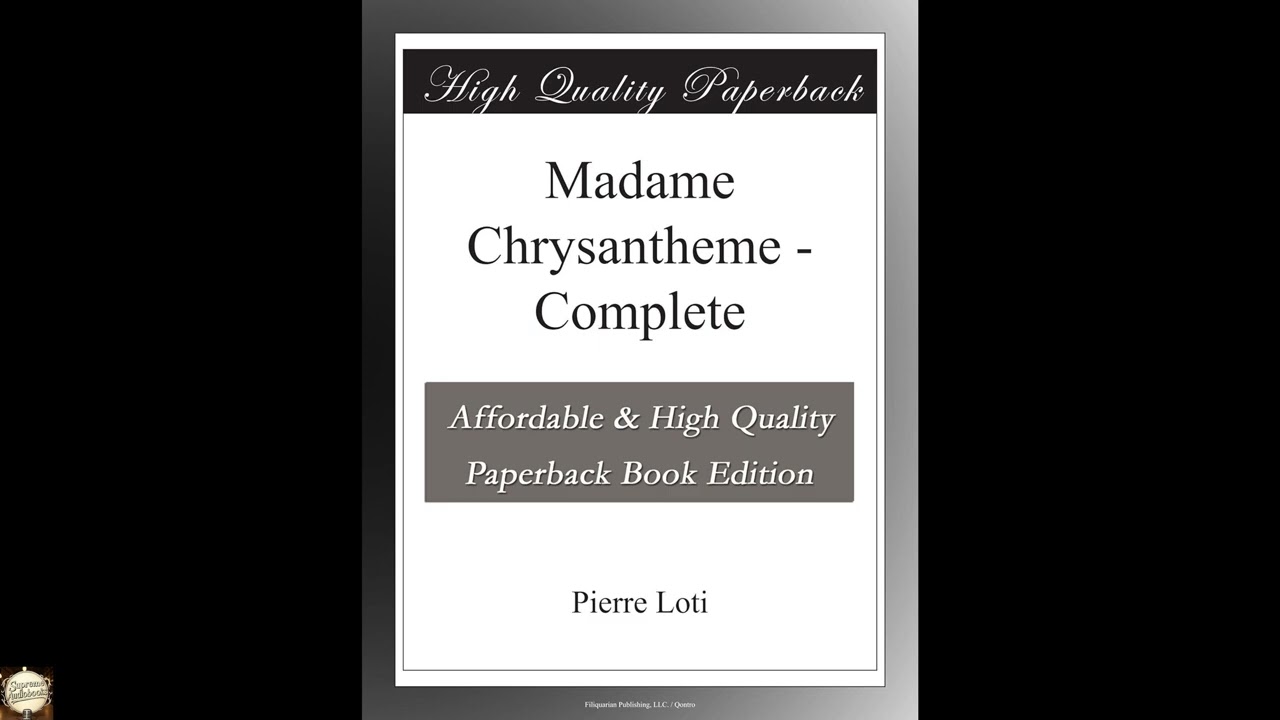
For listeners drawn to the delicate dance of cultural encounter and the poignant, ephemeral nature of love, Pierre Loti’s Madame Chrysantheme offers a compelling and often unsettling experience. This classic novella, published in 1887, presents an intimate glimpse into the world of a French naval officer, Pierre, during his temporary stay in Nagasaki, Japan. Far more than a simple romance, it is a nuanced study of exoticism, colonialism, and the profound distances that can exist between people even in their closest moments. It stands as a pivotal work in Western literature’s engagement with Japan, influencing countless subsequent narratives, including the famous opera Madame Butterfly, and continues to resonate today for its honest, if sometimes problematic, portrayal of cross-cultural fascination and misunderstanding. The story unfolds in the late 1880s as Pierre, a young officer aboard a French warship, arrives in the bustling port city of Nagasaki. Immersed in the novelty of this foreign land, he decides to "marry" a local woman for the duration of his stay—a common, albeit informal, practice among foreign sailors at the time. Through the help of a local agent, he selects Chrysantheme, a young Japanese girl from a respectable but impoverished family. Their arrangement is clear: a temporary union, facilitated by a monetary contract, granting Pierre companionship and a domestic life, and providing Chrysantheme with financial security for her family. Pierre moves into a charming small house with Chrysantheme and her elderly aunt, creating a domestic bubble detached from the rigid routines of naval life. The narrative meticulously chronicles his observations of Japanese customs, the beauty of the landscape, and the quiet, often inscrutable nature of Chrysantheme herself. He views her through a lens of exotic admiration mixed with a certain patronizing distance, seeing her as a pretty, doll-like figure, a symbol of the charming, alien culture he observes. Their interactions are marked by politeness and a surface-level affection, but a deep, authentic connection proves elusive, hampered by language barriers and vastly different cultural expectations. The narrative carefully builds towards the inevitable moment when Pierre’s ship will depart, leaving their contrived domesticity to dissolve as quickly as it began. The author, Pierre Loti, was the pen name of Julien Viaud, born in Rochefort, France, in 1850. His life was as adventurous and romantic as his novels. He joined the French Navy at the age of seventeen, embarking on a distinguished career that took him to nearly every corner of the globe. His extensive travels provided the rich backdrop and inspiration for his literary works. He served in the Mediterranean, the Pacific, and the Far East, encountering diverse cultures that profoundly shaped his perspective. During a stay in Tahiti, he acquired the nickname "Loti" from Queen Pomare IV, a name he subsequently adopted for his writing. He was elected to the prestigious Académie française in 1891, a testament to his significant literary standing. Loti was a prolific writer, known for his highly atmospheric and often melancholic prose. His experiences as a naval officer infused his fiction with vivid descriptions of foreign lands and the transient nature of human relationships forged across oceans. Beyond Madame Chrysantheme, his notable works include Aziyadé, a story set in Turkey, and Le Mariage de Loti (published as Rarahu in English), which details a Polynesian romance. His novel Pêcheur d'Islande depicted the arduous lives of Breton fishermen. Loti’s writing is often characterized by its impressionistic style, focusing on sensory details, emotional states, and a pervasive sense of nostalgia for lost places and vanished loves. He created a unique niche in French literature, combining elements of exoticism with a deeply personal, elegiac sensibility. At its heart, Madame Chrysantheme brilliantly enacts the theme of exoticism, showcasing the Western gaze upon the "Other." Pierre’s descriptions of Japan and Chrysantheme are filled with wonder, yet consistently frame them as charmingly alien, childlike, and ultimately unknowable through his European sensibility. We see this in his detached observation of her simple customs, her "doll-like" appearance, and his inability to truly penetrate her thoughts or feelings. He admires the aesthetics of her world but remains an outsider, an observer rather than a participant, a point underscored by the very nature of their contractual marriage. Another prominent theme is transience and the fleeting nature of human connection. The entire premise of Pierre’s arrangement with Chrysantheme is built on its temporary status. From the moment they meet, the ticking clock of his ship's departure looms over their interactions. Loti evokes this through the melancholic undertone that permeates Pierre’s reflections, the sense that everything—the domestic bliss, the exotic scenery, the companionable silence—is inherently impermanent. Their relationship is a bubble, destined to burst upon the return to his own world, illustrating how love and belonging can be as ephemeral as a port visit. The story also subtly engages with the power dynamics inherent in colonial encounters, where the European officer holds economic and social sway over the local woman, making her agency constrained by necessity and cultural expectation. This novel emerged during a pivotal time in global history—the late nineteenth century. It was an era defined by aggressive European imperialism, widespread global travel, and an intense fascination with "the Orient." Japan, in particular, had only recently opened its doors to the West following centuries of isolation under the Tokugawa Shogunate, spurred by the Meiji Restoration of 1868. This period saw a surge of European interest in Japanese art, culture, and society, leading to the "Japonisme" craze that swept through Western artistic circles. Loti’s unique position as a naval officer afforded him direct access to these rapidly changing societies, allowing him to capture the moment of initial, often awkward, encounter between East and West. His work, while sometimes criticized retrospectively for its orientalist perspective, provides an authentic snapshot of how these cross-cultural interactions were perceived and fictionalized at the time. Listening to Madame Chrysantheme as an audiobook offers a particularly immersive experience, perfectly suited to Loti’s atmospheric and descriptive prose. The narrator’s voice brings to life Pierre’s observational tone, his blend of romantic curiosity and detached cynicism. You can appreciate the rhythm of Loti’s sentences, the deliberate pacing that mirrors the slow, measured unfolding of life in Nagasaki, punctuated by the rigid schedule of the warship. A skilled narrator can convey the subtle nuances of cultural misunderstanding and the melancholic undercurrent that defines the entire temporary arrangement. The story, running for several hours, is an ideal companion for a quiet afternoon or evening, allowing the listener to truly sink into its evocative descriptions and contemplate the enduring questions it raises about love, perception, and the boundaries between cultures.
Enjoyed Madame Chrysantheme? A few ways to support us
Audible & Amazon links are affiliate; we may earn a small commission at no extra cost.
About this production
Human narration by a volunteer reader from LibriVox.org, the public-domain audiobook project. LibriVox volunteers record literary works whose copyright has expired in the United States, releasing the resulting recordings into the public domain.
Madame Chrysantheme by Pierre Loti. The underlying text is in the U.S. public domain. We do not republish any modern copyrighted edition, translation, or commentary.
The 4K cinematic visuals accompanying this audiobook are generated by an AI image model from prompts derived from the source text. No copyrighted photos, paintings, or stock footage are used. AI generation is disclosed on every video on our YouTube channel as required by YouTube's altered/synthetic content policy.
English subtitles are transcribed from the LibriVox recording with OpenAI Whisper. Translations into the 11 other supported languages are produced by Meta's NLLB-200 neural translation model. No human translator's copyrighted translation is used.
Questions about sourcing or rights? See our DMCA & Sourcing policy or contact us.
Enjoyed this audiobook?
If you'd like to own a copy of Madame Chrysantheme or hear a professionally produced edition, the links below help support free audiobook production at no extra cost to you.
As an Amazon Associate we earn from qualifying purchases. Audible / print links are affiliate.