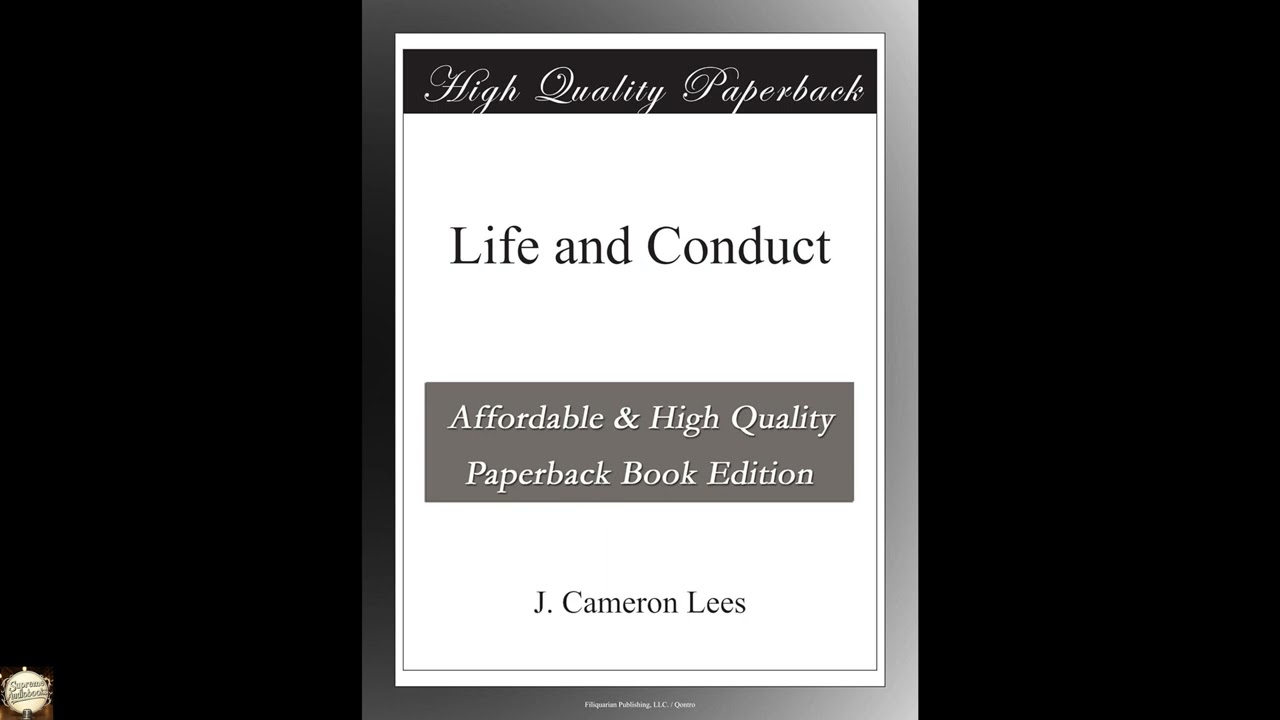
Life and Conduct
In an age characterized by ceaseless change and often unsettling uncertainty, the enduring questions of how one ought to live, what constitutes genuine virtue, and where to find one's moral compass resonate with a profound and perhaps renewed urgency. J. Cameron Lees' "Life and Conduct" emerges from the hallowed tradition of ethical inquiry, not as a fleeting self-help manual, but as a steadfast guide through the complex terrain of human experience. This is a text designed to provoke thoughtful self-reflection and to offer a framework for personal integrity and responsible engagement with the world, its insights remaining strikingly relevant for any individual grappling with the practical and philosophical challenges of a well-lived existence in our modern moment. "Life and Conduct" unfolds not as a narrative of external events, but as an intellectual and spiritual journey through the landscape of the human soul. The "setting" for this work is the universal stage of daily life, where individuals encounter dilemmas, make choices, and forge their character brick by painstaking brick. Lees introduces the listener to a variety of implicit "characters": the earnest seeker striving for moral clarity, the community member navigating social obligations, the introspective spirit confronting personal failings, and the leader wrestling with the weight of influence. The central "conflict" in this discourse is an internal one: the perennial struggle between an individual's baser instincts and higher aspirations, between immediate gratification and long-term wisdom, and between societal pressures and personal conviction. The arc of the story—or rather, the arc of argument—begins with foundational principles, inviting the listener to consider the very essence of human nature and the inherent dignity of each person. From this bedrock, Lees meticulously builds a case for specific virtues, illustrating how they manifest in various spheres of existence. The "narrative" progresses by examining different facets of conduct: how one relates to family, how one fulfills professional duties, how one contributes to civic life, and how one cultivates an inner life of purpose. It’s a measured, thoughtful progression, designed to equip the individual with both the understanding and the resolve necessary to navigate the ethical ambiguities of their world, always pointing towards a more conscious and principled way of being without prescribing a rigid dogma. J. Cameron Lees stands as a distinguished voice from a bygone era, a figure whose intellectual contributions reflect the serious moral and theological concerns of his time. While specific biographical dates are not readily available, Lees belongs to that venerable lineage of late nineteenth and early twentieth-century thinkers who sought to provide clarity and guidance amidst rapidly changing social landscapes. He was likely a clergyman, an academic, or a public intellectual who saw the value in articulating principles of good living for a broad audience. His work aligns with a period when ethical discourse was often interwoven with spiritual contemplation, and figures like Lees were instrumental in shaping the moral consciousness of their generations. Authors of Lees' caliber were often deeply involved in the social and intellectual debates of their day, keenly aware of the impact of industrialization, scientific discovery, and evolving philosophical thought on the individual's sense of purpose and place. They were, in essence, moral cartographers, charting pathways for individuals to uphold integrity and contribute meaningfully to their communities. "Life and Conduct" can be seen as a direct product of this intellectual environment, a testament to the ongoing human need for guidance in cultivating character and understanding one's responsibilities to self and others. Lees’ contribution is significant not for breaking from tradition, but for articulating enduring truths with eloquence and insight, solidifying his place among those who shaped the classical understanding of ethics. At its heart, "Life and Conduct" grapples with several profound themes that resonate across centuries. One primary theme is the cultivation of virtue, wherein Lees meticulously delineates the qualities essential for a principled existence. He might, for example, illustrate how the seemingly simple act of honesty in a casual conversation builds the foundation for trust and integrity in all relationships, moving beyond mere truth-telling to an active commitment to genuineness. Another significant theme is personal responsibility, emphasizing the individual's agency in shaping their character and their impact on the world. Lees could present a scenario where an individual faces a choice between immediate self-interest and a more arduous, ethically sound path, using this as a concrete illustration of how character is forged in the crucible of daily decisions, not grand pronouncements. A third prominent theme is the interconnectedness of individual and community. Lees likely argues that personal conduct is not an isolated endeavor but has ripple effects, demonstrating how acts of kindness or negligence can strengthen or fray the fabric of society. He might detail how a commitment to civic duty, such as participating actively in local affairs, translates personal virtue into collective good, showing the reciprocal relationship between an individual's moral strength and the health of their wider community. Lees’ prose, while reflective, offers these vivid, almost parable-like scenarios, grounding abstract moral concepts in relatable human experience, making the intellectual work of understanding ethics a deeply personal and practical exercise. "Life and Conduct" emerged during a period of considerable societal upheaval, roughly spanning the late nineteenth and early twentieth centuries, a time when traditional structures and beliefs were undergoing intense scrutiny. The rapid pace of industrialization, the rise of scientific naturalism, and burgeoning democratic movements led to significant shifts in how people understood their place in the world and their moral obligations. Old certainties, often rooted in specific religious doctrines or aristocratic hierarchies, were being questioned. In this climate, works like Lees' provided a crucial anchor, offering a reasoned, often spiritually informed, framework for ethical living that could transcend sectarian divides and speak to universal human experiences. It was a time when intellectuals wrestled with the implications of progress and sought to define a modern morality, making Lees' contribution particularly pertinent as a guide for navigating what was then an increasingly complex and morally ambiguous world. To experience "Life and Conduct" as an audiobook is to invite a thoughtful companion into your daily rhythm, transforming passive listening into an active process of contemplation. The several hours of its duration allow for a leisurely absorption of Lees' considered arguments, making it ideal for reflection during commutes, while tending to household tasks, or during dedicated quiet moments. The narrator's voice becomes crucial here, lending a measured gravitas and clarity to the philosophical insights, allowing the listener to truly savor the carefully constructed prose. Listen for the subtle pacing that encourages mental pause, the nuanced vocalizations that highlight key ethical distinctions, and the overall atmospheric quality that transports you to a time when moral discourse was a cornerstone of public intellectual life. This oral rendition transforms the printed word into an intimate, guiding presence, offering solace and wisdom through the spoken word.
Enjoyed Life and Conduct? A few ways to support us
Audible & Amazon links are affiliate; we may earn a small commission at no extra cost.
About this production
Human narration by a volunteer reader from LibriVox.org, the public-domain audiobook project. LibriVox volunteers record literary works whose copyright has expired in the United States, releasing the resulting recordings into the public domain.
Life and Conduct by J. Cameron Lees. The underlying text is in the U.S. public domain. We do not republish any modern copyrighted edition, translation, or commentary.
The 4K cinematic visuals accompanying this audiobook are generated by an AI image model from prompts derived from the source text. No copyrighted photos, paintings, or stock footage are used. AI generation is disclosed on every video on our YouTube channel as required by YouTube's altered/synthetic content policy.
English subtitles are transcribed from the LibriVox recording with OpenAI Whisper. Translations into the 11 other supported languages are produced by Meta's NLLB-200 neural translation model. No human translator's copyrighted translation is used.
Questions about sourcing or rights? See our DMCA & Sourcing policy or contact us.
Enjoyed this audiobook?
If you'd like to own a copy of Life and Conduct or hear a professionally produced edition, the links below help support free audiobook production at no extra cost to you.
As an Amazon Associate we earn from qualifying purchases. Audible / print links are affiliate.