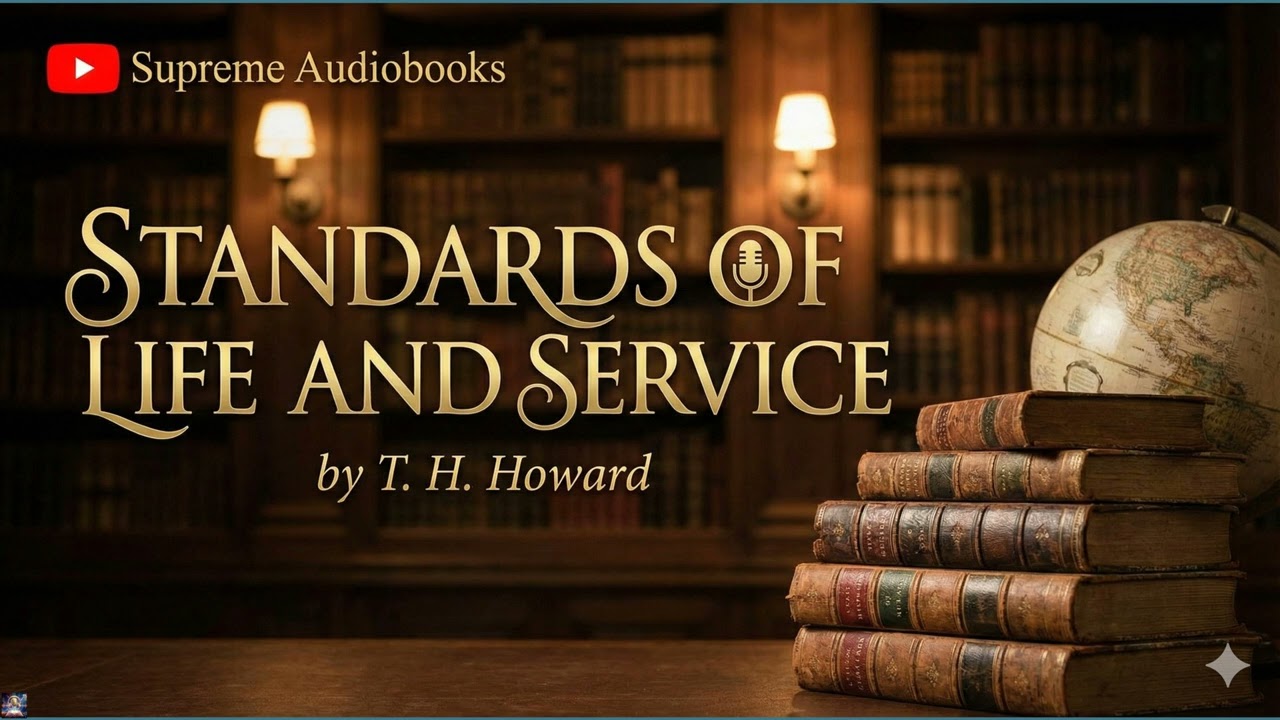
Standards of Life and Service
How does one live a life that truly matters? How does one serve not only oneself, but also the wider community, with integrity and purpose? These are the foundational questions at the heart of T. H. Howard's "Standards of Life and Service," a seminal work that has, across generations, offered guidance to individuals grappling with the demands of ethical living and meaningful contribution. Though its precise origins are shrouded in antiquity, the counsel within remains remarkably pertinent, addressing universal human dilemmas that transcend specific eras or cultures. It is a work that speaks to the perennial search for moral clarity, a beacon for those who seek to align their actions with their deepest values and contribute positively to the world around them. "Standards of Life and Service" does not present a conventional narrative with characters and a plotted sequence of events. Instead, it unfolds as a meticulously structured discourse, an extended meditation on the principles that ought to govern human conduct and endeavor. The setting, in a broad sense, is the human condition itself – the shared experiences of aspiration, temptation, duty, and discernment that define our existence. The work introduces, through a series of carefully reasoned arguments and illustrative hypotheticals, an overarching philosophical framework designed to elevate one's personal standards. It begins by establishing the inherent dignity of the individual, then systematically moves outwards, considering the individual's responsibilities within the family unit, the immediate community, and finally, the broader societal sphere. The central intellectual conflict within the text arises from the tension between base impulses and higher ideals, between self-interest and altruism, and between the transient and the enduring. Howard, through a sagacious and steady voice, acts as a seasoned guide, leading the reader through this internal landscape. He does not offer simple answers, but rather a robust methodology for ethical reasoning, urging a rigorous self-examination of motives and consequences. The arc of the work progresses from introspection to action, from understanding oneself to understanding one's place and function in the grander scheme, culminating in a vision of a life lived with unwavering dedication to virtue and a conscious commitment to serving others. It is a slow, deliberate unfolding of wisdom, encouraging pause and reflection with each successive concept. Of T. H. Howard himself, concrete biographical details remain scarce, lost to the passage of time. The very lack of specific dates or places associated with the author only underscores the work's universal and enduring appeal, suggesting its emergence from a period more focused on collective wisdom than individual celebrity. What we glean from "Standards of Life and Service" is the mind of a profound thinker, an individual deeply versed in the nuances of human nature and the complexities of moral philosophy. Howard's insights suggest a life lived with considerable observation and introspection, possibly as an educator, a spiritual leader, or a community elder whose primary concern was the cultivation of character and the promotion of societal well-being. "Standards of Life and Service" stands as Howard's singular recognized contribution, its influence likely disseminating through oral tradition and various copyings before its eventual solidification into the text we know. While we cannot speak of specific literary movements Howard participated in, the work aligns with a broad tradition of ethical philosophy and moral instruction found across many cultures and eras – texts intended not for fleeting entertainment, but for lifelong guidance. Howard occupies a unique, somewhat mythical position within the canon, a wise voice from antiquity whose words continue to resonate because they address the unchanging core of human striving. Among the prominent themes meticulously unpacked in "Standards of Life and Service" is the concept of duty, understood not as a burdensome obligation, but as an inherent privilege and a cornerstone of a well-ordered existence. Howard illustrates this by contrasting the casual fulfillment of a task with the deliberate, principled execution of a responsibility, showing how a conscious embrace of duty elevates both the individual and the outcome. For instance, in a passage discussing the role of a parent, the text moves beyond providing basic sustenance to emphasizing the moral imperative of instilling virtue and wisdom in offspring, framing parental care as a profound service. Another central theme is self-restraint, presented as an active, conscious choice rather than mere abstinence. Howard demonstrates its power through hypothetical scenarios where an individual, faced with temptation or provocation, chooses measured response over immediate gratification or impulsive reaction, thereby preserving their integrity and fostering harmonious relations. A third significant theme is community solidarity, which Howard portrays not as a loose association of individuals, but as a reciprocal network of mutual support and shared purpose. He frequently uses metaphors of foundational elements or interconnected vessels to depict how each person’s contribution, however small, strengthens the whole, while neglect weakens it. The text offers a powerful scene where the speaker reflects on a famine – a collective disaster – arguing that true service during such times extends beyond direct aid to include upholding moral courage and fostering hope within the afflicted populace. Lastly, Howard consistently champions personal integrity, not as an abstract ideal, but as the bedrock of all lasting achievement and respect. He provides practical examples, such as the unwavering commitment to truth-telling even when inconvenient, or the steadfast adherence to promises made, demonstrating how these small acts forge a reputation of trustworthiness and build moral fortitude. The precise historical context in which "Standards of Life and Service" came into being may elude precise dating, yet its very emergence speaks to a foundational human need for structure and meaning. Such a work naturally arises during periods of intense societal formation or profound philosophical inquiry, times when communities are actively defining their moral codes, their systems of governance, and their collective aspirations. It stands as a testament to humanity's ongoing quest to articulate guiding principles that transcend ephemeral trends, offering instead a framework for ethical decision-making that could be applied across diverse social structures. The demand for clear, articulable standards of conduct and service is a constant across history, making this text a perennial resource, a touchstone for any society or individual seeking to cultivate wisdom and virtue. Listening to "Standards of Life and Service" as an audiobook offers a singular opportunity to absorb its profound teachings with greater depth. The narration, extending over several hours, allows for a deliberate pace, inviting the listener to fully digest each concept before moving on. An accomplished narrator breathes life into Howard's carefully constructed prose, lending gravity and nuance to his arguments, making potentially abstract philosophical concepts resonate with immediate personal relevance. The aural experience transforms the text from a silent reading into a guided conversation, allowing the steady rhythm of the speaker's voice to create an atmosphere of thoughtful contemplation. Listen for the subtle shifts in tone as the author moves from foundational principles to specific applications, and appreciate how the spoken word brings out the persuasive power in Howard's methodical building of ideas, creating an immersive educational experience ideally suited for reflection during daily commutes or quiet moments of introspection.
Enjoyed Standards of Life and Service? A few ways to support us
Audible & Amazon links are affiliate; we may earn a small commission at no extra cost.
About this production
Human narration by a volunteer reader from LibriVox.org, the public-domain audiobook project. LibriVox volunteers record literary works whose copyright has expired in the United States, releasing the resulting recordings into the public domain.
Standards of Life and Service by T. H. Howard. The underlying text is in the U.S. public domain. We do not republish any modern copyrighted edition, translation, or commentary.
The 4K cinematic visuals accompanying this audiobook are generated by an AI image model from prompts derived from the source text. No copyrighted photos, paintings, or stock footage are used. AI generation is disclosed on every video on our YouTube channel as required by YouTube's altered/synthetic content policy.
English subtitles are transcribed from the LibriVox recording with OpenAI Whisper. Translations into the 11 other supported languages are produced by Meta's NLLB-200 neural translation model. No human translator's copyrighted translation is used.
Questions about sourcing or rights? See our DMCA & Sourcing policy or contact us.
Enjoyed this audiobook?
If you'd like to own a copy of Standards of Life and Service or hear a professionally produced edition, the links below help support free audiobook production at no extra cost to you.
As an Amazon Associate we earn from qualifying purchases. Audible / print links are affiliate.