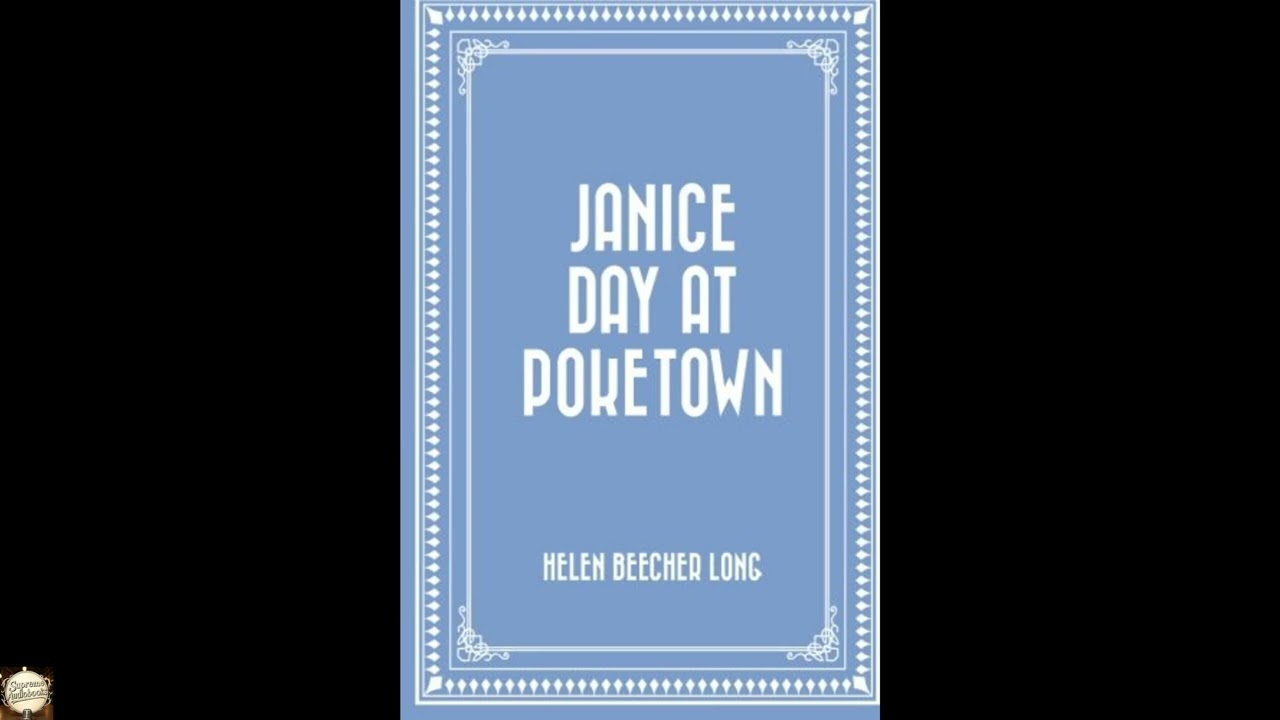
Janice Day at Poketown
Among the many quiet corners of classic literature, certain stories possess a unique charm, acting as gentle yet profound reflections of their time and offering lessons that resonate across generations. Janice Day at Poketown is precisely such a work, a tenderly observed narrative from the pen of Helen Beecher Long. Far from being a mere relic, this story invites listeners into a simpler world, a turn-of-the-century American landscape where character is forged in the crucible of community and personal growth unfolds through everyday interactions. It stands as a testament to the enduring power of kindness, the challenge of accepting difference, and the quiet heroism found in making a home amongst strangers, making it a compelling listen for anyone seeking solace, insight, or a connection to the literary spirit of a bygone era. The story introduces us to Janice Day, a young woman of spirited independence and thoughtful observation, who finds herself transplanted from her familiar surroundings to the quaint, somewhat insular village of Poketown. Her arrival is not without its complications; the townsfolk, accustomed to their routines and the familiar faces that comprise their small world, regard Janice with a mixture of curiosity and cautious reserve. Poketown itself is painted with evocative detail: its dusty main street, the general store serving as the hub of local gossip, the close-knit families whose histories are intertwined over decades. Janice, initially feeling the pangs of an outsider, faces the challenge of adapting to a pace of life and a set of social customs vastly different from her own, all while trying to understand the unspoken rules that govern this peculiar community. As Janice endeavors to find her footing, she encounters a spectrum of personalities that embody the very essence of Poketown. There's the stern but ultimately fair Mrs. Perkins, whose initial skepticism slowly gives way to grudging respect; the perpetually cheerful Mr. Gable, a fount of local lore and good humor; and a cohort of children whose innocent curiosity proves to be Janice's first bridge into the community's heart. The central conflict of the story quietly builds around Janice's efforts to integrate, to prove her worth, and to perhaps, inadvertently, stir the stagnant waters of Poketown with her fresh perspectives and youthful energy. Through a series of small but significant events—a misunderstanding resolved, a kindness offered, a dormant talent discovered—Janice gradually begins to peel back the layers of local skepticism, earning trust one genuine interaction at a time, and in doing so, uncovers the deeper heartbeats of Poketown and its residents. The author, Helen Beecher Long, was a significant, if less heralded, literary figure of her era, born in 1858 and living until 1934. Her lineage alone places her within a formidable tradition of American letters and social reform, as she was a member of the famed Beecher family, a niece to the influential abolitionist and author Harriet Beecher Stowe. This familial connection undoubtedly instilled in Long a keen sense of moral purpose and a commitment to storytelling that often carried an uplifting or instructional message, a hallmark of much late 19th and early 20th century American fiction aimed at younger audiences or general readers. While her aunt achieved widespread fame with Uncle Tom's Cabin, Helen Beecher Long carved out her own niche, often focusing on tales of character development, community life, and the quiet virtues of persistence and kindness. Long's literary output frequently centered on protagonists, like Janice Day, who navigate personal challenges and contribute positively to their surroundings. Beyond the Janice Day series, her works often appeared in periodicals and as standalone novels designed to inspire and entertain, reflecting the prevailing literary tastes for stories that combined entertainment with wholesome values. She was part of a broader movement of writers who sought to define American identity and moral fiber in the post-Civil War era and into the new century, often through narratives set in distinct, often rural, American landscapes. Her place in the literary canon is that of a consistent and earnest voice, contributing to the body of literature that shaped the moral imagination of a generation, particularly children and young women, offering role models and reflections on ethical conduct. One prominent theme within Janice Day at Poketown is the nuanced interplay between the individual and the community. Janice's initial experience highlights the natural resistance of a tight-knit community to an outsider, exemplified by the reserved demeanor of Mrs. Perkins, who views Janice's modern ways with suspicion. Yet, Janice's persistent efforts to understand and connect, such as her patient listening to Mr. Gable's anecdotes, demonstrate how individual empathy can gradually break down collective barriers. Another powerful theme is the transformative power of kindness and understanding. There's a memorable scene where Janice quietly mends a broken toy for a shy Poketown child, an act that, though seemingly small, ripples through the community, slowly changing perceptions and fostering goodwill far more effectively than any grand gesture could. The narrative also subtly examines the concept of finding one's authentic place in the world. Janice, while initially disoriented by Poketown's unfamiliarity, learns to appreciate its unique rhythm and the genuine warmth hidden beneath its reserved exterior. Her personal growth is intertwined with her acceptance of Poketown, showing that one's "home" is not just a physical location but a space where one can contribute and connect. Furthermore, the story touches on the quiet dignity of rural life and its often-overlooked wisdom. Through Janice's eyes, the listener gains an appreciation for the simple routines and communal spirit of Poketown, contrasting it with the often more complex or impersonal dynamics of urban existence, suggesting that profound truths and character-building experiences can be found in the most unassuming of settings. Janice Day at Poketown emerged at a fascinating juncture in American history, roughly at the turn of the twentieth century. This was a period marked by significant cultural shifts: rapid industrialization and urbanization were drawing people away from rural communities, creating a sense of nostalgia and a desire to preserve the values associated with small-town life. Politically, the nation was grappling with the aftermath of the Gilded Age and the burgeoning Progressive Era, which sought to address social inequalities and moral decline. In the literary world, there was a strong appetite for stories that offered moral guidance, celebrated American ingenuity, and explored regional identities. Long's work, therefore, can be seen as a reflection of these trends. It addresses the changing relationship between the city and the country, offering a gentle affirmation of the virtues inherent in close-knit communities, even as the broader society was moving towards greater anonymity. The emphasis on character building, neighborly relations, and overcoming initial prejudices resonated deeply with a public that was both yearning for stability in a changing world and keen to instill strong moral principles in its youth. The book's popularity at the time speaks to a collective desire for narratives that championed decency, resilience, and the power of human connection in an increasingly complex and impersonal landscape. Listening to Janice Day at Poketown as an audiobook offers a particularly immersive and delightful experience. The narration breathes life into the distinctive voices of Poketown's inhabitants, from the gruff tones of the skeptical elders to the cheerful patter of the village children, giving each character a unique auditory presence. The several hours of listening time allow for a gradual unfolding of the narrative, perfectly matching the unhurried pace of the story itself, much like life in Poketown. Listeners can savor the descriptive passages that paint a vivid picture of the rural setting, letting the sounds and inflections of the narrator's voice transport them to dusty roads, bustling general stores, and quiet, contemplative moments by the fireside. The dialogue, rendered with care, highlights the charming idioms and social graces of the era, while the atmospheric delivery subtly underscores the story's gentle humor and poignant observations, making it an ideal companion for moments of quiet reflection or long, meandering drives.
Enjoyed Janice Day at Poketown? A few ways to support us
Audible & Amazon links are affiliate; we may earn a small commission at no extra cost.
About this production
Human narration by a volunteer reader from LibriVox.org, the public-domain audiobook project. LibriVox volunteers record literary works whose copyright has expired in the United States, releasing the resulting recordings into the public domain.
Janice Day at Poketown by Helen Beecher Long. The underlying text is in the U.S. public domain. We do not republish any modern copyrighted edition, translation, or commentary.
The 4K cinematic visuals accompanying this audiobook are generated by an AI image model from prompts derived from the source text. No copyrighted photos, paintings, or stock footage are used. AI generation is disclosed on every video on our YouTube channel as required by YouTube's altered/synthetic content policy.
English subtitles are transcribed from the LibriVox recording with OpenAI Whisper. Translations into the 11 other supported languages are produced by Meta's NLLB-200 neural translation model. No human translator's copyrighted translation is used.
Questions about sourcing or rights? See our DMCA & Sourcing policy or contact us.
Enjoyed this audiobook?
If you'd like to own a copy of Janice Day at Poketown or hear a professionally produced edition, the links below help support free audiobook production at no extra cost to you.
As an Amazon Associate we earn from qualifying purchases. Audible / print links are affiliate.